Pilgrimage and the Experience of Holiness
The Temple was a center of activity and life, not an empty building that existed in itself. A central part of this activity were the three pilgrimages during the three major festivals celebrated each year. The Torah commands a pilgrimage to the place that God would choose three times a year during these great festivals, and in time this place was identified with Jerusalem. The purpose of the pilgrimage was to appear before God: “Three times a year all your males shall see the face of the Lord God, the God of Israel” (Deuteronomy 16:16). In addition to the three pilgrimages, it was customary to make a personal pilgrimage to the Temple on special occasions such as gratitude for the birth of a child, offering a sacrifice for guilt or sin, vows, celibacy, and purification, and it was also possible to make a pilgrimage at will.
It should be remembered that in ancient times people used to wwalk great distances, and therefore every gathering of people for religious purposes included a pilgrimage.[1] The process of walking to the holy place was valuable in itself; it brought about purification, separation from everyday life, consolidation (among the pilgrims), and charging of spiritual energies.
Pilgrimage is a phenomenon that crosses borders, cultures, and religions, and has its origins in prehistory in the sacred journey upon earth. The pilgrimage to Jerusalem was an important part of Jewish life during the existence of the Temple. We know about it from various sources and can reconstruct its course, especially during the Second Temple period. We do not have enough information about the First Temple period, and in addition to Jerusalem, there were two other alternative pilgrimage sites in the Kingdom of Israel: Dan and Beit El.
For centuries, the Tabernacle at Shiloh served as a pilgrimage site, until it was destroye by the philistines and, decades later, when the Temple was built, it became the ultimate pilgrimage destination. Jewish pilgrimage differed from pagan pilgrimage because it was associated with the worship of a monotheistic god, rather than a specific place. To put it figuratively, Jewish pilgrimage was to the place where the Temple was located, while pagan pilgrimage was to a holy place on which a temple was built. The Jews received the Torah at Mount Sinai, which is about two to three weeks’ walk from Beersheba,[2] so one might have expected an annual pilgrimage to the mountain in which the covenant would be renewed each year,[3] or at least a pilgrimage by individuals, but because of the different conceptions of a holy place and holiness, this did not happen.[4]
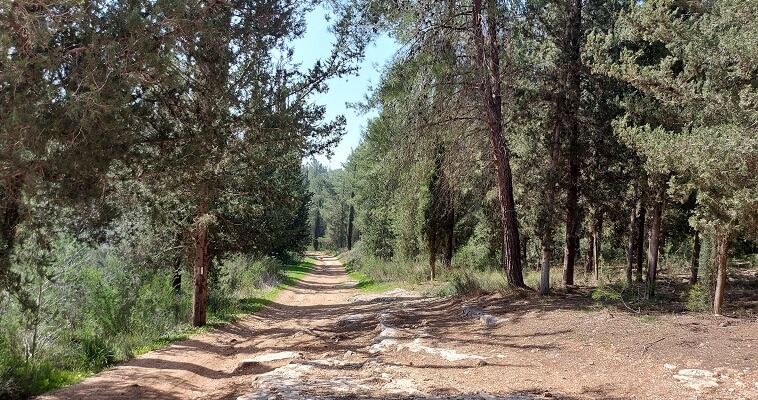
The routes of Jewish pilgrims during the Second Temple period left Galilee and passed mainly through the coastal plain, or Jordan Valley, and not through the mountain areas, because this was a Samaritan land and therefore considered impure. The pilgrims had to maintain their purity during the journey. The western route passed through Caesarea, Lod, Modi’in, with Modi’in being an important gathering and organizing point, a day or two’s walk from Jerusalem. Modi’in was considered to be within the sphere of influence of Jerusalem, because of its holiness, the pottery produced there was considered pure and suitable for use in the Temple, so it became a supply base.
During the First Temple period, there were cities for Levites and priests, but these disappeared during the Second Temple period, and the priesthood moved to “regular” cities. The only city that retained its status as some kind of priestly city was Modi’in, and this was another reason for its importance. It is likely that after the Hasmonean revolt and the rise to power of the Hasmonean dynasty, Modi’in’s importance increased even more.
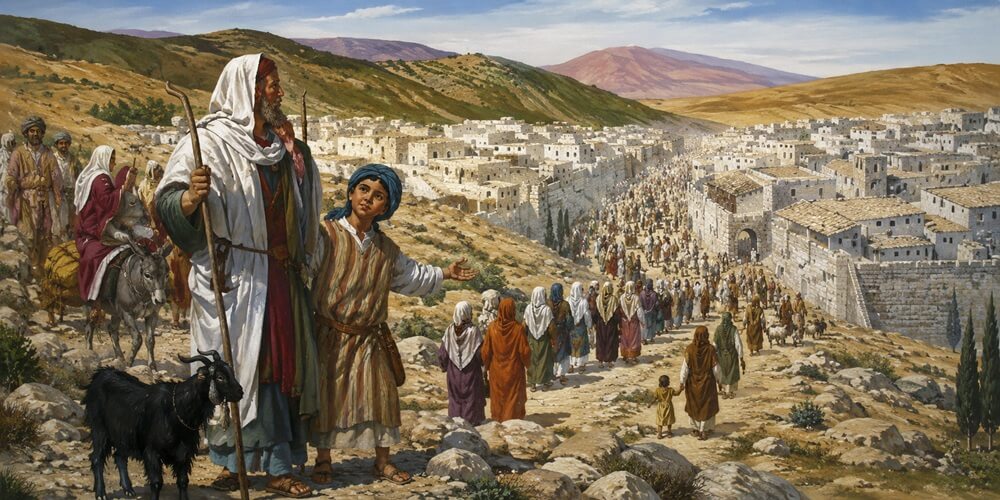
From Modi’in, caravans set out for the holy city. During the pilgrimage, people would be awakened at dawn, with the cry, “Arise, and let us go up to Zion to the house of the Lord our God” (Tractate Bikurim, 3:2), and perhaps also with the help of a trumpet or shofar. During the day, they would repeat the verse from Psalms 122:1-2: “I rejoiced when they said to me, ‘To the house of the Lord we will go.'” When they arrived in Jerusalem, they would recite the rest of the verse: “Our feet have stood at your gates, O Jerusalem.” On the Temple Mount, they would recite the first verse of Psalms 155: “Praise the Lord in his holy place,” and with the help of the Temple, they would recite the last verse of this beautiful song, in which God is praised with a drum, a dance, an organ, a harp, a violin, and more: “Every soul praises the Lord, Hallelujah.”
In Jerusalem, pilgrims would purify themselves from impurity in special houses of purification, and then be welcomed by the city’s residents and accommodated in the residents’ homes free of charge (at least officially; unofficially, they would give gifts to their hosts). A special purification ritual was the burning of the red heifer on the Mount of Olives and the use of the ashes to cleanse the impurity of the dead. Pilgrims would be sprinkled with water containing the ashes of a red heifer, a few drops of which would cleanse the impurity of the dead. The water was drawn from the Pool of Siloam and transported from there in purity to special places, where the purification ceremonies would be performed. The purification process before entering the Temple lasted about a week, after which they ascended to the Temple, through the Hulda Gates, took off their shoes, and entered the courtyard with the sacrifices they wanted to offer before God. Temple personnel and artisans would go out to greet those who came.
The pilgrimage to the Temple during the time of the Temple’s existence was seen as a process of personal and national rectification, hence the extensive preparations and strict observance of purity. Over the years, a symbolic spiritual reference to the pilgrimage process also developed, especially among Jewish spiritual groups of the late Second Temple period. Philo of Alexandria (15 BCE-45 CE) refers to the pilgrimage of the Diaspora and claims that it symbolized for them the abandonment of everything familiar for the sake of God, and that out of fear of God they were willing to sacrifice their comforts. Therefore, the pilgrimage was seen as a test of character that involved sacrifice.[5]
“And (Moses) does not give permission to those who wish to bring sacrifices in their homes (to do so), but rather he commands them to arise from the ends of the earth and come to this (temple), and thereby he puts their character to the test. This is very necessary, because someone who does not have the mind to offer sacrifices according to religion will not undertake to leave his homeland, friends and relatives and wander. Rather, it seems that only when he is led by a stronger force of attraction, the attraction to the fear of heaven, will he undertake to separate himself from his close friends as a part of the body is separated from it.”[6]
The interesting thing is that according to this view, only someone who lives abroad can go through the full process of pilgrimage, which means leaving a familiar land and language and moving into the unknown. In other words, when we were in exile, we had more Jerusalem than we have today. And indeed, for Philo, pilgrimage is a religious deed: “that a person leaves that sphere of life that normally surrounds him and enters the sphere of the divinity’s radiance. A person must stand on the contrast between the framework of life in which he is given in everyday life and that life to which he is called.” [7]
The product of the pilgrimage is the experience of holiness that provides peace and rest, a feeling of coming home. Thus writes Philo: “There they are sheltered as if in a common anchorage and refuge, safe from the hustle and bustle of life, there they seek for themselves the peace of silence and relief from those worries under whose yoke they have walked since the dawn of their childhood. For a short time they will now be given to breathe easy and live happily and full of pleasure. And when their hearts are full of good hopes. They rest in the rest of the commandment and turn to holiness and the fear of God, and in the process they forge bonds of friendship with people they have not known before, and while there they bring sacrifices and offerings, they exchange feelings among themselves and reach a faithful unity of hearts.” [8]
Jewish Pilgrimage to Jerusalem
The soul finds rest because it is in the realm of holiness, which is its natural home: “The very step it takes changes its perspective from one end to the other, and whoever sets out on his journey as a sacrificer. arrives at his desired destination as a fugitive who blesses salvation.” The calm associated with arriving at the Temple stems from connecting with the Logos and avoiding the storms of emotions and passions, and admiration. The Jerusalem that Philo imagines is heavenly Jerusalem, the metropolis of the soul. According to the Stoic concept that influenced Philo, the soul that arrives in the physical world detaches itself from its sourch and aspires to return to it. Arriving at the Temple is like returning home.
According to Rudolph Otto [9], there is a special type of emotion in man that appears only in a religious context, which he called the “numinous.” Words such as sublime, awe, and reverence have no connection outside the realm of faith and religion, and they express man’s connection to something greater outside himself, to which man surrenders and assimilates himself, thus connecting to the eternal and sacred plane and the higher parts within ourselves. Eliade speaks of two planes of being and experience: eternal and sacred, mundane and ordinary, the Numinous connects them. Both agree with Philo’s conceptions of pilgrimage.
The spiritual goal of the pilgrimage was to connect with the numinous, not merely to arrive mechanically at a place. The pilgrimage takes a person out of routine and allows him to connect, through a sacred place and time, to feelings of the sublime and exalted. The journey is a journey of sanctification, one of the most beautiful expressions of which appears in the Psalms relating to the pilgrimage to the Temple. These Psalms, traditionally attributed to David, express the feelings of the Israelites toward the Temple and its holiness, whether when they reached it or when they contemplated it: “O God, I thirst for you, my soul thirsts for you, my flesh longs for you, in a dry and barren land where there is no water. So I have looked for you in the sanctuary, to see your power and your glory” (Psalms 63:2-3); “My soul longs, yes, faints for the courts of the Lord; my heart and my flesh cry out for the living God” (Psalms 84:2); “One thing I have asked of the Lord, that will I seek: that I may dwell in the house of the Lord all the days of my life, to behold the beauty of the Lord and to inquire in his temple” (Psalms 27:4).
These lines express the pilgrims’ sense of homecoming and the happiness that accompanied it. Arriving at the Temple and tasting the holiness present there was like living water to a thirsty traveler in the desert. The atmosphere of holiness that permeated the Temple allowed visitors to connect with the divine part within them. The pilgrims made the journey to Jerusalem many times during their lives, and it must be assumed that this was the formative experience of their lives, a moment in which they felt that something else was possible, that there was meaning and purpose, that the world was good and just, and that there was someone who cared for them. As a result, they were filled with longing and gratitude, for experiencing moments in which they could feel something within them, they did not even expect exists.
The experience the pilgrims had at the Temple gave them comfort and security, strength and courage to face the problems of life after they returned to their villages. They always knew that God dwells in Zion, and that in times of trouble and distress, even mental, they could find salvation and help there. The Temple was seen by them as a place of refuge from enemies and besiegers, from drought and natural disasters, famine and war, a place where a person could pour out his heart and his requests before God, and there would be someone who would hear.
The verses in the Psalms convey this experience, but not in its entirety, because it is impossible to write about love without experiencing it. As the poet said: “It is impossible to describe the taste of honey.” And so they say: “Lord, who shall abide in Your tent? Who shall abide in Your holy mountain? He that walketh blamelessly, and worketh righteousness, and speaketh the truth in his heart. He that slandereth not his tongue, nor doeth evil to his neighbor, nor beareth up reproach against his neighbor. He abhorreth that which is vile in his eyes, and honoreth them that fear the Lord. He hath sworn evil, and hath not slandered; he hath not given his money for gain, nor taken a bribe against the innocent; he that doeth these things shall never be moved” (Psalms 15:1-5).
The Temple was perceived as a place of purity, beauty, order, devotion, sincerity, wonder and awe, a place that revealed the good sides of people, where the righteous felt at home, and those who were not righteous aspired to be better: “Who shall ascend the mountain of the Lord? Who shall stand in his holy place? He that hath clean hands and a pure heart, that hath not lifted up his soul in vain, nor sworn deceitfully, shall receive a blessing from the Lord, and righteousness from the God of his salvation” (Psalms 24:3-5).
In my doctoral thesis I showed the connection between a charismatic holy place and the possibility of an experience of holiness in a person [10]. My argument was that there are places that help to awaken this experience, and the Temple in Jerusalem is a classic example of this. However, it should be added that what helped to experience the place fully and acutely was the process of pilgrimage and purification that preceded the visit, which detached the person from the routine and the superficial, opened him to the experience of something different, and activated his faculties in a different way. Perception, feeling and understanding.

reaching the Temple
Footnotes
[1] Archaeologist Adam Zertal discovered six foot-shaped enclosures in the Jordan Valley and Samaria, and argued that they served as pilgrimage sites during the period of the Judges, appearing under the name “Gilgal.” A drawing of a foot already in prehistoric times indicated a pilgrimage site, as seen in rock art in the Negev and Sinai. The most famous of these enclosures is at Gilgal, measuring 200 by 80 meters. In these large complexes the Israelites would gather, perform rituals, and also engage in matters of leadership, society, and law.
Zertal, A. (2023). Kapot raglei ha-El: Eikh gilinu et ha-galgalim bi-Biqat ha-Yarden [The footprints of God: How we discovered the “gilgalim” in the Jordan Valley]. Tel Aviv: Sela Meir Publishing. (in Hebrew)
[2] In the case of identifying Mount Sinai with Jebel Katrina, some claim that it was Mount Halal in northern Sinai or Mount Karkom in the Negev, in which case the place of pilgrimage is much closer, a few days’ walk from Beersheba.
[3] As is the case among Ethiopian Jews who gather every year on a high mountain and celebrate the feast of Sigd.
[4] According to archaeologist Uzi Avner, there was a Jewish pilgrimage to Mount Sinai at the beginning of the First Temple period and the period of the Judges. Avner relies on findings at Qantilat Ajarud, a site that looks like a fortress and contains an abundance of Hebrew inscriptions and paintings. The name Yahweh appears five times, four of which are with the name Asherah. Yahweh and his wife. There are paintings of the gods, male and female, and above them the inscription Yahweh of Samaria and his wife. There is a stone bowl one meter in diameter on which are written the biblical verses – “God came from the wilderness, the city of Paran”, Avner claims that Paran is in southern Sinai and the abundance of inscriptions in Ajarud indicates a pilgrimage in that direction.
[5] Amir, Y. (1997). Ha-‘aliyah la-regel nusach Philo [Pilgrimage according to Philo]. In ‘Aliyah la-regel: Yehudim, notzrim, musulmim [Pilgrimage: Jews, Christians, Muslims] (pp. 110–122). Tel Aviv: The Open University of Israel. (in Hebrew)
[6] Ibid., p. 114.
[7] Ibid., p. 115.
[8] Ibid., p. 118.
[9] Otto, R. (1958). The idea of the holy: An inquiry into the non-rational factor in the idea of the divine and its relation to the rational (J. W. Harvey, Trans.; 2nd ed.). London: Oxford University Press. (Original work published 1917 in German).
[10] Ben Arie, Z. (2023). Generators of Sacredness in Charismatic Sacred Places in Israel (Doctoral dissertation). University of Haifa, Faculty of Humanities, Department of Israel Studies, Haifa, Israel.