The Riddle of First Temple Tombs
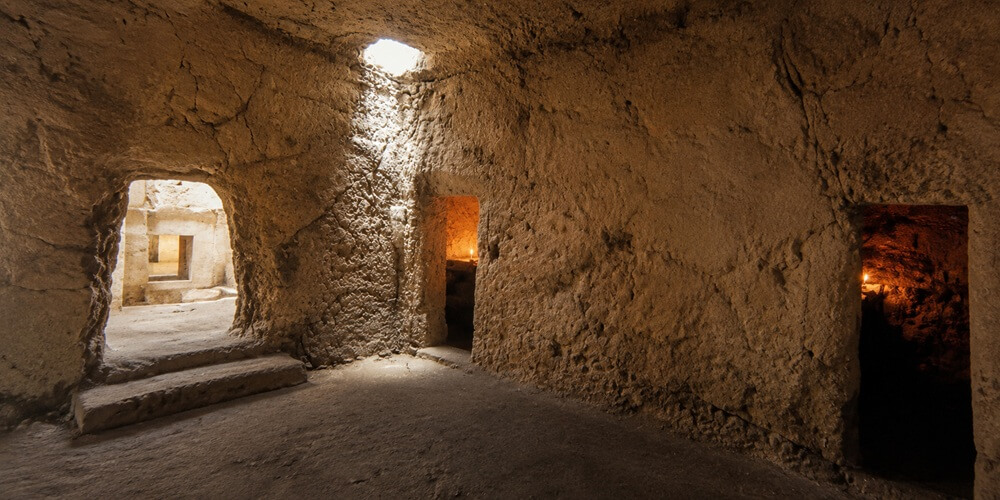
One hundred and thirty rock-cut tombs have been found in Jerusalem from the First Temple period, some of which bear inscriptions that attest to the faith of our earliest ancestors. Some are magnificent burial caves, such as those found under the Saint-Étienne complex north of the Old City. These subterraneans spaces have a large hall from which there are side rooms in the style of ancient palaces. Archaeologist Gabriel Barkay claims that they are reminiscent of rock-cut tombs of nobles and kings of the Kingdom of Ararat in eastern Turkey, and that it was a kind of hypogeum (an underground structure that is a tomb and temple) that was used by various royal family members.
Inside the rock-cut tombs in the Saint-Étienne there are benches, and some of them have a headboard designed in the shape of Hathor’s wig hairstyle—the Egyptian goddess’s wig had a curl. The Hathor priesthood played a central role in the Egyptian death rituals, and she was associated with the feminine principle of resurrection and the sky. According to Gabriel Barkay, these magnificent rock-cut tombs were built using Egyptian measurements of a long and short cubit, and the golden ratio proportion. The connection of Jerusalem of the First Temple period and its burial traditions to Egypt is also expressed in the monolithic monument named after the daughter of Pharaoh and found today among the houses of the village of Silwan. It is a square carved into the rock and topped with a pyramid and an Egyptian cornice, somewhat similar to the nearby tomb of Zechariah, except that Zechariah tomb dates from the Second Temple period, hundreds of years later.
Near the rock cut structure of Pharaoh’s daughter, situated on the cliffs of the Kidron Valley opposite the Gihon Spring, there is a cluster of additional tombs from the First Temple period, most of them rock-cut tombs for single individuals (nobles), similar in their architecture to those of Egypt. These rock-cut tombs s use a long Egyptian cubit, sacred proportions, gable and barrel vault shapes on the roof, an Egyptian cornice, and stonework similar to Egyptian. One of the rock-cut tombs is that of “Yehu who is overseer of the house,” according to an ancient Hebrew inscription found at the entrance to the tomb, which contains a magical curse on anyone who disturbs the rest of the dead, somewhat similar to the curse of the pharaohs.
Egypt was a culture that emphasized life after death more than any other culture. The Egyptians believed that man has several spiritual bodies and they continue to exist after the death of the physical body. One body, “Akh”, came from the sun and stars and returns to them. He joins the god Ra (the sun) on his nightly journey across the realms of nothingness, fighting monsters and difficulties along the way and emerging victorious on the other side. Describing what happens to the Akh from another perspective, the boat of Ra, Ma’at, and Thoth crosses the great sea on its way to eternity, and with it the spiritual part of man.
Another part, which we may perhaps compare to the soul that every living thing has, remains in this world but in a spiritual form, and it wanders the world with its anchor being the grave. This part relives earthly life through the images, statues, and objects found in the grave, so it is important to prepare the grave as much as possible. But that does not mean not living life, om the contrary.
The basic Egyptian concept was that there is a universal order called Ma’at, named after the goddess of truth whose symbol is a feather. There is a collective truth—the order of the world and society—for which the pharaoh and the priests are responsible. And there is a personal truth for each and every individual—the role they need to play in life, their destiny, and personal mission. At the end of life, a person stands trial and their heart is weighed on the scales of truth, with a feather on the other side. If the heart is lighter than a feather—meaning the person was true to themselves—they pass to the realms of the blessed. If it is heavier than a feather, a monster devours them. In other words, a person must be true to themselves and their personal calling. Then society miraculously and synchronously works itself out. Each of us needs to fulfill a specific mission in life: for one, it may be being a mother, and for another, being a poet. In addition, because the soul relives countless times the moments of earthly life after death, with the help of the objects and images left in the tomb, it is important to live every moment to the fullest.
At the beginning of Egyptian culture, the aspect of returning to the spiritual sun and crossing the great sea was more important. Only a few could make this journey, so the effort was to ensure the pharaoh’s journey, and for this purpose, the pyramids were built. However, over the years, changes in belief affected the burial method, and so with the rise of the status of the god Osiris in later Egypt, the focus shifted to burial in rock-cut tombs instead of pyramids or temples, because Osiris is the hidden one, the ruler of the underworld.
The Egyptian influence in Jerusalem is from the last periods of the Egyptian kingdoms—from the times of the 25th Nubian dynasty and then the 26th dynasty that ruled from Sais. The small rock-cut tombs in the village of Silwan were built in the shape of a house or room, similar to the rock-cut tombs in Egypt, except that no paintings were found in them. The large rock-cut tombs in Saint-Étienne were built in the form of a temple, or an Egyptian tomb of a nobleman with several rooms.
Another group of rock-cut tombs from first temple period is found in the cliffs of the Ben Hinnom Valley, but it has a slightly different, more Canaanite character. In one of the tombs (Mamilla) figurines of the Canaanite goddess Ashtoreth who helps with rebirth—the counterpart of Hathor were found. In another tomb (Kefar Hinnom), in the middle of the rock cut tomb there is a pit into which the bones of the deceased were thrown, in secondary burial, with various objects related to them. This was a common tradition in Jewish burials if the time, and hence the expression “gathered to one’s ancestors”. Inside the cistern rolled silver tablets on which were the oldest Hebrew inscriptions in the world were discovered, including the priestly blessing.
In the same pit, jewelry, amulets, a seal, glass objects, bone and ivory items, and many urns were also discovered. In another tomb, pottery shards were found buried beneath the heads of the buried and wine jars buried beneath their feet. All of this shows the importance of magical formulas and magical objects for the deceased’s journey to the afterlife, and in general, the presence of Egyptian magical spiritual concepts regarding the afterlife in the burial customs of the First Temple period in Jerusalem.
And at the same time, and unlike Egypt, according to the Bible, in the days of the First Temple there was no belief in personal resurrection, reward, and judgment after death, but in a collective resurrection (collective consciousness), and therefore there are family burial caves with collections of the different members bones in a pit in the middle. The Torah does not contain specific references to the worlds beyond, nor magic formulas like those of the Egyptian Book of the Dead. The tombs, on the other hand, tell a slightly different story.
Places of Worship for Asherah and Ashtoreth
During the First Temple period, there was not just one temple In Jerusalem, but many. Alongside the Jewish temple, there were places of worship and perhaps also temples to pagan deities most of the times, especially to Asherah and Ashtoreth. We find specific references to this in the Bible. King Solomon, the man who built the Temple on Mount Moriah, which is located on one side of the Kidron Valley, built a temple (or rather places of worship) for the female deity on the other side of the Kidron Valley on the Mount of Anointing. It is written: “And the high places that were before Jerusalem, which were on the right side of the Mount of Anointing, which Solomon king of Israel had built for the abominations of the Sidonians…” (2 Kings 23:13).
The truth is that it wasn’t his fault. He had a thousand wives, including a princess from Egypt and a Phoenician princess from Tyre, and he built the altars in their honor, according to the Bible version. But if we delve deeper into the meaning of the word Ashtoreth, it means “womb” or “that which comes from the womb,” and if Jerusalem is the place of creation, this explains its connection to Ashtoreth and why it was so important to build altars for her there.
In the chapter on “Early Goddess Spirituality in Jerusalem,” the hypothesis was raised that Jerusalem was a center of goddess worship already in prehistory, and the well-founded claims that Jerusalem was a place of goddess worship in the Canaanite period. And here we find that with Jerusalem becoming the capital of the Jewish people and the construction of the Temple, the cult of goddess worship continues to exist and florish, and this continued throughout most of the First Temple period until the religious revolution of Josiah. Most likely, this cult continued an earlier cult, and this strengthens the claims that Jerusalem was a center of goddess worship in ancient times.
In any case, professor Raphael Patai wrote an important book on Jewish goddess worship called The Hebrew Goddess[1], from which we can learn about the worship of the female divinity that took place in Jerusalem, and also in other places in the country among Jews, as well as Gentiles—a worship that is mentioned in the Bible many times, but only in a negative context. The center of this worship in Jerusalem was on the Mount of Anointing located opposite Mount Moriah.
The Mount of Anointing is an extension of the Mount of Olives, whose summit is at the same height as Mount Moriah, but it is located across the deep valley of the Kidron, 800–850 meters as the crow flies from the temple site in a southeasterly direction. Today there is a pine tree grove there, which is somewhat reminiscent of what was there in the past, since goddess’s worship places included sacred groves and trees called asherahs. Under those trees, sacred marriage ceremonies. Done by Qedeshot (sacred prostitutes) took place, and therefore it is said, “On every high hill and under every green tree you have played the harlot” (Jeremiah 2:2). The trees were associated with the fertility attribute of the goddess, and sexual relations were supposed to activate this attribute.
The connection of plants to the feminine deity is expressed in the importance of incense, which is made from tree resin and other substances extracted from plants, and sometimes a mixture of several plant products, as was present in the incense in the Temple. The Bible says, “Burn incense to the queen of heaven and pour out offerings to her” (Jeremiah 44:17). The offerings were often plant products such as wine or beer. The incense and offerings expressed the high essence of plants, which were perceived as capable of being a homes for energetic beings (which is why the Tabernacle is also made of wood, and wood is widely used in covering the walls and floor of the Temple).
The beautiful grove on the Mount of Anointing is indeed a home to energies like no other in Jerusalem, and it is recommended to visit the place, if only for the wonderful views it offers of the City of David and the Temple Mount. The grove is part of a Christian monastic complex called the French “House of Abraham,” which was built over a century ago. It is a virtually unvisited site, and it is necessary to arrange a visit in advance.
During the reign of King Asa, an attempt was made to destroy the altars and groves on the Mount of Anointing, and there were probably Asheroth on the Temple Mount itself. Asa’s mother, Maacah, daughter of Absalom, erected a monstrous Asherah—a place of worship based on a tree trunk. Asa removed her from her royal position and cut down the sacred tree: “And Asa cut down her grove and burned it at the Brook Kidron” (1 Kings 15:11–14). However, the abominations and monstrosities returned on a grand scale during the reign of his grandson Jehoram, who married Athaliah, the daughter of Jezebel, Queen of Sidon, who was apparently also a high priestess of the goddess.
They say the apple doesn’t fall far from the tree. Athaliah (daughter of Jezebel) tried to promote the worship of the Asherah and Ashtoreth in Jerusalem, as well as that of Baal. Her reign was dramatic and will be recounted in the next chapter. After Athaliah, King Manasseh came to power, who continued to promote the worship of the Asherah, and even during the reign of King Hezekiah, Asherah worship is mentioned. The worship of the Asherah did not cease in Israel until the exile and destruction, and in Judah it continued until the reforms of King Josiah. The Asherah was represented as a female figure in the shape of a cone with protruding breasts supported by hands. The figure’s head usually had a balanced wavy hairstyle or a hat of some kind. The conic body was probably worn on a wooden pole. Many of the Asherahs were made of wood and therefore did not survive, and only those made of clay remain.
Asherah was the mother goddess of the Canaanite pantheon, and she and her husband, El, had three “good” children—Baal, Anat, and Ashtoreth—and two “bad” children—Yam and Mot, who aspired to destroy all life. Baal, Anat, and Ashtoreth fought Yam and Mot and defeated them, and from then on the worship of Baal, Anat, and Ashtoreth spread in Israel. According to Raphael Patai, the Hebrews worshiped several goddesses in various forms: they worshiped Ashtoreth through consecrations, and the goddess Anat, for example, by baking special cakes in which they would cast her image. She was depicted as a slender girl, sometimes riding a panther and holding two branches of papyrus in her hands, as shown in a relief in the Tower of David Museum.
And so it is written: “And the women kneaded dough, to make cakes for the queen of heaven” (Jeremiah 7:18). Some think that the queen of heaven was Ashtoreth, and it may depend on the point of view, since the figures of Anat, Ashtoreth, and Asherah sometimes merge with each other, just as the figures of the Egyptian female divinities Hathor, Sekhmet, and Bastet are different appearances of the same goddess.
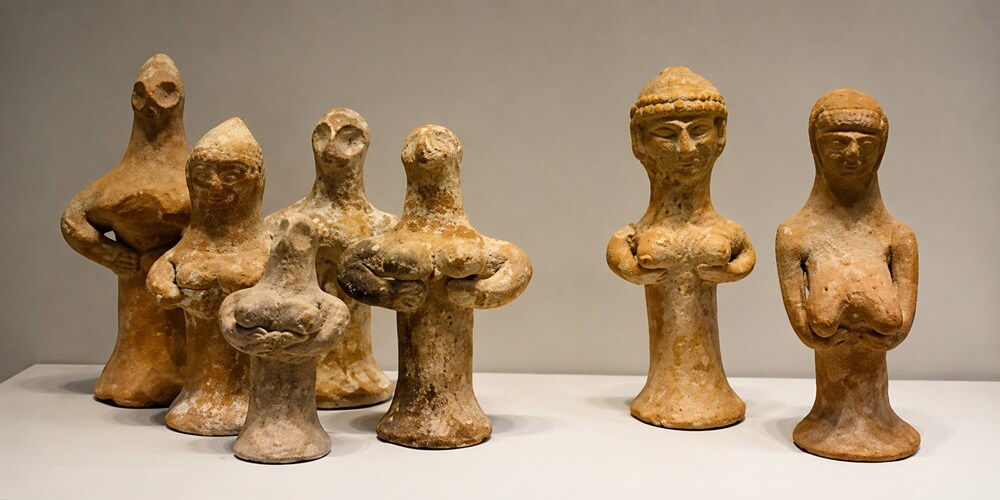
Jewish Asherah
Athaliah and the Palace in Ramat Rachel
After the death of Solomon and the rise of his son Rehoboam to power, ten tribes of Israel rebelled against him and established their own kingdom. In the small kingdom of Judah, only the tribes of Judah and Benjamin remained (and parts of Simeon and Levi). The one who stabilized and strengthened the kingdom of Judah was Asa, Rehoboam’s grandson, who reigned for 41 years, and after him his son Jehoshaphat, who tried to regulate relations between Judah and Israel. To this end, he made an alliance with Ahab, king of Israel. The two decided to marry their children to each other in order to strengthen the alliance, and so Jehoram, king of Judah, son of Jehoshaphat, married Athaliah, daughter of Ahab and Jezebel.
Over the years, Jehoram died of a serious illness, and his son Ahaziah was murdered by General Jehu of Israel, along with King Jehoram of Israel and his mother Jezebel, during a royal visit to his relatives in the city of Jezreel. In response, Athaliah seized power in Judah. According to the Bible, she murdered the entire royal house of David, except for Jehoash, who was saved by the priesthood, led by Jehoiada the priest. From the moment she took power, she promoted the worship of Baal and Asherah in Judah.
The Bible tells a strange story about Queen Jezebel, who was waiting for Jehu, the ambitious general who had rebelled against her son, King Jehoram, and was on his way to kill her after having already killed Jehoram and her entire family. Jezebel put on makeup and sat on the window sill of her palace in Samaria, waiting for her death. Why did she do this? This is not the expected response in such a situation. Jezebel could have fled, written a will, or prayed, but instead she chose to put on makeup, thereby defying death. The custom of the priestesses of Ashtoreth was to put on makeup and sit at the window in order to summon a man to perform ritual sex with them, thereby ensuring the fertility of the land. Jezebel, daughter of the king of Sidon and queen of Israel, a witch and high priestess of Ashtoreth, chose to die as a priestess.
Throughout her life, Jezebel educated her daughters to follow in her footsteps, as was the custom of high priestesses in ancient times who would prepare the next high priestess. Thus, Queen Ti, mother of Akhenaten, educated Nefertiti to be the high priestess after her. And Jezebel educated Athaliah to be the high priestess of Ashtoreth and to strive for political influence in order to promote her beliefs. Therefore, from the moment power was in her hands, she built the House of Baal in Jerusalem, and promoted the cult of Ashtoreth. For this reason, she is probably the only woman referred to as “wicked daughter of wickedness” in Jewish sources. Ultimately, High Priest Jehoiada plotted against her, which led to her murder in the Temple, while she was being summoned there. This was the first, but not the last, time in which the priesthood intervened in the political power struggle.
In the 1950s, a magnificent palace was discovered in Ramat Rachel, south of Jerusalem, in which capitals typical of the First Temple period (proto-Aeolian with a triangle in the center) were found, similar to the capitals that appear in Ahab’s palaces. The proto-Aeolian capitals originally symbolized the palm tree that was sacred to Asherah. A decorated window railing was found at the site as well, reminiscent of representations of Asherah priestesses sitting in the window that appear in reliefs from the period. The finds led some archaeologists (Yadin) to identify the place as Athaliah’s palace. Although this identification is not accepted today, it helps to revive Athaliah’s story.
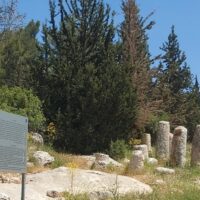
The site in Ramat Rachel has become an impressive archaeological park, with a large courtyard surrounded by rooms, walls, and even a columbarium and rock cut tombs. The remains are combined with sculptural displays of large stones placed in the air by the artist Ran Morin.
There are shaded seating areas, and you can see remains of an advanced water system with pools and aqueducts, probably from the Persian period. The archaeological remains are integrated into a grove and a beautiful garden. The site is located on one of the highest and coolest peaks in Jerusalem, and the view from it is amazing. At the edge of the grove, in the observatory overlooking Emek Refaim, there is a sculptural element of a large cone of flint stones with a large oak tree planted on top. It seems as if the tree cult of Ashtoreth has returned through art in a new form.
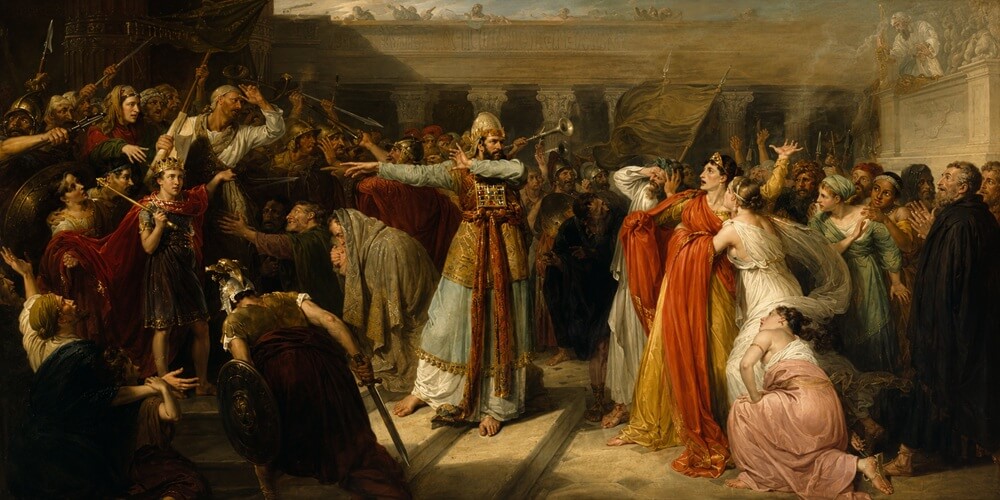
The Gates of Hulda the Prophet
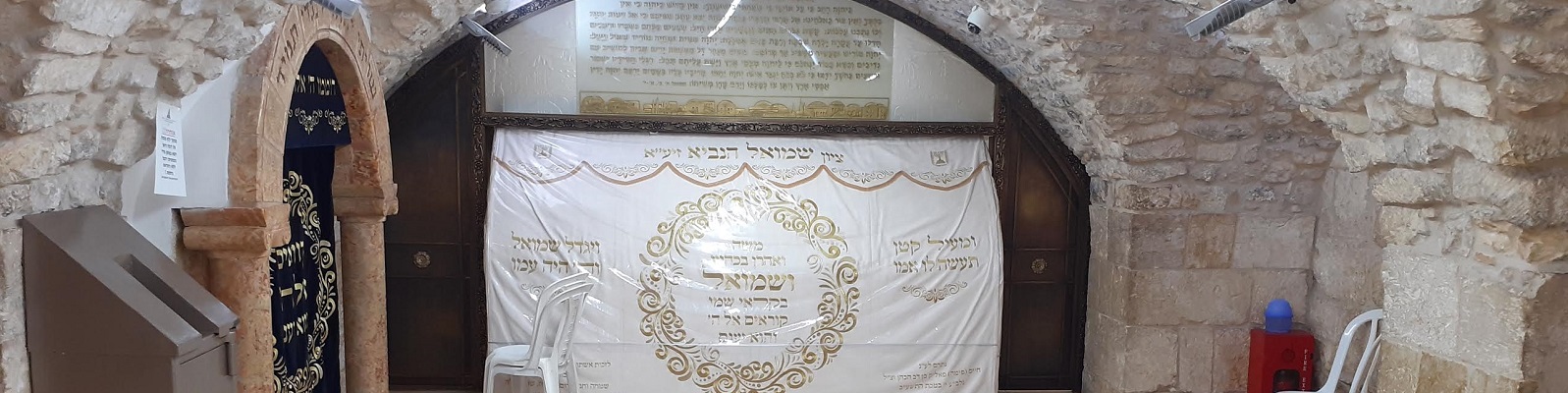
There are three explicit prophetesses in the Bible: Miriam, Deborah, and Hulda. Hulda is the last of them and is identified with two places in Jerusalem: one is the Gates of Hulda, the main gates to the Temple Mount complex from the south, and the other is her tomb high on the Mount of Olives, which is identified by Muslims as the tomb of Rabaa al-Adawiyah, the poet of love (see a chapter in Book II), and by Christians as the tomb of the nun Pelagia (see the chapter The Two Melenias). Three women in one mausoleum rock cut tomb.
Hulda was active during the time of King Josiah and the prophet Jeremiah. When Josiah finds the Book of Deuteronomy in the temple and realizes that the people have sinned all these years, he sends a delegation to ask God’s prophets about God’s word, and although Jeremiah is supposedly more important, the delegation reaches Hulda who sits at the entrance to the Temple Mount (2 Kings 22:14): “And she sits in Jerusalem in the Mishneh.” Hulda answers from God’s mouth that indeed the people have sinned and will be punished, but this will not happen in Josiah’s time because he has submitted to God.
During the Hasmonean period, the gates in the southern wall of the Temple Mount began to be called “Hulda Gates,” and Herod rebuilt them for glory as part of the general construction of the Temple Mount complex. These are two sets of gates and underground passages to the plaza, one further west with two openings with an arch above them, and the other a few dozen meters further east with three openings with an arch above them. Today, the gates are closed by a stone wall, but the underground passages behind them still exist. The western gate was used to ascend the mountain to the Temple Mount plaza, and the eastern gates were used to descend, unless a person was in mourning, in which case he would walk “against traffic” and be comforted by pilgrims.
Prophecy was associated with the gates because the energy of a place is in its envelope, as Plato said: “Memory is in the envelope of the soul.” For this reason (and for practical reasons) judges and sages sat in the gates, as did the prophets.
In ancient times, prophecy among other peoples was mainly practiced by women prophetess called Sibyls in the roman Hellenic world, and sometime Pythias, but in Israel prophecy was mostly identified with men, and despite this we have a number of explicit and other implicit cases of women prophets. However, Hulda is the only prophetess associated with the Temple; she sits not far from the Hall of Hewn Stones of the Sanhedrin.
Much of the prophecy of ancient times was associated with temples, and so we find professional prophetesses in some of the temples of Greece and in Egypt. Hulda can be said to continue this spiritual tradition, and later also Mary, the mother of Jesus, who grew up in the Temple (more on that later).
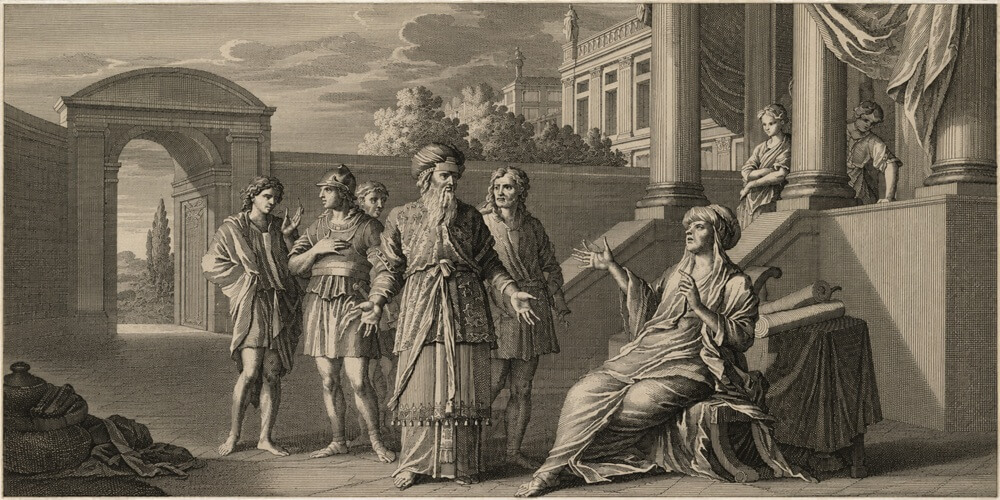
Huldah the prophetess
Zedekiah’s Cave and the Target Court
Three years before Josiah’s death, in 612 BCE, the Babylonians rebelled against the Assyrians and succeeded in defeating them and taking over their empire. The Assyrians tried to fight back with the help of the Egyptians. Pharaoh Necho led a military campaign to the aid of Assyria, and along the way fought Josiah and killed him. But he was ultimately defeated by the Babylonians at the Battle of Carchemish. King Jehoiakim took advantage of the ongoing struggle between the Egyptians and the Babylonians and rebelled against them in 600 BCE. Initially, the rebellion was successful and the army sent by Nebuchadnezzar was destroyed, which led Nebuchadnezzar to personally lead a large army into Judah. After a six-month siege, he captured Jerusalem and exiled King Jehoiachin (Jehoiakim’s son who had replaced him in office) and 8,000 people from among the nobility and upper classes. In his place, he appointed Zedekiah as a nominal ruler, but Zedekiah also rebelled in Babylon after 10 years, and Nebuchadnezzar returned to Jerusalem. It took him a year and a half to defeat the Jews, and in 586 BCE he captured the city, destroyed the Temple, and exiled most of the population to Babylon. During all this time, Jeremiah lived in Jerusalem and had to watch his darkest prophecies come true.
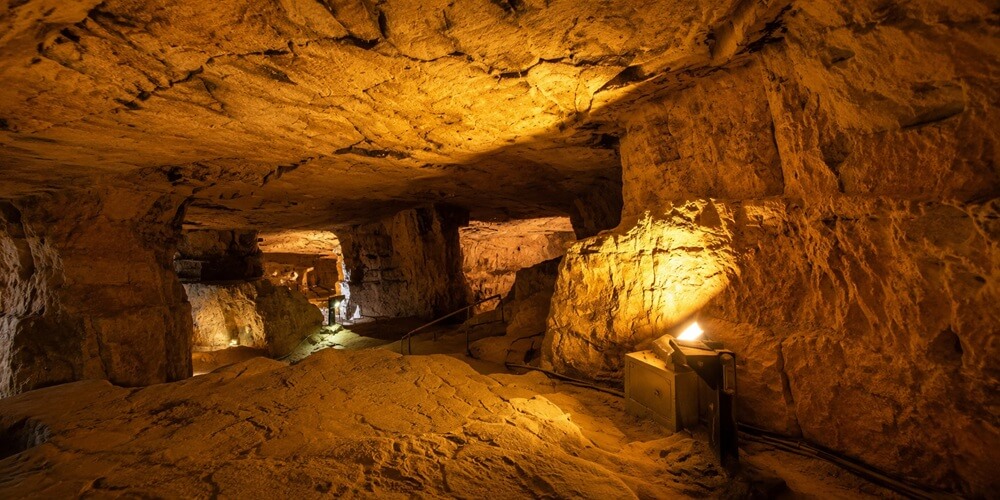
According to tradition, after the conquest of the city, King Zedekiah fled through a large artificial cave (9,000 square meters) located under the Muslim Quarter, which has many passages, one of which served as an escape tunnel to the Dead Sea region. But the Babylonians caught him in the plains of Jericho, and Nebuchadnezzar ordered his sons to be executed before his eyes, and then blinded him, and then exiled him to Babylon. The cave through which Zedekiah fled is called a cave after him, and there is a dripping spring in it, which some claim are the king’s tears.
The entrance to the Cave of Zedekiah is not far from the Nablus Gate at the foot of the city wall. For generations, the place was a quarry for building stones for Jerusalem. Tradition has identified the place as King Solomon’s quarries from which stones were taken to build the First Temple. It is possible that mining in the cave began as early as that period, but its main use was as a quarry for the construction of Herod’s Temple, and in later periods. It is interesting to note that on one of the stones that remained attached to the wall of the cave, a drawing of an ancient cherub was discovered in 1873. According to Ze’ev Vilnai, the stone and the drawing are currently in the office of the Palestine Exploration Fund (PEF).
With the Arab conquest of the city, the cave was forgotten and abandoned, and it was only in 1854 that a missionary and explorer named James Turner Barclay discovered it by chance. Thirteen years later, Charles Warren, one of the leaders of the Palestine Exploration Fund (PEF), arrived in Jerusalem. He was a senior member of the Freemasons (later the Grand Master of the English Lodge), and brought about the beginning of the use of the cave for Masonic ceremonies. To this day, the Freemasons, and especially the Jerusalem Lodge, use the cave for ceremonies. The place is important to them because of its connection to the Temple of Solomon and Hiram, and because of the symbolism of the act of quarrying and hewing the stones for the new temple of humanity. Man is likened to an unhewn stone that must be separated from its quarry, chiseled, shaped, and processed in such a way that it can be used as a hewn stone in the building of the new temple. Indeed, in the tower of the YMCA building in Jerusalem, which was built inspired by the Freemasons, there are fieldstones from Zedekiah’s Cave at the base of the tower, and ashlars at the top.
Opposite Zedekiah’s Cave is the East Jerusalem bus station. On the back side of the station is a cliff with a big open cave, traditionally considered the site of “the court of the guard”, the prison where Jeremiah was thrown after prophesying the defeat of the Jewish kingdom to the Babylonians, contrary to the false prophets who prophesied victory. Some say that this was his residence during his stay in the city from the time of Josiah through the four kings who followed him until the time of the city’s destruction, the place where he stayed, studied, prayed, wrote, and received his prophecies.
The cave is located under a rocky hill surrounded by a wall. The place is also considered to be the burial place of Ibrahim ibn Adham, an important Muslim saint, and in the past there was a center for his followers there, and today a mosque in his honor (read the section on the early Muslim period).
Notes
[1] Patai, R. (1990). The hebrew goddess. Wayne State University Press.