The Kingdoms of David and Solomon
According to Jewish legend, when David first fled from Saul, he stayed with the prophet Samuel. These two spiritual giants delved into the Torah and, with the help of prophetic spirit, found hints, especially in the Book of Joshua, about the place God had chosen to dwell and where the Temple could and should be built. Some also claim that they found a hidden scroll containing the plan of the Temple and the ancient spiritual history of Mount Moriah as the place of the creation of the world, the fall of Adam and Eve, the binding of Isaac, and so on—or that they discovered it in their mind’s eye.
In any case, King David represents, according to Kabbalah, the sefirah of Malchut (Kingship), a person connected to the Holy Spirit and the Shekinah energy. Thanks to the gift of prophetic inspiration he received, he was the first to recognize the holiness of Jerusalem beyond time and place, and this led him to choose Jerusalem as the capital of Israel and to desire to build a permanent house for God there. Thus, after conquering Jerusalem from the Jebusites, he set up a tent on Mount Moriah, on the threshing floor of Araunah the Jebusite, and brought the Ark of the Covenant there.
There is an interesting episode in David’s life, when he fled from Jerusalem because of his rebellious son Absalom. Zadok the priest asked to join him with the Ark of the Covenant, but David told him to return the Ark to the tent where it dwelled, because that was its place. In other words, David recognized Jerusalem as the only place where the Ark of the Covenant belonged, and therefore the only place where God could be worshiped completely—even if not by him, but by those who rebelled against him. This shows that, in David’s eyes, the holiness of Jerusalem was greater than that of any particular king. David believed in something greater than himself that determined destiny, and therefore, when Shimei son of Gera mocked him as he fled from Jerusalem, he accepted the judgment and ordered his men to leave the man alone, because God was speaking through him.
David first reigned from Hebron, where, according to the Zohar, he connected with the three patriarchs and became one of the four legs of the “chariot” (merkavah). It is interesting to note that Hebron is the only place on the mountain ridge with a geographical and topographical shape similar to that of Jerusalem, a kind of concave circle, and therefore there is a deep inner connection between Hebron and Jerusalem. The characteristic of King David is his involvement with all the inhabitants and places of the Land of Israel: his great-grandmother was Ruth the Moabite, his friend Hushai the Archite was from the Canaanite inhabitants of the land, his priest Zadok was probably of Jebusite origin, one of his wives was Maacah, daughter of the king of Geshur, and he even found refuge with the Philistines. The shepherd from Bethlehem reached all parts of the country. He is described as having red hair, a redhead, and as such, his hand was in everything and everyone’s hand was in him. There was something proud, almost “sabra,” about David—an air of power and freedom.
After expanding his kingdom to include the northern tribes, David conquered Jerusalem from the Jebusites and made it the capital of the united kingdom. He then brought the Ark of the Covenant up to Jerusalem from Kiriath-jearim and prepared a tent for it on Mount Moriah. At that time, there was a separation between the Tabernacle and the Ark of the Covenant, which occurred after the Ark fell into the hands of the Philistines in the Battle of Eben-ezer and the Tabernacle of Shiloh was destroyed. The Israelites set up a new Tabernacle in Gibeon, because a Tabernacle was needed to perform the sacrificial service, but the Ark of the Covenant remained in Kiriath-jearim, where it miraculously arrived after the Philistines decided to get rid of it. It is not clear why they did not move the Ark of the Covenant from Kiriath-jearim, only a few kilometers away, to Gibeon. What was the meaning of the separation between the two? At that time, and probably also because of this separation, it was permissible to offer sacrifices to God in other places throughout the country, on high places (bamot).
After the unification of the kingdom and the conquest of Jerusalem, King David builds a palace for himself, and asks to build a house for God at the same time, and so he says: “I dwell in a house of cedar, but the ark of God dwells in a tent” (2 Samuel 7:2). David asks God about this through the prophet Nathan, and the answer is divided into two: at first, God is resentful of the request and claims that he dwells in a tent and has never asked for a house to be built for him. After that, he strengthens David and promises him that his seed will be established forever and will bring peace and rule over Israel. Finally, God accepts the idea that a house will be built for him, but that it must be done by a descendant of David, who will be like a son to God and he will be like a father to him. This descendant is Solomon.
The reason David did not receive permission to build the house, as he himself says in the book of Chronicles, is that he was a man who had shed blood. At the same time, David was privileged to see the Temple in his mind’s eye, and perhaps even received a secret scroll with the plan of the house from the prophet Samuel, which he passed on to Solomon. David prepared the ground for the construction of the Temple and, according to Jewish tradition, dug the foundations, marked the area of the Temple courtyard, and sanctified it. David prepared the “camp of the Shekinah,” the floor of the courtyard. This was the tradition in other temples of the ancient world—to plow the ground and mark the boundaries of the Temple as a first step in the sanctification of the place. From the moment this happened, the Temple area was considered pure. Indeed, the courtyard of the Temple (similar to that of the Tabernacle) was considered pure, and it was forbidden to bring a corpse into it. David sanctified the courtyard (the new dwelling place of the Shekinah) down to the depths of the abyss, and when he did so, he composed one of the songs of the book of Psalms, chapter 91: “He who dwells in the secret place of the Most High…”
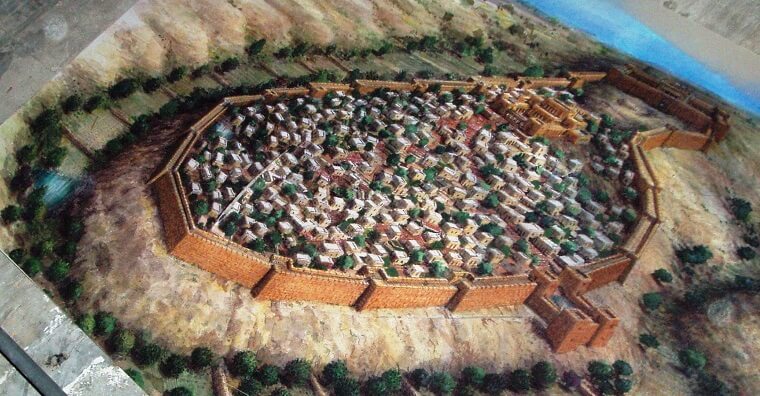
According to Avigdor Aptowitzer in his article on the celestial Temple[1], David saw the celestial Temple in his mind’s eye, but there is no necessary direct connection between the plan of the celestial Temple and the plan of the earthly Temple. A plan was indeed given in a vision to David, and before him to Moses on Mount Sinai, but it is possible that this remained an abstract thought and that they did not see a concrete physical form. At the same time, the Kabbalistic interpretation of the Temple (as we will see later) claims that such a connection does exist and that the physical structure of the Temple reflects a divine plan of the spiritual structure of man and the world.
The importance of Jerusalem and David’s connection to it is revealed in the story of the threshing floor of Araunah the Jebusite (2 Samuel 24; 1 Chronicles 21). According to the story, a plague of pestilence struck the people of Israel and killed tens of thousands because of David’s sin in ordering the numbering of the people of Israel, contrary to a clear command from God not to do so. After the plague broke out, the angel of the Lord was sent to Jerusalem to destroy it. King David saw him standing between heaven and earth with a drawn sword in his hand, and he prayed to God for mercy. God relented and commanded David, through the prophet Gad, to erect an altar on the threshing floor of Araunah the Jebusite, and this is what stopped the plague. The merit of Isaac, who was bound on this site, stood by the people in their time of trouble, proving that Jerusalem is the chosen place. (In the Christian Quarter in Jerusalem, on Saint Francis Street, there is a church in honor of the archangel Michael, where they show the spot where the angel’s foot stood when he appeared before King David.)
What is interesting is that Araunah the Jebusite also saw the angel. David turned to him and asked to buy the place, but Araunah wanted to give it to him for free. David insisted, paid, and built the altar. Fire descended from heaven, and the angel of the Lord returned his sword to its sheath. At that time, the Tabernacle was in Gibeon, but David did not go there because he was afraid of the angel. The scene of the encounter with the angel is, of course, reminiscent of Jacob, who was also afraid of his encounter. This is one of the characteristics of holiness—being frightening to those who are exposed to it. Rudolf Otto called this the Mysterium Tremendum, and these are the same feelings of awe, terror, and fear that the people of Israel experienced at Mount Sinai, and that the prophets felt when they prophesied.
The event with the angel of the Lord reveals Mount Moriah as a place where there is a gate to heaven, to Paradise—a place where the angel stands with a flaming sword and fire descends from heaven—and this makes it uniquely suitable for the sacrificial service. Jerusalem is a place of salvation (from the plague), mercy, and consequently also a gateway to redemption, a place where miraculous events occur, reminiscent of the story of Paradise. In other words, through the story of the threshing floor of Araunah the Jebusite, the sanctified status of Jerusalem is established, and the place of the Tabernacle in Gibeon becomes irrelevant. Indeed, the next chapter in Chronicles deals with the preparations for the construction of the Temple.
In the book of Chronicles, it is told that King David gathered all the people of Israel in Jerusalem and spoke of his desire to build a house for God. But God forbade him and decreed that the one who would build the house at His command would be his son Solomon. David blesses Solomon and commands him to obey God and build the Temple. He dedicates Solomon to God as a son and asks that God be a father to him. David strengthens Solomon’s heart to do the work and prophesies that God will grant him wisdom and understanding, and that in his days there will be quiet and peace. He reveals to him that if he keeps to the right path, his descendants will rule forever.
David passes on to Solomon all the materials he has gathered from the contributions of the people for the construction of the Temple—gold, silver, copper, and precious stones. He entrusts Solomon with the plan of the Temple as it was revealed to him in his mind’s eye (and perhaps also in a scroll), and he strengthens him to build the house with the help of the priests and the people, and to transfer the vessels and the Ark of the Covenant to it. Afterward, David blesses God before all the people and declares: “Yours, O Lord, is the greatness and the power and the glory and the victory and the majesty; for all that is in the heavens and in the earth is yours. Yours is the kingdom, O Lord” (1 Chronicles 29:11).
In these words, David expresses the structure of the spiritual worlds. Within this verse appear the names of the seven lower sefirot of the Tree of Life, called zeir anpin (“the small face”): the sefirah of Chesed—greatness, the sefirah of Din—power, the sefirah of Tiferet—glory, the sefirah of Netzach—victory, the sefirah of Hod—majesty, the sefirah of Yesod—all that is in the heavens and on the earth, and the sefirah of Malchut—the kingdom. In doing so, David hints, according to one interpretation, at his limitation and the real reason why he did not build the Temple: he has no connection to the three higher energies, Chochmah (Wisdom), Binah (Understanding), and Keter (Crown). David symbolizes the energy of Malchut (the lowest sefirah), through which the six sefirot above it are transmitted, and therefore he is connected to the zeir anpin, the seven lower sefirot of the Tree of Life. But in order to build the Temple, the energies of arich anpin (“the long face”) are required—the three higher sefirot: Keter, Chochmah, and Binah.
There are those who claim that David was a pure soul who came into the world to reveal the secret of the Temple in Jerusalem, that all the blood he shed was in fact sacrifices for the sake of God, and that the reason he did not build the house was that, had he done so, the Temple would have existed forever and could not have been destroyed. Nevertheless, even if he was not privileged to build the Temple, David reveals to us the secret of Jerusalem and establishes the unbreakable connection between the dynasty, the people, the Jewish religion, and Jerusalem. During his reign, the kingdom of Israel reached the peak of its expansion.
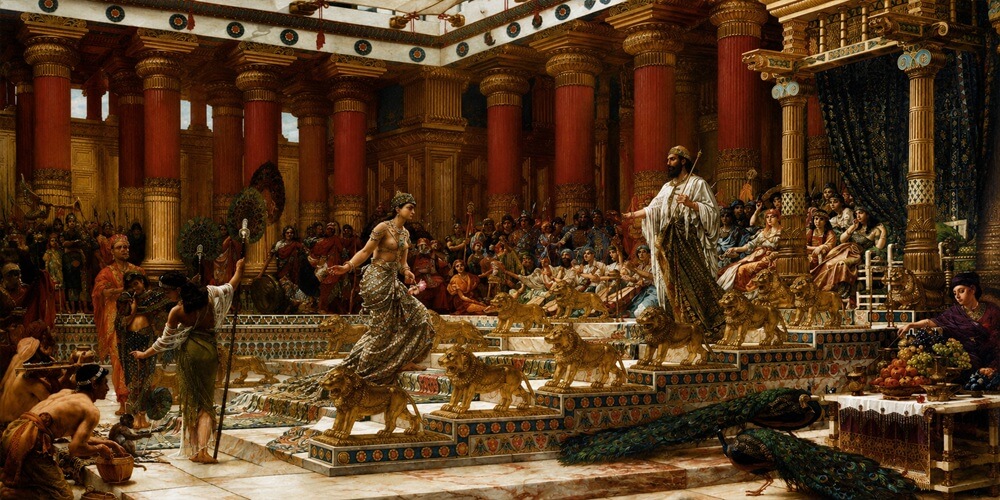
King Solomon and Queen of Sheba
King Solomon
In Judaism, great importance is attached to gematria, to the secrets hidden in names, in the exchange of letters, and in their numerical value. The name Shlomo (Solomon), when reversed, becomes LeMoshe, meaning “to Moses” with the additional letter L. If Moses was the builder of the Tabernacle, then the root of his soul, reincarnated in Solomon, is the one who builds the Temple. It was only in the time of Moses and Solomon that people filled with wisdom, understanding, and knowledge appeared: in the time of Moses it was Bezalel son of Uri, and in the time of Solomon, Hiram Abiff.
According to legend, Solomon ruled over demons and angels and knew the language of animals. The wisest of men, he is credited with writing the books of Ecclesiastes and Proverbs, which contain the finest treasures of Jewish wisdom, as well as the Song of Songs, one of the most mystical and esoteric writings in the Bible, an allegory for the love between God and the people of Israel. Solomon’s fame spread throughout the world, and people came from distant lands to witness his wisdom, including the Queen of Sheba, who came especially from Ethiopia. Through his wives, his alliances, his works, and his wisdom, Solomon became an influential figure on the international stage, similar to his father David, though in a different way.
According to the Sages, Solomon received the scroll of the Temple from David, a scroll containing the plan of the house, which had been passed down from Moses to Joshua, to the elders, and to Samuel, and in it was the plan of the Temple revealed on Mount Sinai. Therefore, the dimensions of the First Temple are binding and contain secrets. David marked and dug the foundations of the Temple in the ground, and Solomon built the structure. The fourth year of Solomon’s reign marks exactly 480 years since the Exodus from Egypt, which is 12 times 40 years, meaning that the sin of the tribes was atoned for and it was possible to proceed to the next stage of the repair of the world—the building of the Temple. The reason why Solomon, and not David, built the Temple is that it was impossible to do so before 480 years had passed. This is also the exact time span between the building of the First Temple and that of the Second Temple. The divine plan is revealed to be very precise. It is worth noting in this context that from the arrival in the land to David’s choice of Jerusalem as the capital is 400 years, but from the Exodus from Egypt to the beginning of the construction of the Temple is 480 years, because the 40 years in the desert and the 40 years of King David’s reign are added.
In any case, the building of the Temple by Solomon was the most important thing he did and the purpose for which he came into the world. It was the completion of the act of creation, the perfect human house, the repair of the world. As a result of the original sin, there is hunger, suffering, extreme heat and cold, pests, and so on in the created world. But in the Temple, miracles happened every day that satisfied hunger and thirst, brought healing and inspiration, and created a paradise on earth. Solomon created a place where death held no rule (the laws of purity determined that a corpse could not be brought into the courtyard) and where there was a gate to Paradise.
If we return for a moment to the historical point of view: Solomon was the son of Bathsheba and David, and he ruled over united Israel for 40 years. During his reign, Israel had a very deep connection with Egypt on the one hand and with the Phoenician kingdom of Tyre on the other. Solomon married the daughter of Pharaoh, and as part of his construction projects, he built a palace for her in Jerusalem. In addition, he had a strategic and economic alliance with the Phoenician kingdom of Tyre, and it goes without saying that some of his one thousand wives were Phoenician, as it is written: “And King Solomon loved many foreign women, and the daughter of Pharaoh, Moabites, Ammonites, Edomites, Sidonians, and Hittites” (1 Kings 11:1).
It is important to note that until the time of Solomon, the Israelites did not build temples and did not engage in monumental construction. They lacked the engineering and organizational knowledge and capabilities required for the building of a large-scale temple, and they also did not yet have the religious concept that God dwells in a permanent house. Therefore, the Tabernacle in Shiloh had no permanent roof, and the same was true of the Tabernacles in Nob and Gibeon. In the neighboring countries, on the other hand, there was a developed culture of building temples, especially in Egypt and Phoenicia.
It is likely that King Solomon, who was the wisest of men and knew seventy languages, received some of the knowledge for building the Temple, including the technological and organizational skills, from these countries. He was assisted by Hiram, King of Tyre, in terms of materials and builders, as is explicitly told in the Bible, but it is also likely that he drew upon the knowledge of sacred architecture that existed in Egypt. This knowledge came from the magical sciences by which temples were built, using sacred proportions, colors, and specific materials that summoned energy in order to bring abundance to the land and connect heaven and earth. It is important to remember that Solomon was married to an Egyptian princess and built a palace for her in Jerusalem, and Egypt was a land of temples.
It is not clear where Solomon learned the seventy languages. Did he visit other countries as a child? Did people come to the palace to teach him? And if so, perhaps they also taught him the ancient knowledge of sacred architecture, as well as the esoteric sciences of alchemy and astrology. Solomon needed this knowledge to create the vessels for the Temple. The alchemists used to work in the womb of the earth, where there was no interference from cosmic energies, and Solomon followed the same practice. The vessels of the Temple were prepared in a special way. Of all the places in the country, the Jordan Valley near Jericho is the most suitable location for the alchemical-magical operations of preparing holy vessels, because it lies 300–400 meters below sea level and is therefore shielded by an additional insulated layer of atmosphere. Indeed, King Solomon cast the vessels of the Temple there, deep in the earth: “In the plain of the Jordan the king cast them, in the deep earth” (1 Kings 7:46).
One of the alchemical considerations in the building of the Temple was the avoidance of using iron, because of its connection to war (the influence of the planet Mars). Instead, Solomon obtained a miraculous device called the Shamir worm (some say he brought it from Paradise) and used it to cut the stones precisely and quickly. It is said that the Shamir worm was also the one that cut the Tablets of the Covenant, which were made out of hard sapphire stone.
Hiram, King of Tyre (reigned 970–936 BCE), helped David build a palace by supplying cedar wood and craftsmen skilled in wood and stone. It is important to understand in this context that the building of a palace was perceived in Canaanite-Phoenician mythology as a religious confirmation of the rule of a king or a god and the establishment of his legitimacy—a magical act. The description of Hiram’s help to David begins with an enigmatic verse: “And Hiram king of Tyre sent messengers to David,” and the question is who these messengers were. The next verse also adds to the mystery: “And David knew that the Lord had established him king over Israel” (2 Samuel 5:12). Hiram’s support was perceived by David as confirmation from God of his rule, and as a result, he took more wives and had more children, including Solomon. After Solomon grew up, Hiram was happy to help David’s son and continued the covenant with him. He sent him cedar and cypress for the building of the Temple and attached his blessing to them[2].
In addition to Hiram, King of Tyre, there was another Phoenician who helped Solomon in the building of the Temple, the craftsman Hiram Abiff, the son of a widow (symbolic), who was full of “wisdom, understanding, and knowledge,” and was probably Jewish only on his mother’s side. According to the Book of Chronicles, Hiram Abiff was a wise man of great understanding who was sent to Solomon by Hiram, King of Tyre, and he worked in “gold and silver, bronze and iron, stones and wood, in purple, blue, fine linen, and crimson, and to do all kinds of engraving and to devise every design” (2 Chronicles 2:6).
The Bible does not explicitly state this, but it is possible that Solomon also received help in building the Temple from Egypt. His father-in-law was Pharaoh Siamun, one of the great builders of the temples of Egypt, who rebuilt the temples of Amun in Memphis and Tanis in the Delta. Siamun conquered Gezer from the Philistines and gave the city as a wedding gift to Solomon, just as Solomon gave cities in the Galilee as a gift to Hiram, King of Tyre. It is known that Solomon built a palace for the daughter of Pharaoh in Jerusalem, and the question is whether he also built a temple for her, and whether in the building of the Temple he was influenced by the ideas of the Egyptian temples. But even if not, the Egyptian influence that was present in the structure of the Tabernacle appeared in the Temple, which was built in the design of the Tabernacle and with the same vessels.
If we adopt the religious-spiritual point of view, we can argue that the knowledge regarding the building of the Temple and the vessels came to Solomon directly from God or from the intelligence of creation. As mentioned, Solomon’s characteristic was that he was full of wisdom and understanding. He earned this through a test in which God asked him what he wanted as king, and his answer was “understanding to judge the people.” God was pleased with Solomon’s wise and humble answer, who did not ask for anything for himself (long life, revenge on his enemies, etc.), but the ability to fulfill his role in the best possible way, admitting his need for help, which is the beginning of wisdom. Indeed, wisdom was given to Solomon as it was not given to anyone before or after him, and not only wisdom but also understanding. “And God gave Solomon wisdom and understanding beyond measure, and breadth of mind like the sand on the seashore, so that Solomon’s wisdom surpassed the wisdom of all the people of the east and all the wisdom of Egypt. For he was wiser than all other men” (1 Kings 5:9-11).
The question arises: why are two types of wisdom needed? Aren’t wisdom and understanding two names for the same thing? It turns out that they are not. Wisdom and understanding are two different ways of thought: one is related to the left hemisphere of the brain and is analytical in nature, and the other is related to the right hemisphere of the brain and is associative in nature, understanding one thing from another. One is expressed through words and numbers, and the other through images. One is specific and the other is holistic. The Kabbalah commands us to think in both ways simultaneously. In the Sefer Yetzirah, the earliest Kabbalistic book, it is said: “Be wise in understanding and understand wisdom.” Only the combination of the two leads to the knowledge of God and unification with Him, for “knowledge” means unification. Therefore, Solomon had to possess both wisdom and understanding in order to build the Temple, and so did Hiram Abiff, his chief assistant.
The combination of wisdom and understanding allows for a higher level of perception of reality. The wisdom and understanding of Solomon and Hiram Abiff enabled them to know the will of God and build a house that is an expression of the seven energies through which God’s energies are emanated. Chochmah, Binah, and Keter are the three upper sefirot in the Tree of Sefirot, which represent abstract principles and the expression of the divinity itself. The seven lower energies in the Tree of Sefirot, through which the upper sefirot are emanated to this world, are the seven names mentioned in David’s blessing to Solomon for the building of the Temple: “Yours, O Lord, is the greatness and the power and the glory and the victory and the majesty, for all that is in the heavens and in the earth is yours. Yours is the kingdom, O Lord” (1 Chronicles 29:11). From this, it is understood that David prepared the infrastructure for the building of the Temple, while Solomon brought the connection that allowed for the establishment of the House of God, and therefore God calls him “my son.” David and Solomon complete each other.
According to the Bible, Solomon employed 150,000 workers in the building of the Temple. The work lasted seven years, and it was inaugurated on Sukkot. The building of the Temple changed the face of the country and Jerusalem, and at its completion, a great celebration of all the people was held. The cloud that had been over the Tabernacle entered the house: “Then said Solomon, ‘The Lord has said that he would dwell in thick darkness'” (1 Kings 8:12). A new era began in the life of the Jewish people—the First Temple period.
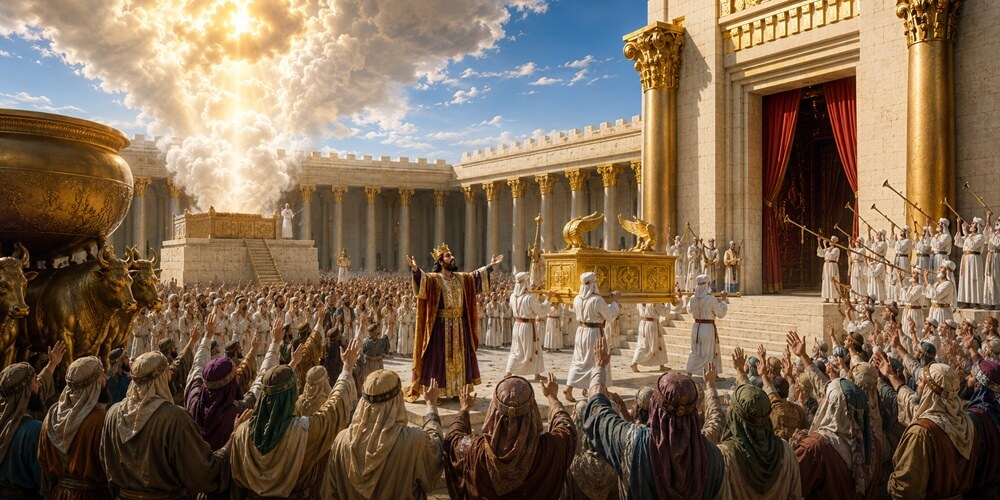
Solomon’s Dedication of the Temple
Solomon’s Building projects
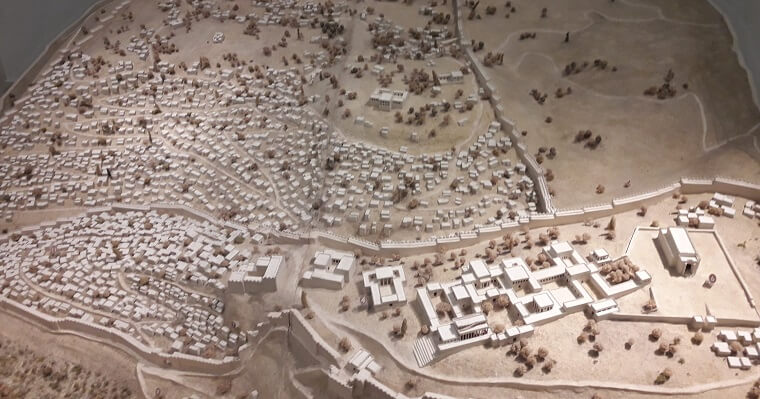
The Temple was part of a complex of buildings that Solomon built in Jerusalem, which are mentioned in the Bible. Among them were the House of the Forest of Lebanon, the Hall of Pillars, the Hall of Judgment, the King’s Palace, and the Palace for the daughter of Pharaoh. There are disputes among scholars regarding these buildings: were they separate, connected, or part of one structure? What did they look like, and what was their purpose? However, it is clear that Solomon built additional buildings alongside the Temple, and the main one was the mysterious “House of the Forest of Lebanon.” This was a large building, 50 meters long, with four rows of massive pillars, similar to the Hall of Pillars in the temples of Karnak in Egypt. According to some scholars, it is possible that the House of the Forest of Lebanon was a kind of summer palace, a relatively cool place to which one could escape the summer heat, and hence the name “Lebanon.” However, this is a somewhat simplistic explanation. The more accurate explanation, in my opinion, lies in the mythical direction: Mount Lebanon was considered in ancient times a holy mountain, the dwelling place of the gods, and it is even mentioned in the Mesopotamian Epic of Gilgamesh.
In addition to the House of the Forest of Lebanon, Solomon built the Hall of Judgment, in which a special chair made of gold was placed, with six steps leading up to it. On the sides stood 12 lions, and two more lions were integrated into the handles of the chair. Royal chairs had an important magical role in Egypt, where they were considered living beings in their own right, a divine entity that granted power to those who sat on them, and this belief also appears in the legends of other peoples. Solomon’s royal chair, together with the six steps leading up to it, is connected to the significance of the number six and the holiness of the number seven—the king being the seventh step. Seven symbolizes nature, the seven colors of the rainbow, and the seven heavens, as reflected in the structure of the seven-branched menorah. The meaning here is that the one who sits on the chair is able to control the forces of nature and direct them as he wishes, and this was Solomon’s defining characteristic.
The entire complex of buildings that Solomon constructed formed an integrated system of temples and palaces in Jerusalem, reminiscent of the great sacred complexes in Egypt. According to David Shapira[3], the layout of the palace mimics the palaces of the kings of Egypt, which were built according to the model of temples. Therefore, at the entrance to the palace there was a hall of pillars, followed by a throne room, and beyond that the king’s residence. Construction began in the fourth year of Solomon’s reign and lasted about ten years, culminating in the building of the Temple.
References
[1] “The Celestial Temple According to Legend,” Tarbiẓ, Volume 2, 1931, pp. 137-250.
[2] Salim George Khalaf claims that the Temple in Jerusalem resembled the Temple of Melqart in Tyre, which was built by Hiram and was a large and magnificent temple also mentioned by Herodotus.
[3] Shapira, D. (2016). “‘And a hall in front of them and pillars and a roof in front of them’ – The Hall of Pillars or the Throne Room? A new reading of 1 Kings 7:6-7.” Beit Mikra: A Journal for the Study of the Bible and its World, 61(2), pp. 276-289.