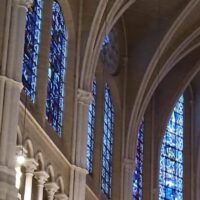
Secular French Spirituality
At the beginning of the 19th century, France was the most populous country in Europe (30 million people, accounting for 20% of the continent), far exceeding England and Spain. The French Revolution and the ideas of Rousseau, Voltaire, and Montesquieu introduced something new to the world, which translated into liberal secularism but also a new secular spirituality. This spirituality was based partly on France’s exposure to Egypt (following Napoleon’s campaign) and esoteric doctrines that emerged with the Enlightenment, such as alchemy, magic, and occultism, and was also connected to the popularity of Freemasonry at the time. The main activity of this secular spiritual movement was concentrated in Paris, a city of three million people, just as 19th-century spiritual activity in England was concentrated in London.
French secular spirituality embraced the Kabbalah and the Hebrew language, which led to an interest in Jerusalem. Part of this was related to the concept of ancient wisdom. The new nationalism sought its inspiration in Jerusalem, which was also a focus of interest for scientific research and art. This led to visits by important French figures like Lamartine and Chateaubriand to the city.
The French Revolution and the establishment of the Republic, the rejection of the monarchy and the Church, and the emphasis on liberal values led to a reaction in the form of a new wave of Christian spirituality, appearing in cities but primarily in rural areas. This spirituality was expressed through the apparitions of Mary at La Salette and Lourdes, and in movements of Christian renewal. Thus, in the 19th century, there were two types of French spirituality that both turned their attention toward Jerusalem: one was a secular and esoteric French spirituality, and the second was a Catholic French spirituality.

Napoleon and the Freemasons
Many French people were members of Freemasonry. Among them were famous figures such as Voltaire, Lafayette, Danton, and others. Napoleon’s brother, Joseph, was the Grand Master of the Freemasons in France, and Napoleon himself supported the Freemasons and adopted some of their principles and symbols. This helped the fraternity to spread throughout Europe, following the French coquests.
Napoleon’s military campaign to Egypt was considered a daring attempt to strike at the British Empire, but like Alexander the Great’s campaign before him, it may have had other reasons. Napoleon was in Egypt from 1798 to 1801 and brought scholars with him to research Egyptian antiquities. This eventually led to the decipherment of hieroglyphs and a wave of interest in ancient spiritual heritage. The Pyramid is a symbol of Freemasonry, which claims ancient origins in Egypt. The Order claims a universal tradition of ancient wisdom, and Napoleon’s campaign in Egypt contributed to this perception.
Napoleon led a military campaign to the Holy Land but did not conquer Jerusalem. Nevertheless, the campaign sparked a renewed wave of interest in the forgotten land—scientifically, culturally, and spiritually—and paved the way for Orientalism. Therefore, some say [1] that the beginning of the Modern Era in the Land of Israel is connected to Napoleon’s campaign. Freemasons claim roots in Solomon’s Temple in Jerusalem, and the connection to the land strengthened this ethos. On the other hand, the campaign and the European presence in the land introduced new influences to the local population, which ultimately led to the rise of Muhammad Ali to power in Egypt, his conquest of the Land of Israel, and its opening to Europeans.
In the 19th century, esoteric elements entered some of the Masonic Lodges, especially in France but also elsewhere. The exposure to Kabbalah and Hermeticism led some lodges to treat symbolic initiation rites more seriously and to infuse spiritual elements and doctrines into them, which later led to the founding of orders that promoted the spiritual development of man, such as the Martinist Order.
The influence of Freemasonry can also be seen in Napoleon III, Napoleon’s nephew, who established the Second French Empire and belonged to the order, and also in the leadership of the Third Republic: Léon Gambetta (1881), Jules Ferry (1883–1885, Prime Minister), and Jules Grévy (1879–1887, President) are among the figures associated with the fraternity.

Alphonse de Lamartine and Chateaubriand
No other nation sought to define itself and aspired to such high ideals in the beginning of the modern era as France did, starting with the French Revolution and continuing throughout the 19th and into the 20th century. France pioneered the desire for a civil, egalitarian, and enlightened society on the one hand, while harboring forces of religion, the human search for meaning, and Romanticism on the other. It is no coincidence that some of France’s statesmen were poets and writers, and that French thinkers wielded great influence. Two important French public figures who arrived in Jerusalem in the early 19th century were François-René de Chateaubriand and Alphonse de Lamartine.
François-René de Chateaubriand (1768–1848) was a writer and statesman who held positions in Napoleon’s government. A Catholic convert who opposed the French Revolution, he authored the book The Genius of Christianity [2] in 1802. And in 1806 embarked on a journey to the Holy Land and wrote the book Itinéraire de Paris à Jérusalem (Travels from Paris to Jerusalem) [3] chronicling his experiences. This emotionally charged book became a source of inspiration for many. Chateaubriand later became the Foreign Minister of France and supported Muhammad Ali. He is considered the founder of the Romantic movement in French literature.
Alphonse de Lamartine (1790–1869) was a poet, statesman, and one of the pioneers of Romantic poetry. Lamartine received a religious upbringing, and his poems often stemmed from longing. He published his first important book of poems, Poetic Meditations, following the death of his lover in 1820. Throughout his life, he held a variety of political roles, including being the Foreign Minister of the republic during the 1848 revolution, and running for president of the Republic against Napoleon III in 1851.
Lamartine dreamed of reaching Jerusalem, and after the publication of his important book Poetical and Religious Harmonies [4] in 1830, he embarked on a journey with his wife and daughter in 1832–33 to the East to find salvation for his soul in the place where Christianity was born. During that journey, his only daughter fell ill and died in Beirut, an event that profoundly impacted Lamartine and gave the pilgrimage another dimension. The book A Pilgrimage to the Holy Land (Voyage en Orient) [5] was written as a result of this journey.
Lamartine believed that the East had something to offer the West, and that through the spirituality and wildness of the East, Western society could be healed. As a devout Christian, he saw in the symbols, landscape, and iconography of the East the potential for creating a new, spiritual Christianity that would save Europe from ruin. Despite the death of his daughter, the journey to the East was a reconnection to his soul, during the journey he became acquainted and influenced by the poetry of the East (especially in Lebanon).
Lamartine’s cooperated in his political efforts with Adolphe Crémieux (1796–1880), a jew that was appointed Minister of Justice in 1848. Crémieux was one of the founders of the Alliance Israélite Universelle and a Grand Master of French Freemasonry (a branch independent of the English one, possessing esoteric characteristics). He returned to serve as Minister of Justice after the defeat of Napoleon III in 1870, granted French citizenship to Algerian Jews, and abolished the death penalty in the country.
Émile Botta and Assyriology
Émile Botta (1802-1870) unveiled the treasures and richness of ancient Mesopotamian ccivilizations to the West. He was the French consul in Jerusalem for seven years, an archaeologist and researcher who worked in the city in the mid-19th century, one of the interesting renaissance men of the new era
Émile Botta was the son of an Italian-French historian from Turin. Born in 1802, he took a world tour by ship from 1826 to 1829 while working on his doctorate. In 1830, he arrived in Egypt and became a close friend of Disraeli. He joined the campaign of Muhammad Ali’s army, consequently visiting the Land of Israel during its conquest by the Egyptians.
In 1842, Émile Botta was appointed French Consul in Baghdad (which was then under Ottoman rule). He engaged in archaeological excavations and discovered the lost Assyrian capital of Dur-Sharrukin—the capital built by Sargon II (Reign 722-705 BC) to fortify his rule and demonstrate his distinctiveness. Impressive artifacts from the excavations were brought to European capitals, arousing great interest in the East, which contributed to Botta’s fame as a discoverer of civilizations. He stayed in Iraq until 1847 and then returned to Paris. The arrival of the large statues of Assyrian sphinxes in Paris sparked a wave of interest in the wisdom of the East, its magic, and its spirituality, just as the Egyptian sphinx statues that arrived in Paris half a century earlier had done. Unlike the Egyptian sphinxes, the Assyrian sphinxes had the body of a bull rather than a lion.
Amittai Baruchi-Unna points to the spiritual connection between the Assyrian city of Dur-Sharrukin, which Émile Botta discovered, and Jerusalem, where he served. According to him [6], Jerusalem is particularly linked by the Prophet Isaiah ben Amoz concept of justice as a central component of God’s revelation in the world. It is a place of just rule, where law is inscribed within its very construction. Justice precedes worship. The plumb line and the measuring weight, the tools of measurement, determine the shape of the stone, just as justice determines the character of Jerusalem.
Sargon II, the great Assyrian king, was a contemporary of Isaiah ben Amoz. When he built a new capital and palace, he founded them on the principles of justice. The name Sargon means “the legitimate king,” and he rules justly in accordance with the name given to him by the gods, just as Melchizedek rules in Jerusalem. The city’s dimensions are numerically derived from Sargon’s name, thus also symbolizing justice. Similarly, in the Jewish tradition, David is the king of justice, and the Messiah will come from his dynasty to establish a kingdom of justice before the Day of Judgment. Émile Botta, in his modest way, attempted to contribute to this vision.
Sargon II built Dur-Sharrukin, and it was therefore natural that his son Sennacherib would also build a new capital: Nineveh. Botta’s colleague in the Assyrian excavations, Sir Austen Henry Layard, finally discovered the location of biblical Nineveh in 1845. Among other things, he found the Black Obelisk of Shalmaneser III, King of Assyria, on which Jehu, King of Israel, is seen at the head of a delegation bowing to Shalmaneser. This was the first time a king of Israel appeared on the stage of history independently, documented by an external civilization. The discovery sparked great enthusiasm and a fascination with the corroboration of the Bible through archaeological excavations. It is reasonable to assume that Sir Austen Henry Layard, who was a friend of Disraeli, saw the discovery as the intervention of a divine hand. Layard visited the Holy Land during his lifetime, was involved in English politics, and was even appointed British Ambassador to the Ottoman Empire in 1877 during Disraeli’s rule.
In addition to the Obelisk, Sir Austen Henry Layard also discovered the Library of Ashurbanipal, containing a wealth of writings on Mesopotamian mythology, religion, medicine, science, and astronomy, including the great epics of Gilgamesh and Enuma Elish. By that time, the decipherment of cuneiform script had been completed, and the spiritual world of the Mesopotamians was opened to the West.
After the Second French Revolution in 1848 and Lamartine’s rise to positions of influence, Émile Botta was appointed Consul in Jerusalem. He served in this position during the Second Empire of Napoleon III, for a total of seven years until 1855, partly through the Crimean War. The beginning of his term was a time of grace for Catholics in the Holy Land: the Catholic Patriarchate was re-established after 700 years in 1847, and Patriarch Valerga worked with Botta to expand Christian institutions and establish the catholic orders (see chapter on Valerga).
In his capacity as French Consul, he assisted a French delegation led by Félicien de Saulcy, who was close to Napoleon III, to excavate and research biblical archaeology in the Holy Land. De Saulcy discovered the Tombs of the Kings in Jerusalem in 1851, researched Masada, searched for the Tablets of the Covenant on Mount Nebo, and more. He was a member of the Order of the Knights of the Holy Sepulchre and returned to the Holy Land in 1863 to complete the excavations at the Tombs of the Kings.
Another French archaeologist who excavated in the Holy Land was Charles-Jean-Melchior de Vogüé. He arrived in Jerusalem in 1854 and received extraordinary permission to research the Temple Mount from the Ottoman aruthorities. A few years after returning to France, he published books on the architecture of the Dome of the Rock and the Temple Mount complex, on the jewish Temple, and on the churches of Jerusalem, including the Church of the Holy Sepulchre. In these books, a Masonic influence and a tendency towards a spiritual and symbolic interpretation of architecture are discernible.
De Vogüé was a colleague of Ernest Renan, a famous French historian, philosopher, and archaeologist who led excavations at Phoenician sites and was connected with Freemasonry. It should be mentioned in this context that Hiram Abiff, the mythological Master of Freemasonry, was a Phoenician from Tyre. As in other cases (see chapter: What were the archaeologists of the Holy Land searching for), archaeology provided proof for a spiritual doctrine—in this case, a tradition of universal ancient wisdom preserved by guilds of builders and appearing in the architecture of ancient periods.
Orientalism
Orientalism must and can be understood against the backdrop of its time. The point of reference is the rupture brought about by the Industrial Revolution, the expansion of cities, and changes in lifestyles on the one hand, and the development of technology, communication, and travel on the other. The immense transformation that Europe underwent caused people to seek answers to life’s riddles, leading them to turn toward new horizons in the hope of finding inspiration and resolution. A similar process occurred in Europe in the 15th century, when the crisis of faith and ecclesiastical institutions led to a search for new sources of inspiration. In that era, Medicean Florence discovered the classical heritage in literature arriving from Byzantium, and the Neoplatonic Academy was established. Various individuals began to delve into the remnants of the classical world, and the Renaissance was born—a cross-pollination of Western culture (especially in Italy) by the culture and thought of the Hellenistic-Roman period.
A similar search for meaning took place in the 19th century. Following the Enlightenment and the onset of the modern era, people looked for something else—and they found it in the Near East. Advancements in technology and transport by sea and land made the journey to the Near East much safer and easier than before. The development of mass communication and the concentration of populations in large cities enabled the dissemination of impressions from these Eastern journeys, transforming what was once a private endeavor into a broad movement. This movement relied not only on books but also on diagrams, art, exhibitions, and interpersonal encounters with people returning from the East. Thus, the Orientalist movement was created.
Orientalism is inextricably linked to the Middle East and involves observing the ancient Muslim and Christian cultures existing there—cultures reminiscent of the biblical period, characterized by simplicity and vitality on the one hand, and deep faith on the other. Naturally, Orientalism is tied to Jerusalem, the Holy City for three religions, which holds a fundamental connection to the biblical era, to Muhammad, and to Jesus. Europe’s rationalism lacked soul—religiosity in its deep and experiential sense. Life in the big cities was mundane, giving rise to the Romantic movement. Yet, this movement needed a subject to romanticize—and found it in the Middle East. The Bedouin with his keffiyeh evoked Abraham and biblical figures; the well in the Arab village recalled Jacob and Rachel. The bright light of the night sky stood in stark contrast to the grayness of the European sky.
The Ottoman-ruled Middle East had remained behind, and this was the secret of its charm. Arriving there was akin to traveling back in time, to a period considered dramatic and blessed. Painters who visited the Middle East found new inspiration for their art, and many writers came to Jerusalem to unlock the gates of creativity. People seeking answers to life’s questions embarked on the journey—which, as mentioned, had become less dangerous and more feasible—hoping to find answers, inspiration, or mystical experiences. Upon returning to Paris or London, they wrote about their experiences, painted what they saw, and brought back objects, new doctrines, and books. This generated a wave of enthusiasm and interest which is, in essence, Orientalism.
Delving a level deeper, the encounter with the “Other”—something different yet connected to a shared past—served as a kind of reminder (anamnesis) that an alternative was possible. It highlighted what Western society lacked and provided inspiration for the next stage of development: a combination of European logic and enlightenment with the emotion and religiosity of the East. Orientalism was intended to enable Europe to take the next step—the development of a new kind of personal religion, a holistic worldview, and a reconnection to the emotional and experiential parts of the self.
Western civilization rests on two foundations: the first is Greek (and Roman) science and thought, and the second is Jewish-Christian morality and faith. Orientalism represented a rediscovery of the second principle—not in the traditional religious-exegetical or institutional Christian sense, but in a personal, faith-based sense. The experiences in the East, and especially in Jerusalem, were significant mystical and personal events that echoed the lives of biblical figures like Moses, Abraham, and David, as well as Jesus and the disciples. Orientalism was also associated with rediscovering the stories of the Old and New Testaments in a personal and experiential way.
The renewed encounter with the Middle East—its antiquities, the remnants of the past, and the local Muslim-Turkish-Arab and Bedouin cultures—enriched European art and literature, as well as Christian religiosity and even branches of philosophy and science. Some Europeans who came to the East learned Arabic, were exposed to Sufi mysticism, integrated into the region, and developed a new worldview regarding the right path for man in the modern age.
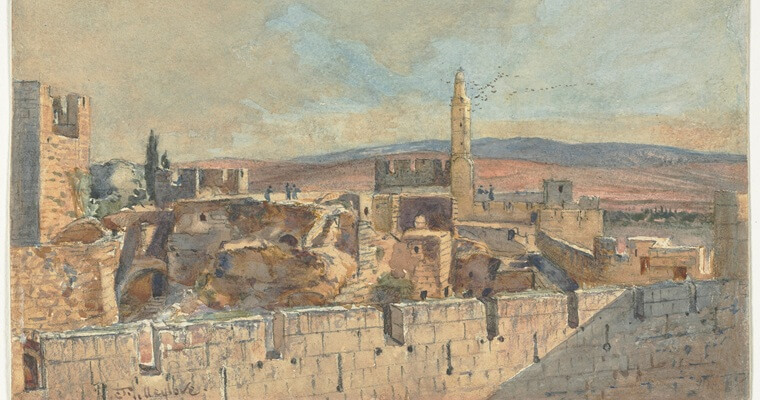
A key component of Orientalism was the renewed exposure to antiquities and sites of the past. Lost sites—such as Petra and Palmyra—were rediscovered. Known sites—such as the Dome of the Rock—were documented with accurate drawings, differing from previous depictions. These research efforts and discoveries shed new light on the region and aroused great interest. The discovery of the antiquities of Egypt, Mesopotamia, and Assyria (by Émile Botta and others), and the transport of large monuments—including obelisks and colossal statues—to the museums and cities of Europe (starting from Napoleon’s campaign onwards), connected the study of the East with the glorious past of humanity, expanding the historical perspective beyond Greece and Rome to include biblical stories and faith.
The Middle East, and the Land of Israel within it, became topics of salon conversations in London, Paris, and other European capitals. A selection of illustrated books and photographs was published, and archaeological exhibitions attracted large audiences. The desire to build a “New Jerusalem” in England, France, and other European countries fueled interest in the old Jerusalem. Jerusalem and the East were the missing link in an awakening and rebuilding world, fostering a feeling that everything was possible.
Footnotes:
[1] Ben-Arieh, Y., & Yad Izhak Ben-Zvi, G. M. (2018). How Modern Eretz-Israel Was Created 1799–1949: Historical Geography. Jerusalem: Magnes Press, The Hebrew University. (Hebrew)
[2] Chateaubriand, F.-R. de. (1900). The genius of Christianity; or, The spirit and beauty of the Christian religion (C. I. White, Trans.). London: Burns & Oates. (Original work published 1802)
[3] Chateaubriand, F.-R. de. (1907). Travels in Greece, Palestine, Egypt and Barbary during the years 1806 and 1807 (W. T. Preston, Trans.). London: Henry G. Bohn. (Original work published 1811 as Itinéraire de Paris à Jérusalem)
[4] Lamartine, A. de. (1853). Poetical and Religious Harmonies (H. R. Weld, Trans.). Boston: Phillips, Sampson and Company. (Original work published 1830)
[5] Lamartine, A. de. (1841). A Pilgrimage to the Holy Land: Comprising Recollections, Sketches, and Reflections Made During a Tour in the East, 1832–1833 (W. K. Kelly, Trans.). New York: Harper & Brothers. (Original work published 1835 as Voyage en Orient)
[6] Amitai Baruchi-Unna, The City of Justice: Jerusalem as the Incarnation of Justice in the Perception of Isaiah ben Amoz, in Jerusalem Research Across the Ages: Material and Knowledge, Jerusalem 2015, Yad Ben Zvi, pp. 9–18. (Hebrew)