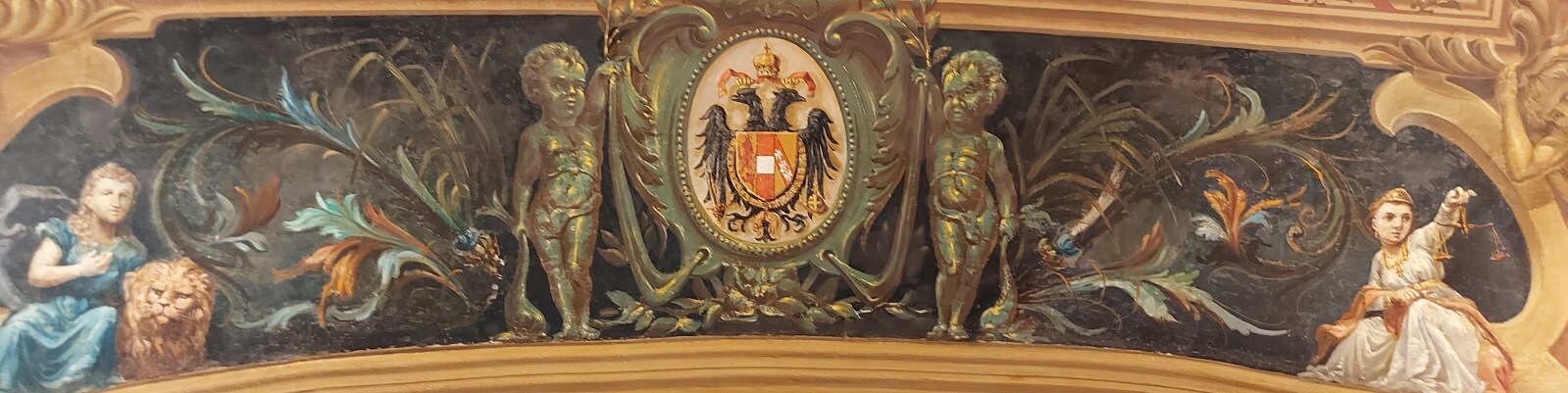
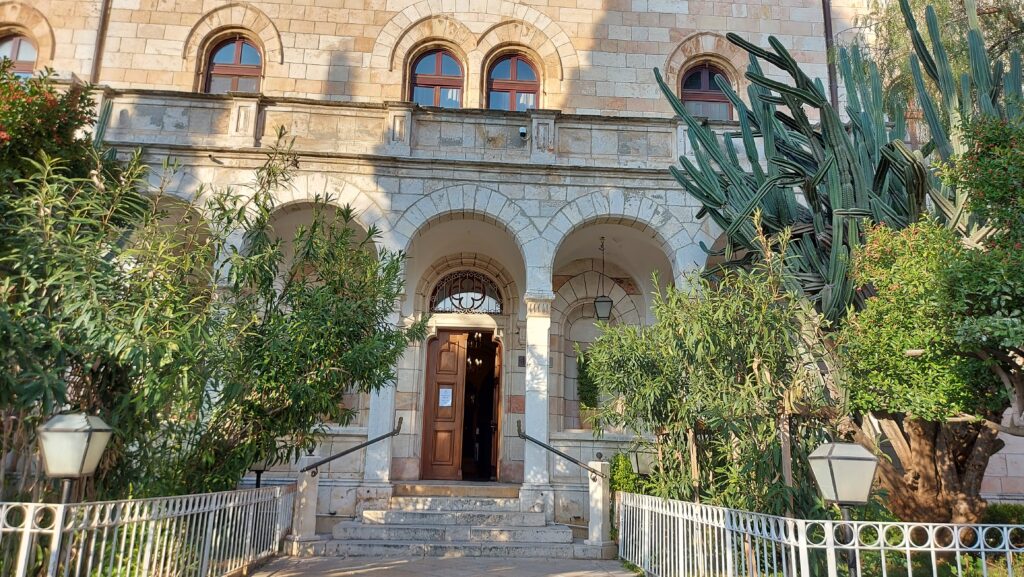
Austria-Hungary in Jerusalem
In the early 19th century, the Austrian Empire recovered from the humiliating defeats inflicted by Napoleon and helped establish a new order in Europe, under which it became a large and powerful state composed of diverse nationalities, but possessing a tradition and pride that seemed destined to last forever. The renewed Austro-Hungarian Empire included the territory of Greater Hungary, Transylvania, Croatia, the Vojvodina region in Serbia, Austria itself, and the annexed regions of Slovenia, Czechia, and parts of Galicia. On the eve of World War I, the Austro-Hungarian Empire was a European power of over 50 million people.
From the beginning of the Modern Era until the Empire’s dissolution, the Austro-Hungarian Empire constituted an important factor in the history of Jerusalem, as evidenced by the legacy it left behind. In 1855, the Emperor’s liberal brother, Maximilian I, visited the Holy Land and erected a statue in the Church of the Holy Sepulchre. He initiated the project of establishing the Austrian Hospice—a monumental building that would express the Empire’s international importance and serve as an anchor for the presence of Catholic Austrians in the city. He later became Emperor of Mexico, developed the capital, Mexico City (which has similar geographical characteristics to Jerusalem), and was executed by rebels, as depicted in Goya’s famous painting.
In 1869, Franz Joseph I, the Austrian Emperor, visited Jerusalem after attending the inauguration ceremony of the Suez Canal. The paving of the Jaffa–Jerusalem Road was completed in his honor. He officially inaugurated the Austrian Hospice and donated money to various buildings in the city, such as the Catholic Patriarchate, St. Saviour’s Church, and the Hasidic Tiferet Yisrael Synagogue. He stayed in the city for several days and was enthusiastically received by the local population. It is plausible that he saw himself as continuing the tradition of ancient Austrian rulers who came to Jerusalem during the Crusades. Austrian rulers had held the title “Kings of Jerusalem” since the time of Frederick II, but this time it was a different kind of crusade.
Austrian rulers participated notably in the Crusades. Henry II, the first Duke of Austria (1112–1177), took part in the Second Crusade before he was crowned ruler, and after Austria was elevated to a duchy, he moved the capital to Vienna. He was a friend of Frederick Barbarossa and founded the Schottenstift Monastery, which served as a rallying point for pilgrims traveling to Jerusalem. Leopold V (1157–1194), the next ruler, played an important role in the Third Crusade. Leopold VI (1176–1230) participated in the Fifth Crusade and remained in the Holy Land for an extended period.
The Kingdom of Hungary also had an ancient tradition of connection to the Holy Land, expressed through the Crusades of the 13th century. King Andrew II of Hungary (1177–1235) led the Fifth Crusade in 1217 to the Galilee and brought back to Hungary the head of Saint Stephen, who became the patron saint of the country. He was associated with the military orders of the Hospitallers and the Templars. Following his return, and thanks to the relics he brought, a mystical connection was forged between the Hungarian nation and monarchy and the Holy City. At the same time, the Golden Bull was written, enshrining the rights of the nobles—a kind of Hungarian Magna Carta.
In 1881, Rudolf, the Austro-Hungarian Crown Prince, visited Jerusalem and was enthusiastically received by the Jewish community (Yishuv). A large part of European Jewry, including a decisive majority of Hasidim, was under the rule of the Austro-Hungarian Empire. Nearly 4,000 Jews in Jerusalem were protected subjects of the Consulate in Jerusalem and received assistance from the Consulate, which had opened in 1849. The Austrian Consulate even protected the settlers of Petah Tikva, and the settlement’s leader, Yehoshua Stampfer, a subject of the Empire (after whom my father, one of his descendants, is named), appealed to the Consulate for aid several times [1]. The Austrians also helped in obtaining licenses for the construction of synagogues and other Jewish institutions, as well as in postal services. The Austrian Post opened in 1854, and its building near the Jaffa Gate was inaugurated in 1870—this became the main link between the growing Ashkenazi Jewish community and Europe.

Viennese Spirituality
During the 19th century, hegemony in Germany and in what remained of the Holy Roman Empire shifted from Austria to Prussia. As a result, Vienna’s intellectual elite focused on the spiritual and the aesthetic rather than on national and political aspirations. Vienna, a cosmopolitan city with a large Jewish population (over 10%), was a center of music where the world’s greatest composers worked from the Classical period (18th century) onward, led by Mozart, Haydn, Schubert, and Beethoven. The city was also a center of literature, art, and philosophy, as well as psychology—the study of the human soul—and maintained a strong interest in occultism and spirituality [2].
At the end of the 19th century, Vienna had nearly 2 million inhabitants and was part of a network of cultural cities in the Empire, along with Prague and Budapest, which were not far away. Vienna was strategically located on the Danube and served as a gateway to Germany, a crossing point for ideas and goods. But beyond that, there was something about this city that led to an exceptional gathering of musicians and individuals interested in the human spirit—two fields that complemented each other.
An important figure in the Austrian spiritual world is Carl Kellner (1851–1905), a chemist, industrialist, and inventor, but also a Freemason, Rosicrucian, and mystic. He founded the esoteric secret society Ordo Templi Orientis (O.T.O.) [3] together with Theodor Reuss. They were friends with the French occultist Papus and the Martinist Order, as well as with Westcott and the Golden Dawn. The Theosophist Franz Hartmann was their partner. In the higher degrees, the Order practiced sex magic, influenced by the American occultist Paschal Beverly Randolph, who visited Jerusalem. In 1910, Aleister Crowley eventually took control of the Order and changed its character.
Kellner traveled the world and met a Sufi master named Affa in Turkey, two Tantric Hindu teachers, and a mysterious organization called the Hermetic Brotherhood of Light. From these teachers, Kellner received keys that enabled him to understand the esoteric symbolism of Masonic emblems and the mysteries of nature. It is possible that he also visited Jerusalem during these travels.
Franz Anton Mesmer (1734–1815) was mentioned in the chapter on Mesmerism. He was a doctor who developed special healing methods using magnets, hypnosis, and shock treatment, based on the idea that an invisible fluid permeates everything, and that health and mental problems arise from a blockage in its movement. This intermediary fluid, which can be compared to the “aether,” the invisible fifth element, passes through certain people and gives them charisma. It is found in ecstatic gatherings. His theories were rejected by science, but they paved the way for the emergence of the psychology of the subconscious in Vienna at the end of the 19th century.
Following Mesmerism, parapsychology also found a home in Vienna. One of the first people to engage with it was Lazar von Hellenbach (1827–1887). He collaborated with the astronomer Karl Friedrich Zöllner (1834–1882), and together they argued that there is a fourth dimension that influences extrasensory phenomena and that the soul is a gateway to this dimension. They influenced the philosopher Carl du Prel (1839–1899), who wrote extensively on spiritual topics [4].
The diverse occult activity in Vienna encountered opposition from the Church, the scientific establishment, and the authorities. Nevertheless, it greatly influenced and prepared the ground for the emergence of psychology under Sigmund Freud (1856–1939) and the Psychoanalytic Society he founded around the University of Vienna. Mesmerism and parapsychology paved the way for accepting the existence of the subconscious: their observations were correct, but their interpretation was wrong. Many of the terms used to describe the subconscious, such as suggestion, come from these doctrines.
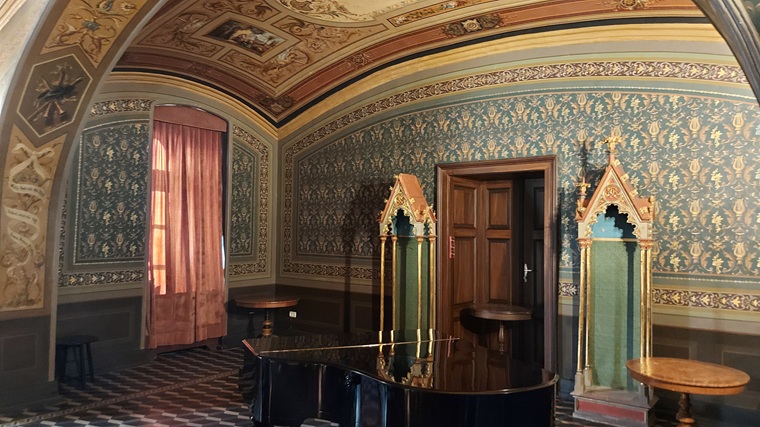
In the early 20th century, there was another wave of musical composition in Vienna, including the Jewish composer Gustav Mahler (1860–1910) and the founder of the Second Viennese School, Arnold Schoenberg (1874–1951). The question arises as to why all these remarkable musical compositions appear specifically in Vienna—why the Muses flourish in Vienna. It is said that the atmosphere of Jerusalem inspires, and apparently, the atmosphere of Vienna does so as well. Alongside musical and artistic creation, there was a wave of spirituality and the emergence of numerous esoteric and psychological groups in Vienna.
One of Vienna’s polymaths and a friend-partner of Freud was Friedrich Eckstein (1861–1939). He founded the Theosophical branch in Vienna together with the well-known feminist Marie Lang and was an associate and friend of Rudolf Steiner. Another person who was on good terms with Freud was Stefan Zweig (1881–1942), who was also in contact with Theodor Herzl. Zweig was interested in spiritual topics and advocated for the spiritual unity of Europe against nationalism. He identified the Viennese spiritual theories and the occultism that accompanied them as the inspiration for Freud’s discovery of the subconscious. He explained clearly the social fracture in Austria and Germany after World War I and lamented the moral and spiritual deterioration of Europe. His famous book is The World of Yesterday [5].
During that period, Jews from Galicia, which was under Austro-Hungarian rule, arrived in Vienna, including many Hasidim, and an interaction began between Hasidic teachers and modern spiritual doctrines and psychology [6]. The fifth Rebbe of Chabad, Sholom Dovber Schneersohn, received psychoanalytic treatment from Freud. In 1910, the Hasid, mystic, and writer Hillel Zeitlin attempted to reinterpret the concepts of Hasidism in the light of psychology, introducing terms such as elevating foreign thoughts, elevating sparks, tzimtzum (contraction), the contradiction between Being and Nothingness, developing positive traits, and more. He drew upon concepts from psychology and modern spiritual doctrines. His son, Aharon Zeitlin, who moved to the United States and became a writer and poet, wrote the first serious Hebrew book on parapsychology in 1967, combining a Jewish Hasidic perspective [7]. He also wrote the lyrics for the song “Donna Donna,” made famous by Joan Baez.
The encounter of Hasidism with Mesmerism and Viennese occultism, as well as with the psychology of the subconscious, led to the interpretation of the Hasidic phenomenon of the Tzaddik (righteous man) in these terms. Thus, the Tzaddik influences the Hasidim merely by his presence, without saying anything; this is explained by his power of magnetism according to Mesmerism. Gatherings of Hasidim strengthen this magnetism—or, in another terminology, the “fourth dimension,” which summons energy—and in this way exerts an influence, even if only subconsciously.
Menachem Eckstein (1890–1943), from the Dzikov Hasidic dynasty, wrote T’nai HaNefesh L’Hasagat HaChassidut (The Soul’s Conditions for Attaining Hasidut) [8] after World War I—a book in which he used terms from psychoanalysis and Mesmerism, such as suggestion and auto-suggestion, as well as techniques similar to hypnosis. Eckstein proposed guided imagery techniques that included a series of visualized scenes. According to his unique interpretation, the condition for attaining Hasidism is self-awareness: a person has two parts—one that is involved in this world, and a second that observes things from above, detached from daily existence. The Higher Self is in a kind of tower, looking down on things, seeing everything that happens to the lower self, and capable of manipulating and directing events as it wishes.
The leader and instigator of the Zionist movement, and the prophet and visionary of the Jewish state, Binyamin (Theodor) Ze’ev Herzl, worked in Vienna and was an editor, newspaper publisher, writer, and high-society figure who knew Freud, Mahler, and many others. Viennese high society, including those interested in occultism and spirituality, was largely Jewish, and over the years many of its members came to Jerusalem and positively influenced the emerging Jewish community there. Freud himself was one of the supporters of the founding of the Hebrew University, participated in its cornerstone-laying ceremony, and was a member of its first board of directors. His Psychoanalytic Society and many of his students found a home in Jerusalem.
If there is such a thing as a magnetic fluid everywhere, a fourth dimension, or—if you will—a collective subconscious, and if it also passes through objects and not only through people and human gatherings; if it is connected to thoughts and events in the past and not only the present, and also to thoughts from afar—then one of the places where this dimension is especially active is Jerusalem, by virtue of being a focal point for many thoughts today and for the sanctification and numerous manifestations of holiness throughout the generations. The magnetism of Jerusalem attracts many people and events, activates the network of synchronicity, and enables the appearance of holiness when the conditions are ripe.
Colors in Heraldry
In the 12th century, during the Crusades, a new tradition of coloring and decorating shields with symbols appeared, called heraldry. This was not only for identification purposes but also carried a deeper meaning—what a person was willing to fight for, what their motto was, what their declaration to the world was, and so on. These were the days of moral chivalry, which later developed into spiritual chivalry, as seen in the legends of King Arthur.
According to Christian teaching, in order to reach one’s higher self, a person had to overcome seven weaknesses and adopt seven virtues—somewhat similar to the ancient Gnostic doctrine, in which a person, to be freed from the rule of this world and attain spiritual existence, had to overcome seven archons (see the chapter on the Archontics in Jerusalem in the first book). These seven stages appeared through the seven colors originally permitted for use in heraldry: white, yellow, black, blue, red, green, and purple. The seven colors are not only stages but also a reflection of the makeup of the world through seven influences; the choice of color on the heraldic shield expressed each person’s inclination.
There are several places in Jerusalem where beautiful displays of heraldic shields can be found—such as the Jerusalem House of Quality in the Hinnom Valley, St. Louis Hospital, the church at Augusta Victoria, the church at the Austrian Hospice, and more. The tradition is shared by both Protestants and Catholics and is, in some cases, related to the meaning of colors in church liturgy. Color is a medium of transition between matter and energy, and thus the spiritual worlds can be described through it.
According to heraldic principles, only seven colors could initially be used, divided into two groups: Yellow and White, which were called “Metals,” and Green, Black, Red, Purple, and Blue, which were called “Colors.” The heraldic shield was composed primarily of two basic parts: the background of the shield—the shield itself before anything was painted on it—which was called the “Field”; and the elements painted on the shield, which were called the “Charge.” For example, in King Richard the Lionheart’s heraldic shield, there were three red lions—the Charge—on a yellow background—the Field.
The laws of heraldry stipulate that if Colors were used in one part of the shield—for example, the “Field”—then Metals had to be used in the “Charge,” and vice versa. These laws are not rigid and include exceptions. In principle, the Metals were identified with the higher qualities of royalty and holiness—Yellow and White symbolized Gold and Silver, and the Sun and Moon—while the five Colors were identified with the five planets visible to the naked eye: Mercury – Purple, Venus – Green, Mars – Red, Jupiter – Blue, and Saturn – Black. The planets, along with the Sun and Moon, are the only seven celestial bodies visible to the naked eye that move against the background of the fixed stars in heaven.
Another law in heraldry dictates that every shield should contain either Yellow or White, but not both together, because a person cannot be under both of these influences. The only exceptions are the heraldic shields of the Vatican and Jerusalem, which contain both Yellow and White—because these places are not of this world [9].
Anyone looking for proof of order in the world can see it in the heavens in two ways. First, the two celestial bodies that give all the light in the world—the Moon and the Sun—are, from our perspective, of the same apparent diameter in the sky, which makes lunar or solar eclipses possible. These two circles in the sky, equal in size, were identified with two different influences and therefore could not both be used on the same heraldic shield. The second proof is that we perceive reality through two main outward-reaching senses—sight and hearing. Both senses perceive the world through a filter of seven: in the case of sight, the seven colors of the spectrum; and in the case of hearing, the seven notes of the octave. Other animals see and hear differently; we were designed to perceive the world through a prism of seven.
In the case of spiritual chivalry, the knight must acquire seven virtues: three spiritual virtues—Faith, Hope, and Charity; and four earthly virtues—Prudence, Temperance, Justice, and Fortitude. The four earthly virtues are identified with the colors Black–Prudence, Blue–Justice, Green–Fortitude, and Purple–Temperance. The three spiritual virtues are identified with the colors Red–Charity, Yellow–Faith, and White–Hope.
In this context, it can be seen that the colors related to the spiritual virtues are warm colors—Red, Yellow, and White—while the colors related to the earthly virtues are cool colors—Purple, Black, Blue, and Green. The path of spiritual chivalry connects opposites. The relationship between the spiritual and the earthly is expressed as a ratio between an odd and an even number—between a triangle and a square. Within the earthly virtues, there is an inherent tension: Temperance and Justice, Fortitude and Prudence. The spiritual virtues form an independent principle that gives meaning. The seven virtues lead to a journey that begins with Prudence and ends with Charity, starting with the earthly virtues and culminating in the divine virtues. The transition between the Purple of Temperance and the Red of Charity is a transition of “Compassion.”
In the legends of King Arthur, the knight Gawain fights knights of different colors in order to rescue a maiden in a castle—the colors of the knights are related to the colors appearing in heraldry, meaning that his struggle is with himself along the path of spiritual chivalry. The liturgy of the Church also uses a system of seven colors, each with its own meaning.
Besides colors, heraldic shields also display symbols, which are part of the Charge; these can be animals, plants, geometric shapes, or inanimate objects such as a tower—each expressing a particular trait that the owner of the shield aspires to. Supporters are added on both sides of the heraldic shield, and thus, in the coat of arms of England, we find a unicorn on one side and a lion on the other. A motto is also added, which in the case of the English shield is “Dieu et mon droit” (“God and my right”), and sometimes a crown is placed above the heraldic shield. Heraldic shields became hereditary, and over time were divided into two or four, combining the heraldic shields of parents or grandparents who came from different families.

Footnotes:
[1] Eliav, M. (1981). The Austrian Consulate in Jerusalem and the Jewish Community in the Nineteenth Century. Cathedra, 20, 83–101.
[2] Baier, K. (2020). Occult Vienna: From the beginnings until the First World War. In Egil Asprem & Julian Strube (Eds.), New Approaches to the Study of Esotericism (pp. 1–28). Brill.
[3] Ordo Templi Orientis. (n.d.). Retrieved from https://www.oto.org/
[4] Du Prel, C. (1889). The Philosophy of Mysticism (C. C. Massey, Trans.). London: George Redway. (Original work published 1885 as Die Philosophie der Mystik).
[5] Zweig, S. (1943). The World of Yesterday: Memories of a European (R. & C. Winston, Trans.). Viking Press. (Original work published 1941 as Die Welt von Gestern).
[6] Reiser, D. (2016). The Encounter in Vienna: Modern Psychotherapy, Guided Imagery, and Hasidism Post-World War I. Modern Judaism: A Journal of Jewish Ideas and Experience, 36(3), 277–302.
[7] Zeitlin, A. (1967). The Other Reality: Parapsychology and Parapsychical Phenomena. Tel Aviv: Yavneh.
[8] Eckstein, M. (2006). T’nai HaNefesh L’Hasagat HaChassidut: A Guide to Jewish Contemplation. Beitar Illit: Makhon Even Shtiyah.
[9] Ibid.
[10] A traditional English witticism: One of the definitions of an English gentleman is that even if he is alone at home and needs to wash dishes, he will spread the butter with the special knife intended for it, and not with the general table knife.