French Catholic Spirituality
From the 17th century to the 20th century, there was a surge of French Catholic spirituality that influenced the entire world, perhaps as a reaction to the Protestant Huguenot turmoil, and perhaps as part of the French genius that led to the development of philosophy and of science. Great French religious thinkers developed the perception of man as capable of connecting with the essence of Jesus and becoming angel-like, emphasizing devotion, faith, and love.
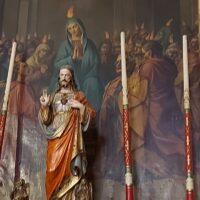
Saint Francis de Sales (1567–1622), one of the founders of the movement, emphasized love as a way of life. This is expressed in the doctrine of the Pure Heart. Saint Margaret Mary Alacoque (1647–1690) presented the devotion of the Sacred Heart of Jesus. Louis-Marie Grignion de Montfort (1673–1716) developed the practice of the Rosary and promoted the veneration of Mary. It is no coincidence that many of the apparitions of Mary, especially in the 19th century, occurred in France.
Despite the Age of Reason and the popularity of science and secularism, and perhaps because of it, the Christian religious revival continued in 18th-century France, and even the French Revolution and the establishment of the Republic did not weaken the power of this religious movement—on the contrary. The Industrial Revolution and the dramatic change in lifestyles that followed, the disintegration of the old social order and the unimaginative political changes, the wars, and the new nationalism—all led people to seek answers, stability, and security in religion. This naturally connected with the French religious presence in the Holy City. France was a Catholic country and, for much of the period, saw itself as the representative of Catholics in Jerusalem.

Charles Lavigerie
Charles Lavigerie (1825–1892) grew up in France and was a professor of religious history at the Sorbonne and a priest. In 1856, he was appointed inspector of schools in the East and came into contact with Islam. This was the moment he discovered his destiny—to present European culture and Christianity to the peoples of the Islamic states in the Mediterranean. In 1860, he arrived in Lebanon, Syria, and the Land of Israel following the Druze massacre of the Maronites. The events that occurred deeply shocked him and drew him out of the world of books and study into the world of action. He worked to help orphans and the needy. In Damascus, he met Abd al-Qādir al-Jazā’irī, the famous Sufi scholar who protected the Christians, and there he became acquainted with the softer and more mystical aspects of Islam (see chapter on Richard Burton)
After returning to France, Lavigerie became the Bishop of Nancy, a rising star in the Church. But in 1866, he asked to be placed in charge of Algeria, dreaming of renewing the North African Church, which had played a central role in early Christianity (e.g., Augustine). Upon arriving in Algeria, he encountered government corruption and the distress of the population. With the support of his friend, the Pope, he was authorized to establish charitable institutions to help the needy, orphans, and the hungry.
Out of respect for local tradition, Lavigerie founded the Order of the White Fathers (Pères Blancs), who traveled throughout the Sahara to help the locals and bring the Gospel. The guiding principle of the new Order was respect for local customs and the study of the local languages. In other words, Lavigerie represented the prominent Catholic French presence in North Africa—one that differed from that of the army and settlers—treating the population with sympathy and respect. He was supported by the Popes and became a well-known public figure.
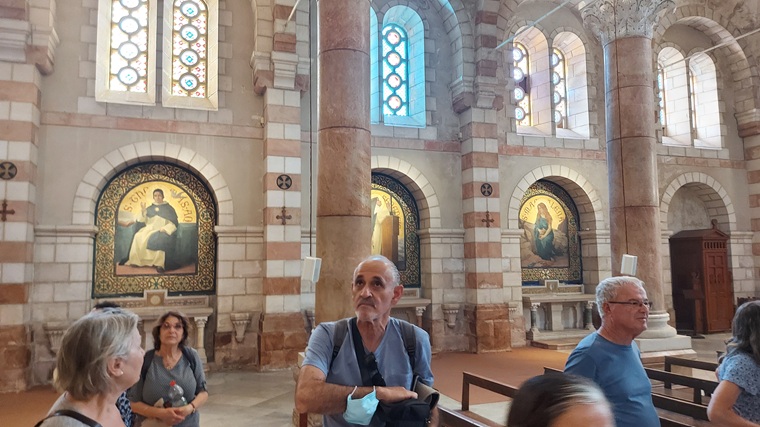
In 1878, Lavigerie and the White Fathers received the St. Anne complex in Jerusalem, which included a Crusader church built by Melisenda and the Bethesda Pools. In 1882, he opened a seminary there for Greek Catholics (Melkites). The architect Charles Mauss, who was a member of the Freemasons, was chosen to renovate the church and build the complex. He later renovated the Crusader church in Abu Ghosh as well. Both structures have special proportions that result in exceptional acoustics.
Lavigerie wanted to become the Patriarch of Jerusalem after Valerga’s death, but this did not happen. He returned to France and engaged in church and public affairs. Throughout his life, he fought against slavery and the slave trade. He undertook diplomatic missions for the Pope and the French government and became one of the most prominent clerics in France and Europe, gaining widespread public recognition, and his opinion carried weight. He died in 1892 and was buried in Tunis.
The Order of the White Fathers has around 1,500 members today, working mainly across Africa. In Jerusalem, there are over 20 monks who operate a seminary for missionaries in Africa. In other words, the dream of an original North African Christianity is still alive and exists in Jerusalem.
The White Fathers – St. Anne
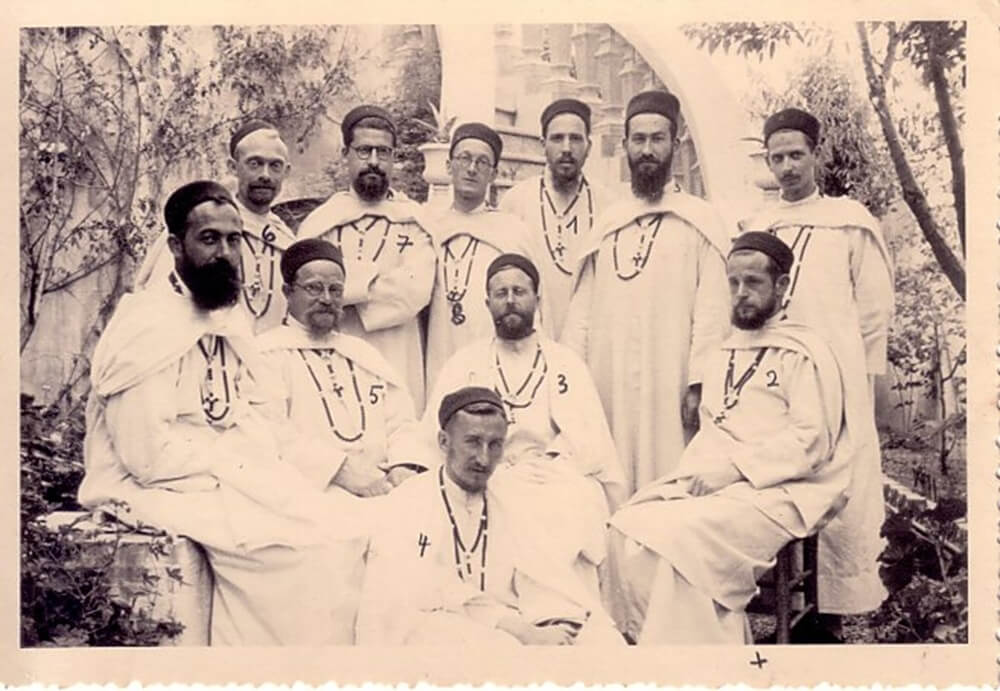
One of the most beautiful and unique complexes in Jerusalem is the St. Anne complex near the Lions’ Gate. Several arches in the building facing the street open into a surprising plaza, with wide and inviting stone surfaces and flower beds, in the middle of which stands the statue of Charles Lavigerie, founder of the White Fathers Order, which is in charge of the place. Around the wide courtyard is an array of buildings. Further on is the Crusader Church of St. Anne and the Bethesda Pools, with open fields and a small archaeological park around them. The location is close to the northern—and most convenient—entrance gates to the Temple Mount Plaza, the site of the Jewish Temple.
According to Christian tradition, Mary was born and grew up in this place, and the complex is therefore named after her mother, Anne. The Protoevangelium of James tells the story of her miraculous birth and her dedication to the Temple, which was just around the corner.
The Crusader Church of St. Anne is one of the most beautiful and well-preserved in the Holy Land, and it is one of three churches built by Melisende, the Armenian Queen of Jerusalem (the other two are the Tomb of Mary in the nearby Valley of Josaphat and St. James Church in the Armenian Quarter). It serves as a starting point for processions on the Day of the Assumption of Mary (August 15), from her birthplace to her burial place in the nearby Valley of Josaphat.
The church has special acoustics that enhance singing and public prayers, and some claim that the acoustics attest to the energetic properties of the space that affect those who enter it, and that the source of this tradition lies in Armenian sacred architecture, from which the Crusaders drew inspiration (Melisende was the daughter of an Armenian princess).
Mary’s presumed birthplace is in the crypt (similar to the Church of the Nativity) beneath the central altar. Mary grew up in this house until the age of three, after which she was given to the Temple to be raised there in holiness. However, it can be assumed that even when she lived in the nearby Temple, she returned to visit her parents’ home, if only because of the commandment to honor one’s father and mother.
As in other cases, the Greek Orthodox offer an alternative location for her home and birthplace in the underground spaces of a nearby house, closer to Lions’ Gate.
After the fall of the Crusaders, the church was confiscated by Saladin, given to Muslim dervishes, and eventually became a madrasa. In the middle of the 19th century, during the Crimean War, it was returned to the French government as the representative of Catholic Christians by the Ottoman Sultan, who entrusted it to Charles Lavigerie and the White Fathers.
Near the ancient Crusader church are the two huge ancient water pools that were exposed during archaeological excavations and served as water reservoirs already in the Second Temple era. They were known as the Pools of Bethesda. Sick and disabled people who could not enter the sacred area of the Temple Mount were left there. According to the New Testament, an angel occasionally appeared in the pool, and the first person to jump in was healed of his ailments. Jesus arrived at the site and healed a man who had tried for years to enter the pool but failed because he was disabled and always found himself last in line. Jesus told him: “Get up! Pick up your mat and walk.” Immediately he was cured and walked (John 5:9). Therefore, this place became a Christian holy site, and Byzantine and Crusader churches were built above the waters of the pools. Remnants of these can still be seen, and one can walk around the pools. Near the pools, a temple to the Greek god of medicine, Asclepius, was discovered, along with other antiquities (see chapter on Asclepius in the first book).
The St. Anne complex contains buildings used as residences for the fathers, monks, and others, as well as a seminary for priests. The curriculum includes, among other things, a 30-day retreat according to the method of Ignatius of Loyola (see chapter).
Aurélie de Bossi and the Our Father
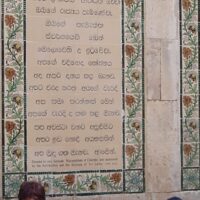
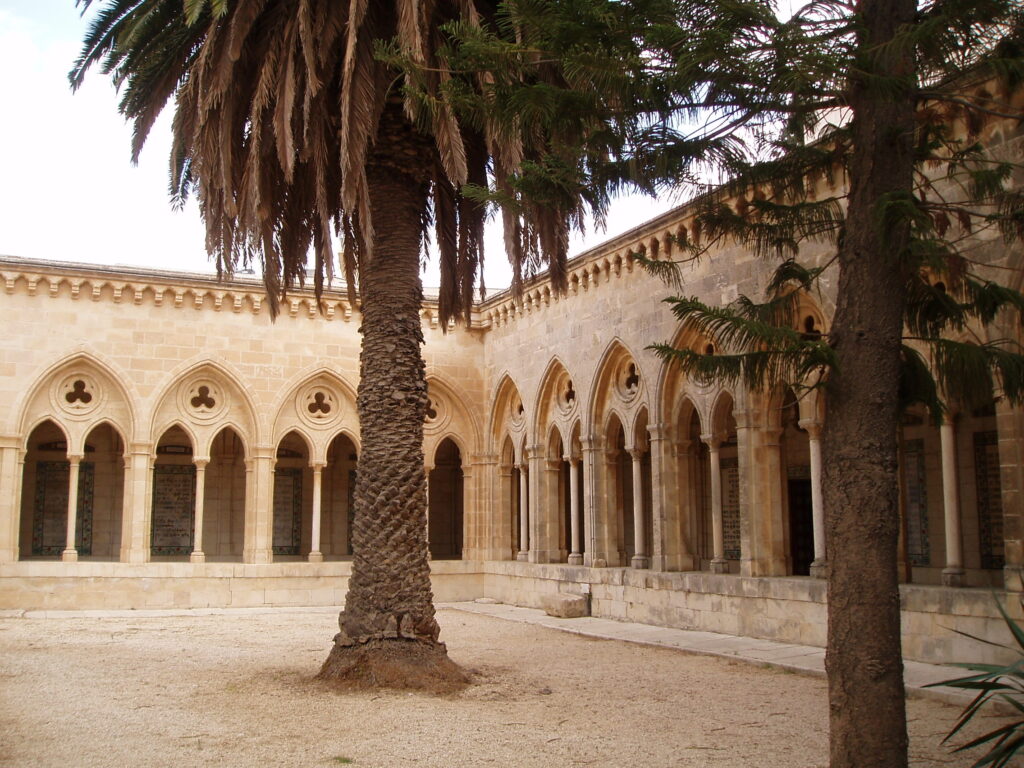
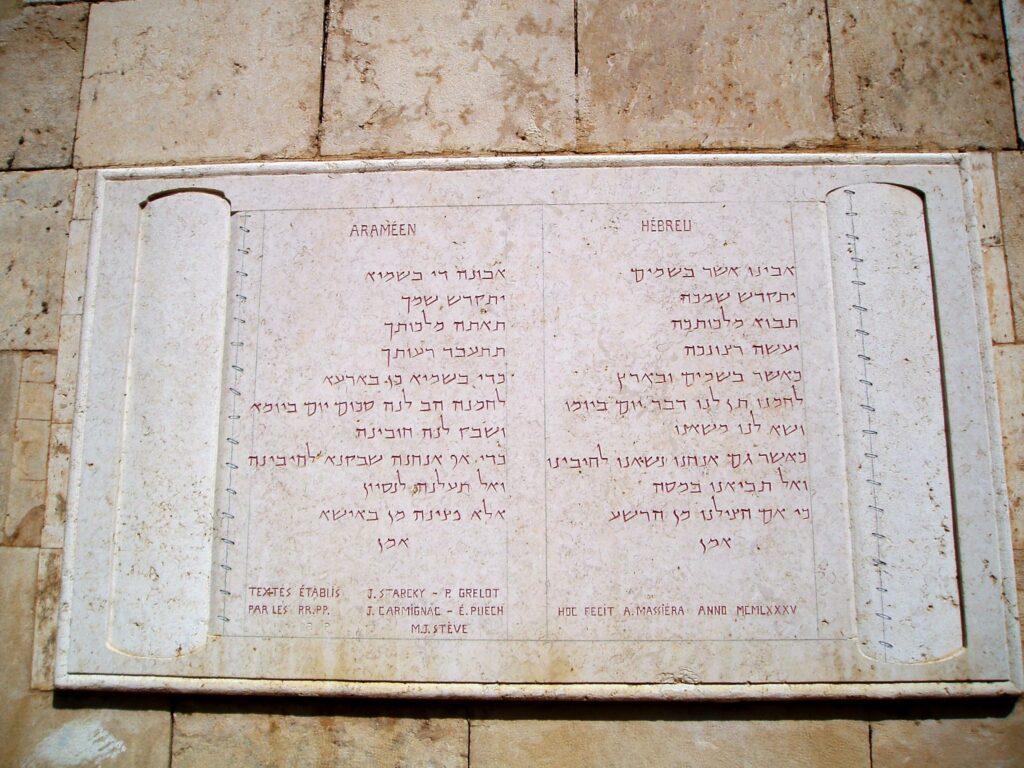
Aurélie de Bossi (1809–1889) was a French princess of Italian descent who helped establish the Carmelite Order on the Mount of Olives. She acquired the site of Pater Noster in 1872 and began construction of a monastery there in 1875, residing in a nearby wooden hut. Aurélie translated the Lord’s Prayer (“Our Father”) into 39 languages during her lifetime, and today the prayer appears in over 140 languages on the monastery walls. After her death in 1889, she requested to be buried in a special tomb she had prepared at the monastery. This request was fulfilled, and her tomb was placed at the entrance to the church. Her heart is located above the grave marker in an elevated stone sarcophagus.
Aurélie followed the path of Teresa of Ávila, the great 16th-century Spanish saint who founded the Order of the Discalced Carmelites. Teresa understood the Lord’s Prayer to be the essence of Christian faith and offered a profound interpretation of the meaning of its words. It is worth mentioning in this context that other Christian groups—including heretical currents such as the Gnostics—also attached special importance to this prayer. Some scholars believe that the prayer originated with the Essenes, or perhaps even earlier. The reason is that in the prayer, the supplicant asks not to be led into temptation, whereas the entire biblical concept is precisely that God leads a person into temptation: Abraham was led into temptation, as were Moses and Job. The Essenes, unlike the rest of Judaism, believed in predestination, and therefore prayed in this manner—“lead us not into temptation.”
In any case, here is Teresa of Ávila’s interpretation of the first two sentences of the “Our Father” prayer, with my additions in parentheses. I recommend reading Teresa of Ávila’s full interpretation of the rest of the prayer, as it appears in Yotam Reuveni’s translation of her book The Way of Perfection: Our Father – Oh my God, how do You reveal Yourself as the Father of such a Son, while Your Son reveals Himself as the Son of such a Father. Blessed be Your name forever. Should such grace, my God, not come only at the end of the prayer? Yet already at the beginning, You fill our hands and grant us such great grace that it would be wonderful if our understanding were filled with it, so that the will would be engaged and we could not say a single additional word. (The word “Our Father” already implies an assumption that Jesus sacrifices Himself for us and compels the Father to accept us as sons as well. We are partners with Jesus in being sons of such a wonderful Father.)
Who art in heaven – In the place where God is, that is where heaven is. From this, you must understand that everywhere His Majesty is there is glory. Remember that Saint Remigius tells us that he sought God in many places and eventually found Him within himself. Do you consider it a trivial matter that a soul, which is usually incapable of any concentration, should understand this truth and discover that in order to speak to her Eternal Father and enjoy Him, she does not need to ascend to heaven or speak loudly, because even if we speak very quietly, He will hear us. We do not need wings to go out and seek Him. We only need a place where we can be alone and contemplate Him who is present within us… (As strange as it may sound, the intention of “in heaven” is “within us.” Within us are heavenly worlds that can be connected to through meditation, contemplation, and silence).
We see that even in these two simple words, there is a dive into the PaRDeS (Jewish mystical exegesis), into the mystical world, and this occurs in two stages: first, a personal relationship with God is established through the word “Our Father,” and then there is a direction toward inner worlds found within us, through the word “heaven.” There are thousands of other interpretations of this prayer, but I believe the example I provided illustrates and emphasizes the fact that the Christian religion is not as simple as it seems, but that throughout the generations, thinking people have interpreted it deeply and given the Christian story a mystical layer of meaning, leading to unification with God.
Ultimately, the watershed between Christian mysticism and the religion of the masses—the ordinary religion—is the choice of whether to adopt the axiom “I believe because it is absurd,” as Tertullian the early Church Father said, or the approach that there is a possibility for man to climb up the spiritual ladder, to be filled with divine light, to draw near to God, and to become the likeness of Jesus, the nature of Jesus. In order to do so, one needs to revive the Christian story—the Christian drama—within himself.
The watershed of Christianity, for me, is between institutional Christianity—whether Catholic or Orthodox—which emphasizes blind obedience and blind faith (and note that I use the word “blind,” because obedience and faith in themselves are not bad), and the conception of the human being as a sinful creature saved only by grace; and, on the other hand, mystical Christianity, which relates to humans as possessing a divine part (a spark) within them, waiting to be ignited and revealed. In this view, one can ascend the steps of the spiritual ladder and discover the nature of Jesus within oneself, becoming filled with divine light and wisdom.
The contemplative nuns in the Church of the Our Father show the way to connect with God within themselves, following the example of Teresa of Ávila. The interpretation of the Lord’s Prayer is not philosophical but touches upon very deep spiritual and emotional layers, and thus the prayer becomes a means of meditation and an object of contemplation, a tool for connecting with the emanations of God (see chapter on Teresa of Ávila and the Carmelite Order).
Count de Piellat
Comte de Piellat (1852–1925) was born to a wealthy family in southern France, a sickly but talented child who received a broad education. As a young man, he was interested in many fields, drawn to religion, and searched for himself and his life’s purpose. When he did not find a clear direction, he decided at the age of 23 to embark on a pilgrimage to the Holy Land to receive answers and discover his destiny [1]. He fully believed that after the pilgrimage he would know what to do with his life—and so it was.
De Piellat set out alone in 1874, arrived in Jerusalem, and met various figures here, including Alphonse Ratisbonne, who greatly influenced him, and the new Catholic Patriarch, Vincent Bracco (1873–1889), who also influenced him. During the visit, he realized that his destiny was to dedicate his life to establishing French Catholic presence and institutions in the Holy Land. From then on, he came here many times—the second time in 1876 with his mother. He is buried in the Church of St. Peter in Gallicantu in Jerusalem, one of the institutions he helped establish.
De Piellat collaborated with the Sisters of St. Joseph, who had recently begun operating in the city. He founded the St. Louis Hospital as a hospital for pilgrims, on the site of Tancred’s Tower, in 1881, dedicating the ground floor to the Crusaders. De Piellat himself painted the chapel and the walls of the first floor with Crusader symbols and figures. He organized the Pilgrimage of the Thousand to Jerusalem in 1882 together with the Assumptionist Fathers—a pilgrimage dedicated to the approaching Third Millennium—which led to the establishment of the Notre Dame Complex. The pilgrimage marked a turning point in the European Catholic presence in the city.
From that time onward, De Piellat spent most of his time in the rapidly growing Jerusalem. He collaborated with the Sisters of St. Joseph, Alphonse Ratisbonne, and the Dominican Fathers in establishing the St. Étienne church and complex; with the Assumptionist Fathers in establishing the St. Peter in Gallicantu church and complex; and with other French orders. He lived in a small house on the Mount of Olives near the future Dominus Flevit Church, was privileged to witness the renewed Christian rule of Jerusalem (after World War I), and died in 1925, being buried in the St. Peter in Gallicantu church.

Notre Dame Building
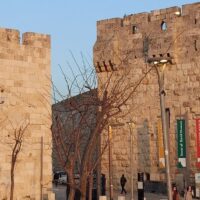
On the site where the Pilgrimage of the Thousand camp had been located, Count de Piellat helped build one of the largest French complexes in Jerusalem—the Notre Dame Hospice, a building with 300 rooms intended to accommodate pilgrims. Following the completion of the building in 1885, the French received permission from the Ottomans to open an additional gate in the Old City wall—the New Gate—which enabled movement between their complexes, the Christian Quarter, and the Church of the Holy Sepulchre.
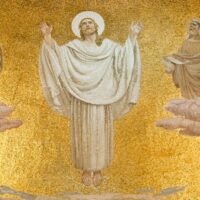
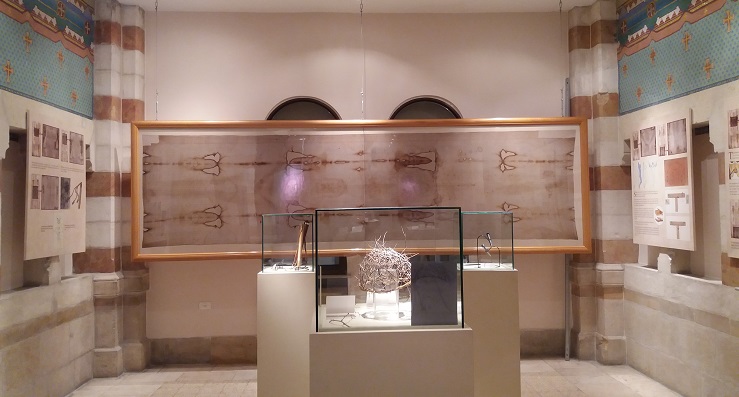
In the center of the building is a church dedicated to Our Lady of Jerusalem. The southern wing houses a museum recounting the history and essence of the Shroud of Turin. Today, a new hall has been added with frescoes and art portraying the descent of the Holy Spirit upon the disciples at Pentecost.
The building incorporates Renaissance elements in its order, rhythm, and centrality, as does the nearby St. Louis Hospital (although they feature other architectural styles as well). The entrance road resembles a famous staircase in Rome called the Spanish Steps.
The word Renaissance means “Rebirth.” It expresses the aspiration of the people of the 15th-century era to return to the values and knowledge of the Classical world, which they perceived as ideal. These values placed man at the center, especially his ability to think, which, according to them, expressed one of the first complete appearances of the Logos—the Divine Intellect—and therefore was relevant even in a Christian context.
The Renaissance world sought to return to the classical concepts that “Man is the measure of all things” and “Everything in measure,” which were the mottoes of Greek and Roman cultures. The people of the Renaissance were religious, but not in the sense of submission to God, as in the Romanesque period, or aspiration toward God, as in the Gothic, but in the sense of finding God’s perfection in man—his proportions, his virtues, and especially in the way his intellect operates. The order and centralization of Renaissance buildings are an expression of this perception.
The Shroud of Turin
The Shroud of Turin is one of history’s great mysteries. When Jesus was buried, his body was wrapped in a winding sheet, as was the custom of the Jews. After three days, when he resurrected, the tomb was found empty, and only the winding sheet remained, upon which his image was scorched (like a photographic negative). The cloth eventually reached Turin, Italy, and is therefore called the “Shroud of Turin.” Its importance lies in the fact that it allows us to discover the true image of Jesus: what he looked like, and what happened to him during the crucifixion and the Passion.
The sacred relic made its way from the Middle East to Europe (France) and eventually found a home in Turin in the 16th century. It can be seen in the city’s cathedral once a year, on Easter. Some claim the shroud is a medieval forgery, while others claim it is authentic. It must be remembered that the industry of sacred relics was, and still is, an important component of the Catholic Church. Many sacred relics related to Jesus are found in Italy—starting with his foreskin (the only part that remained of his physical body, as a Jew he was circumcised), continuing with his blood, the crown of thorns, the cloth with which he wiped his face, and finally, the shroud in which he was buried.
Scientific tests found pollen grains of plants blooming in Israel during the spring on the shroud, which is presented as proof of the shroud’s authenticity. However, carbon-dating tests show the cloth is a thousand years old. If indeed the shroud is a forgery, how did the producers know about the pollen, and what is more intriguing is that Jesus’ image is present as a negative.
We know that after death Jesus became a spiritual, non-physical figure, and thus he appeared before the disciples (which is why he tells Mary Magdalene not to touch him). The proof of this is that the image on the shroud appears like a photographic negative and not as a physical impression. If it is indeed a forgery from a thousand years ago, as some scientists claim, how did medieval people know about negatives?
If the shroud is authentic, the image imprinted on it offers a possible clue to the explanation of Jesus’ resurrection. According to esoteric Eastern doctrines, a person who reaches enlightenment can undergo a process called Kundalini, in which the seven chakras (energy centers) open. In extreme cases, this can manifest as Spontaneous Human Combustion, in which the body disappears (therefore the body was not found in the tomb). When such a process occurs, it is expressed in a great release of energy, the disappearance of physical matter, and a flash of light. It is possible that this is what happened to Jesus and left its imprint on the shroud.
According to the image on the shroud, Jesus appears to have an Eastern-Indian look of an enlightened teacher, rather than the blond European appearance he usually has in church paintings. It is interesting to note that in ancient images of Jesus from the Sinai Monastery and other places in the Orthodox world, he resembles the figure that appears on the shroud. According to the shroud, Jesus was a very physically strong person, able to endure many lashes on all parts of his body. The cloth reveals what the crown of thorns was made of, which nails the Romans used, how Jesus was crucified, and how he died. All the details that appear on it are consistent with the Roman period (another support for the claim that the shroud is authentic). A coin can also be seen in a certain way over Jesus’ eye—a common custom in the burial practices of that time, payment to Charon, the ferryman on the River Styx who leads souls to the land of the dead.
The exhibit in the Notre Dame rooms is wonderful. It shows the vicissitudes of the Shroud of Turin, presents the different theories about it, and even includes a holographic image of Jesus based on the cloth, as well as a statue of him.
St. Étienne Monastery (Saint Stephen)
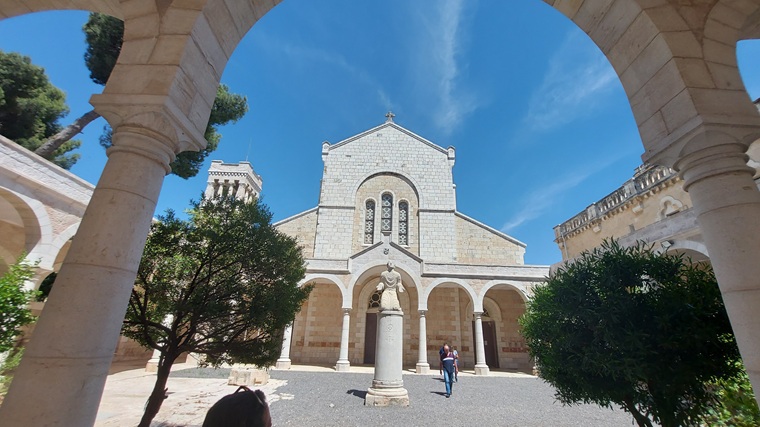
North of the walls of Jerusalem, on the border of eastern Jerusalem, there is a cluster of new churches and Christian religious institutions. This was one of the most popular areas for settlement and for establishing Christian institutions beginning in the Byzantine era and then again from the end of the 19th century. Various Christian religious traditions are linked to the area, including the stoning of St. Stephen—the first Christian martyr. Thus, as early as the 5th century, a monastery was built on the site in his honor by Empress Eudocia and Bishop Juvenal (see chapter in the first book), but it was destroyed in the Persian invasion in the 7th century CE. The complex was rebuilt during the Crusader period and destroyed by Saladin.
In the late 19th century, the land was purchased by Father Ratisbonne (see chapter). In collaboration with Count de Piellat and the Sisters of St. Joseph, a beautiful church and courtyard, monastery, study center, and a house for the French Dominican Order were built on the site, as part of strengthening the French presence in the city. The building project included archaeological excavations in which important findings from the First and Second Temple periods were discovered, including royal tombs (see chapter).
The French Biblical and Archaeological School (“École Biblique”) was established inside the complex in 1890, headed by Father Marie-Joseph Lagrange (and active to this day), and the monastery church was inaugurated in 1900..
Father Marie-Joseph Lagrange was one of the great scholars of Jerusalem, active in the years 1889–1935. He knew Arabic and Hebrew, deciphered the Ugaritic script, led excavations, wrote books, and engaged in biblical and New Testament exegesis [2]. He was the first president of the Palestine Oriental Society, founded in 1920. He is the man who headed the École Biblique, advanced its activities, and is buried in the apse of the St. Étienne Church.
The church building itself is an architectural blend of East and West—Romanesque, Gothic, and Andalusian styles—a large and impressive structure with a beautiful atrium courtyard in front of it, at the center of which stands a statue of Saint Stephen, who was stoned to death there. Beneath the courtyard, underground burial systems were discovered, some dating back to the First Temple period, and some say the Ark of the Covenant was hidden in them.
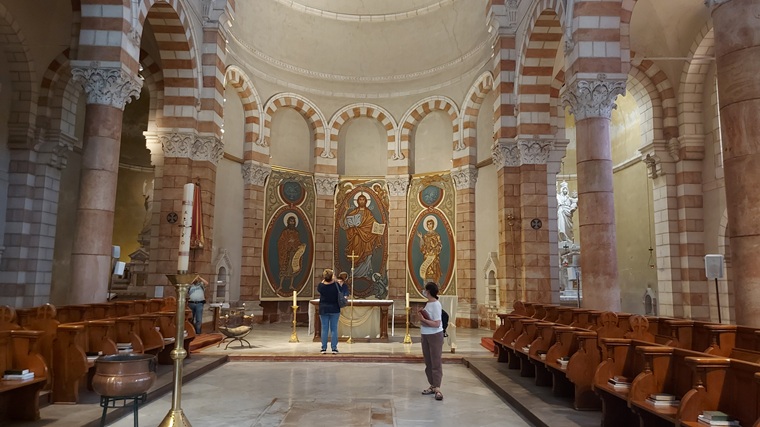
On the church walls, one can see the great Dominican theologians, including the most important thinker and philosopher of the Middle Ages—Thomas Aquinas. In the southern apse, one can see Saint Dominic, the founder of the Dominican Order, receiving the Rosary from Mary as a tool for prayer and meditation, to be used in his struggle against the Cathars.
The Dominican Order
Saint Dominic (1170–1221) was born in Caleruega, Northern Spain. His barren mother went on a pilgrimage to the Silos Monastery, where she prayed for a child. She was given a dream in which a dog jumped out of her womb with a torch in its mouth, and the fire from the torch spread all over the world. Consequently, she bore a child and named him Dominicus, meaning “Dog of God” (Domini Canis).
At that time, medieval Europe reached its zenith. The Late Middle Ages were characterized by population growth and the creation and expansion of a middle class in the developing cities. Dominic saw the need for a new order with a flexible organizational structure that would be suitable for the new social reality. The monasteries of the Early Middle Ages were no longer suitable for the needs of the time, especially in light of the spread of education and the rise of heretical movements like the Cathars in Southern France.
The young Dominic received an extensive education, but when a drought struck Spain in 1191, he sold all his possessions, including his clothes and books, to feed the poor. He told his classmates: “Would you study from dead skins while people are dying of hunger?” In 1194, he became a monk. In 1204, he traveled in Southern France, where he met the followers of the Cathar “heresy” and had to confront their arguments.
In 1206, he founded a small monastic community in a Southern French village called Prouille for several noblewomen who had abandoned the Cathar faith and returned to Catholicism under his influence. He wrote a rule for them and turned the place into a center for preaching the Catholic faith. Some say that it was at this location that he received the secret of the Rosary from Mary, and that it became a powerful spiritual weapon in strengthening the true faith against the heresies.
The Dominican Order, also called the Order of Preachers, adopted the Augustinian Rule and spread very quickly throughout Europe, establishing magnificent educational institutions, some in conjunction with existing universities such as the University of Paris. One of the Order’s goals was to bring the knowledge that existed in Benedictine monasteries to the emerging bourgeois public in Europe at the time. Dominic argued that one cannot preach something one does not understand, and therefore study and education are crucially important. People can only be persuaded to repent by the power of personal example and theological argument.
From its inception, great thinkers appeared among the members of the Order, such as Thomas Aquinas and Albertus Magnus. These two figures reintroduced Aristotelian thought to Christianity and championed the figure of Pseudo-Dionysius the Areopagite, a legendary figure from Athens in the 1st century, under whose name Christian Neoplatonic writings were published in the 5th–6th centuries CE. Later, great mystics appeared in the ranks of the Order, such as Meister Eckhart, as well as women saints like Catherine of Siena.
The color of the Dominican Order’s habit is black, while the color of the Franciscan habit is gray or brown, and that of the Carmelite habit is white. These three monastic orders were founded around the time when the use of colors in liturgy and heraldry was introduced into Christianity. Their choice of color has meaning and stems from the association of different colors with different energies and influences (see chapter on heraldry).
Charles de Foucauld
Charles de Foucauld (1858–1916) was a wild young man, a military officer, and an explorer whose early life was characterized by cynicism, a life of “sin,” and ego. At some point, he began discovery journeys in North Africa, Morocco, and Algeria, some with a Moroccan Jewish guide. Foucauld learned Arabic and Hebrew, traveled in a Jewish disguise (Christians were forbidden to enter these countries), was impressed by Muslim religious devotion and by the beauty of nature in the Maghreb. The journeys refined his spirit, moved him away from a life of debauchery, and led him to begin seeking answers in religion.
In 1888, after turning 30, Charles de Foucauld came to Jerusalem at the encouragement of his confessor and spiritual director, Abbé Huvelin, to find an answer to the questions of his life and to discern whether he was destined to be a Christian monk or not. He was in Jerusalem during Christmas and received answers through revelations and dreams. When he returned to France after four months, he asked to be accepted into the Trappist Order, and so it was. Foucauld wanted to imitate the humble worker Jesus, not the public figure. He wished to focus on the inner life, greatly influenced by the writings of Teresa of Ávila.
After becoming a monk in France, he was transferred to a monastery in Syria and became known for his devotion and ascetic life. He debated whether to become a priest and decided to relinquish his monastic vows and leave the Order in order to do so and fulfill what he sensed was his calling. In 1897, after his request was granted, he returned to Israel as a simple man and worked as a gardener at the Poor Clares Monastery in Nazareth, where he was also known for his modesty and devotion. During his three years in the Holy Land, he wrote his meditations in a book called Spiritual Writings [3], which includes prayers and reflections—more than 3,000 pages of mystical work, the most important part of which is a prayer called the Prayer of Abandonment, in which Foucauld, out of love, entrusts himself into God’s hands. This was the most fertile period of his life. At the end of this period, he was asked by the head of the Poor Clares Order in Jerusalem and by his confessor to become a priest. He planned to be ordained by the Patriarch of Jerusalem, but this did not materialize, and he returned to France to be ordained there. In Jerusalem, he chose the name Charles.
Foucauld wanted to become a priest out of a desire to imitate Jesus in His giving. If until then he had enjoyed solitude and moments of connection, he understood that this had no value if he did not pass it on to other human beings. One must shout the Gospel not with words but with deeds, and reach precisely those who need it most. Love is imitation—and in this case, the imitation of Jesus, who shepherds His people and turns to the lost sheep. This was the meaning of being a priest for him. However, it begins with imitating the humble and hidden Jesus between the ages of 13 and 30, who provided for His own needs.
After becoming a priest, he began his ministry in North Africa, establishing contact with the White Fathers. In 1902, he freed a slave and named him Joseph of the Sacred Heart. In 1905, he wrote Meditations on the Holy Gospels. He lived among the Tuareg in the harshest conditions of the Sahara, working for his living, praying, and studying. He deciphered their language, studied them, and brought this knowledge to the West. Concurrently, he helped heal and perform acts of kindness for the weakest among them, established contact with the local ruler, and became known as a man of virtue. When he fell ill in 1908, during a time of famine in the land, and it seemed his end was near, the Tuareg sacrificed a sheep for him, leading to his recovery and a second conversion. From then on, he no longer sought to convert the Tuareg and turn them into Christians, but only to love them.
In 1909, he returned to France, met Louis Massignon—who would later continue his path by founding the Badaliya organization (see chapter)—and wrote a Rule for a new organization, the Union of the Brothers and Sisters of the Sacred Heart, a fraternity of simple people (not monks) that promotes the love of Jesus in the world. He returned to the Sahara and discovered the high mountain region of Assekrem, where he established a place of solitude—on the roof of the world, far from everything. Precisely because of its isolation and unique location, he was spiritually connected to the entire world, exerting his influence from there.
Foucauld’s companion in solitude was the Eucharist—the bread and wine of Jesus that radiated his presence in a mysterious, almost magical way—and prayer, especially the Prayer of Abandonment. Foucauld saw all human beings as brothers, argued that one must be responsible for one another, and believed that a Muslim could also reach heaven. The Union of the Brothers and Sisters continues his work today and numbers around a thousand people who draw inspiration from Foucauld’s extraordinary story. In addition, about twenty other organizations—comprising tens of thousands of people—continue his unique spiritual path, including the Little Sisters of Jesus, who have a presence in the Old City.
The Little Sisters of Jesus have a monastery on the Via Dolorosa near the Fifth Station of Veronica, as well as an icon-production workshop. They mingle with the local population and spread joy—a ray of light amid the surrounding darkness. In 2021, Foucauld was canonized as a saint by Pope Francis. The first words of his Prayer of Abandonment are:
“My Father, I abandon myself to you.
Do with me what you will.
Whatever you do with me, I thank you for it.
I am ready for everything, I accept everything,
Provided that your will is done in me and in all your creatures.
I desire nothing else, my God.” [4]

Footnotes:
[1] Shilony, Z. (1994). The deeds of the French Baron de Piellat in the Holy Land (1884–1925). Cathedra: For the History of the Land of Israel and its Settlement, 63–90. (Hebrew)
[2] Lagrange, M. J. (1906). Historical criticism and the Old Testament. Catholic Truth Society.
[3] de Foucauld, C. (1999). Writings selected: With introduction (R. Ellsberg, Ed.). Orbis Books.
[4] Ibid. (Translated quote).