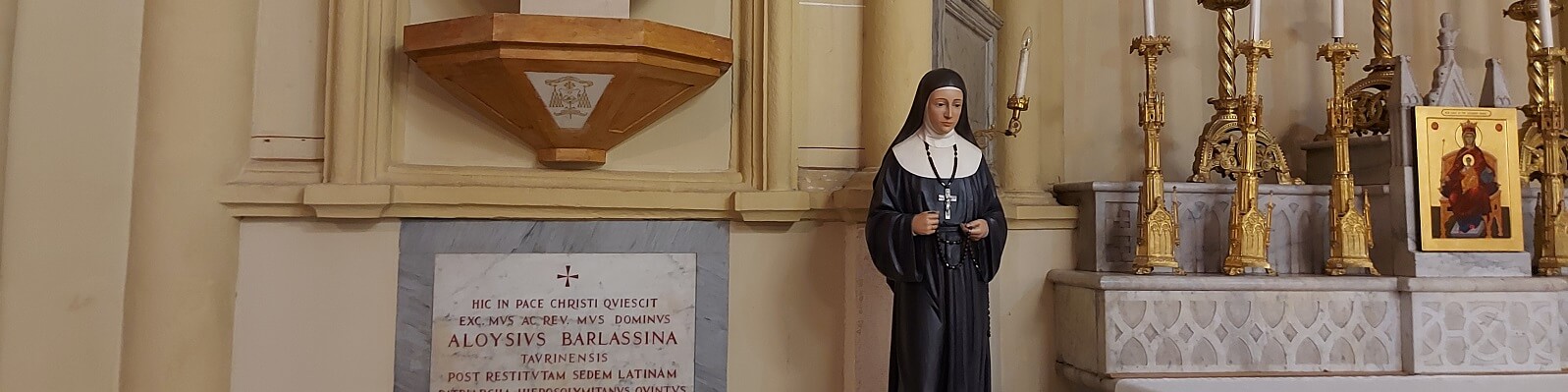
Marian Apparitions in Israel
Starting from the 13th century, Mary began to intervene in world events through apparitions to individuals and later to groups, during which she sought to protect Christianity, guide it toward the true religion, answer the pressing questions of the time, and offer comfort and encouragement. Mary had served as a mediator and guide long before this, even during Jesus’ lifetime, but from the 13th century onward she began to intervene in political and historical events and was not afraid to “get her hands dirty” in guiding humanity toward the right path, bringing ever new messages of love and hope.
For this reason, Mary became the protector and patroness of various countries. She appears in the guise of local women and speaks the local language, addressing the cultural and psychological needs of different peoples and strengthening national pride and religious identity. Thus, every nation developed its own image of Mary. Nevertheless, it seems that a special place was kept in Mary’s heart for the land where she was born. Therefore, she appeared several times to various people in the Land of Israel, especially with the renewed awakening of the 19th century and the return of the Catholic presence. Mary seeks to influence events and bring hope and love, fraternity, and peace among all the diverse groups and religions living here.
In 1842, Mary appeared before Alphonse Ratisbonne in Paris, which led him to move to Israel and dedicate his life to serving the people, and especially the children, of the Holy Land with Mary’s blessing and guidance. He founded the Sisters of Zion order, built institutions for orphans in Jerusalem, and helped establish various Christian institutions and churches.
In 1846, the year of Mary’s apparition in La Salette in the French Alps, a girl named Mariam Baouardy was born in Israel. Twelve years later, in 1858—the year of Mary’s apparition in Lourdes—Mary appeared before her in Alexandria and saved her from death while she lay bleeding and abandoned in one of the city’s alleyways. Mariam Baouardy continued to receive guidance and Marian apparitions for twenty years, until her death. She would later bring the Carmelite Order founded by Teresa of Ávila back to Israel.
In 1874, an Arab girl named Marie Alphonsine Danil Ghattas from Jerusalem began experiencing Mary’s apparitions, which lasted for 53 years. The apparitions occurred first in Bethlehem, where Mary famously gave birth to Jesus, and then in Jerusalem and in Ein Karem. They led her to found the Sisters of the Rosary order, the first order of its kind for native-born Arab women, intended to serve the local population.
What Mary attempted to do through her apparitions during the 19th and 20th centuries, in my understanding, was to inspire some people to take responsibility for the children of Israel. First, through her apparition before Alphonse Ratisbonne; then through apparitions to Mariam Baouardy; and finally through apparitions to Marie Alphonsine. In this way, with Mary’s encouragement, Catholic Christianity strengthened and took hold.
In 1917, the Holy Land was taken by Christians (the British) for the first time in 600 years. Mary’s activity in Israel intensified, including through apparitions. In 1919, a young Italian named Barluzzi became responsible on behalf of the Vatican for building churches in Israel. He continued in this role until 1958, received inspiration and perhaps even apparitions from Mary, and built the beautiful and impressive churches in the country, many of which feature Marian doctrines.
In 1927, the Catholic Patriarch Barlassina declared Mary “Our Lady of Palestine” and established the feast day in her honor. Churches dedicated to Our Lady of Palestine were erected in various places in the country (such as in Deir Rafat near Beit Shemesh). Processions in Mary’s honor took place in various cities, especially Haifa. Mary wished to bring harmony between the three religions and the two peoples in the land where she was born, but this did not succeed, and in 1947 the War of Independence broke out, and the bloody conflict between Arabs and Jews deepened. But Mary did not despair.
In 1954, she appeared several times before hundreds of people in the Coptic Compound of St. Anthony near the Church of the Holy Sepulchre in the Old City. She came to establish peace between Jews and Arabs and to restore order to the world after the catastrophe experienced by Arab Christians in the War of Independence. When this, too, proved insufficient, she appeared again in 1983 before many people, in an apparition that has not yet been authenticated by the Vatican, in Beit Sahour in the West Bank, four years before the outbreak of the First Intifada.
It is possible that Mary is trying to convey a message to us even today, and perhaps she is appearing at this very moment before a boy or girl somewhere in the country. However, due to the noisy culture in which we live, it is difficult to believe that anyone could pay attention to such an apparition today. The news of the apparition would likely be swallowed up in the general noise and sensory overload to which we are all subjected, as well as within the spiritual and ideological supermarket where everything is supposedly possible, but in fact, nothing truly happens.
If Mary wishes to convey a message to humanity today, she will need to find other ways (and I do not mean WhatsApp messages or Instagram, as that would be belittling to her). It may even be that miracles are not the right approach for this time, but I am sure that she will find her way to the hearts of the faithful, as she has done in the past. Everyone carries within them an archetype of the Great Mother who cares for them, and in this regard, nothing has changed.
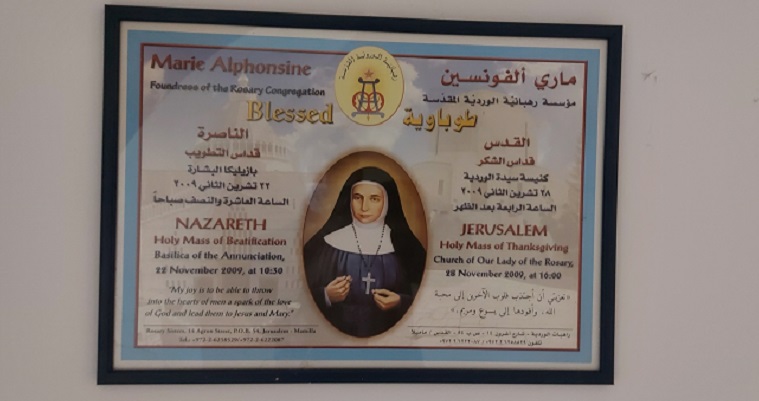
Saint Marie Alphonsine
In 2015, Pope Francis recognized two Palestinian women as saints. This was the first time that Arab Christian women were recognized as saints. Both experienced apparitions of Mary. At the canonization ceremony, the Pope said that each of the canonized women (there were four in total) had a secret, which was the fulfillment of Jesus’ commandment: remain with me, dwell in my love. He stated that they remained connected to Him throughout their lives like grapevines, bearing much fruit; they gave the fruits of love.
In 1847, after an absence of over 660 years, the Catholic Church returned to Jerusalem and built the Latin Patriarchate in the Christian Quarter—an impressive stone complex with a neo-Gothic cathedral, a palace for the Patriarch, a residence for monks, and administrative and hospitality facilities. Adjacent to the compound is a small, little-known house where one of the most significant events of that period took place: the apparitions of Mary to a local girl named Marie Alphonsine Ghattas.
Marie Alphonsine experienced Mary’s apparitions for thirty years, which led to the founding of the Sisters of the Rosary order in Israel. Throughout this time, the apparitions were kept secret and were known only to three people: her two spiritual mentors—Fathers Belloni and Tannus—and the Patriarch of Jerusalem. Marie lived as a simple nun in the order founded as a result of her apparitions, and even her sister, who was the head of the order, did not know what had led the Patriarch to establish it.
The house in the Christian Quarter of Jerusalem belonged to a carpenter’s family from Bethlehem (the Ghattas family). The family also had a summer house in Ein Karem, where they spent holidays and vacations. Marie was born in 1843, on the day of St. Francis of Assisi, and there are parallels between the two of them. Four years after her birth, the Catholic Patriarchate was established in 1847. The first Patriarch was a monk named Valerga. This was a festive moment, but it was clear that Catholicism would not take root in the local population until there were local clergy and nuns. To make this happen, an educational system needed to be developed. For this purpose, nuns from the Sisters of St. Joseph of the Apparition order were invited to Israel. They opened a girls’ school in 1848 near the Patriarchate.
Marie Alphonsine was one of the first students in the new Catholic institutions. As such, she nurtured the ideal of monastic life in her heart, which the Sisters of St. Joseph, led by Mother Émilie Julian, taught. They encouraged the students to become nuns and dedicate themselves to religious life.
Marie was likely a distinguished student, as she received the Sacrament of Confirmation from the Patriarch himself at the age of 12. At age 17, she requested to be admitted to the convent, but her father conditioned his consent on her not leaving the Land of Israel. All other candidates until Marie’s time had to travel to a seminary in France for their period of novitiate. However, in her case, an exceptional permit was granted to ordain her as a nun without a seminary period. She received her training privately in Jerusalem and was ordained at the Golgotha site in the Church of the Holy Sepulchre (which became her preferred place of visit thereafter).
She was given the name Marie Alphonsine, probably after Marie Alphonse Ratisbonne. Her first role as a nun was to teach Christian catechism in the Sisters’ school in Jerusalem. She succeeded in influencing many Arab girls to pursue the monastic path, resulting in the creation of the Confraternity of the Immaculate Conception (a non-monastic religious organization).
In other words, the renewed Catholic activity in the Land of Israel led to the establishment of educational institutions where Arab Christian girls studied. One of them took on various roles and integrated into the monastic establishment—an example for other locals. A young, enthusiastic, idealistic, and talented girl, a kind of local leader.
In 1862, Marie Alphonsine was transferred to teach at the Sisters of St. Joseph Catholic School in Bethlehem, which was founded in 1854. She lived with four other nuns under simple conditions, working at the school and being very active in the local Christian community. Occasionally, she began experiencing moments of blessing and ecstatic states, mainly during her private Rosary meditation prayers.
Marie Alphonsine’s pure faith and devotion invited Marian apparitions into her life. On January 6, 1874, the feast of the Epiphany (Baptism), at nine in the morning, something difficult to describe in words occurred: Sister Marie Alphonsine was praying and using the Rosary meditation, concentrating on the Fifth Sorrowful Mystery (the death of Jesus on the Cross). She focused on the Mother of Sorrows (Mary) and felt her chest fill with love for her. At that moment, she was surrounded by a beautiful and great light that cannot be described [1]. The Virgin appeared before her, standing within a radiant cloud, her hands outstretched, white and shining with indescribable beauty. On her chest was a cross from which the rosary beads hung, draping down to the right and left in a circular shape, their lower boundary the hem of her dress, where her feet were visible. The rosary beads shone like stars, and in the center of each one appeared an image of the mystery associated with it. Above the Virgin’s head was a crown with fifteen stars. Beneath her feet, set in two clouds, were two parallel rows of seven stars.
“All this appeared before me at the same time. Oh, what a blessed hour it was, what “All this appeared before me at the same time. Oh, what a blessed hour it was, what sweet love filled my heart! It cannot be described. And especially my mother—how beautiful she was. I have never seen a picture that in any way resembles such beauty. The moment my eyes rested upon her, tears full of love flowed from my eyes. I opened my arms and wanted to hug her. She then became more radiant, and it seemed that she moved toward me. I could look at her comfortably; I wanted to approach her, but then I lost all awareness.”
“I do not know what happened to me afterward; all I know is that I remained in that sweet ecstatic state from nine in the morning until one in the afternoon. And then she suddenly disappeared, leaving me in a spiritual tranquility, peace, and comfort that cannot be described, with a strong desire to see her again and a strong willingness of heart to fulfill great tasks and act nobly for her love and for others.”
“Above all, I wanted to practice internal purification of the heart, and I gave my full attention to achieving this important goal” [2].
The apparition occurred at a time when other apparitions of Mary were happening around the world. Sixteen years earlier, Mary had appeared in Lourdes, France, to another young girl, and the site became the most important pilgrimage destination in France—a place of miracles. Marie Alphonsine’s apparition created a new psychological state within her. For four months, she lived in a state of happiness:
“Since the time when the beloved Mother favored me with her visit, it created in me a detachment from all earthly sentiment and from all that is fleeting, and a thirst, as it were, to endure every hardship and pain. Every suffering and bitterness became sweet to me; solitude—a marvelous paradise; discipline—a necessity of my heart and mind. I fulfilled the commandments and directions of my superiors with incredible love and loyalty. My Mother enriched me with an abundance of virtues without any effort or merit on my part. All these favors were the result of her maternal generosity.”
Then, for four months, Mary stopped appearing to Marie Alphonsine, which led to a few weeks of apprehension: perhaps the apparition had not been real? The devil tried to confuse her. But the crisis passed with the help of prayer to God, which led to another apparition of Mary. On May 31, during a Rosary prayer, Mary appeared again, immersed in a transparent light that looked like pure gold, with the Rosary in her hands. Beneath her feet were two rows of seven stars, on which was written in golden letters: The Joys and Sorrows of the Virgin. Above the crown on her head appeared luminous letters reading: The Virgins of the Rosary. This was the first sign of Marie Alphonsine’s mission—to found the Order of the Virgins of the Rosary. The apparition filled her with confidence and faith, happiness and joy, and continued to transform her personality. The Virgin still did not speak to her but allowed her to feel her presence.
The Arab Christian women of that time, most of whom were illiterate, were not socially accepted as learners from men—and especially not from Europeans. It had to be Arab women like them, who did not pose a threat to the social order and spoke their language. Thus, there was a need to establish an order of Arab women who would appeal to Arab women—and so Mary appeared before Marie Alphonsine and guided her in the creation of the Rosary Order.
Seven months passed until the next Feast of the Epiphany. On the eve of the holiday, Marie Alphonsine prayed, filled with the recognition of her shortcomings compared to the beauty and virtues of the Virgin, asking to follow her example in living a pure life. Suddenly, while immersed in such thoughts, she felt as if she were being drawn into the presence of a divine good that was like an ocean without bounds.
A wonderful and beautiful light filled her heart without harming her eyes. In the middle of the light appeared the sweet Mother, holding the Rosary in her hands. Around her halo were figures of young girls, to her right and left, dressed in white and blue like her. Above them was the inscription “The Virgins of the Rosary.” Marie Alphonsine heard Mary’s voice within her, without anything being said, and the voice said: “I want you to start the Rosary Order.”
“She looked at me with a tenderness that filled me with sweetness, and I began to shed many tears. It was as if I were in a heavenly paradise. While I was absorbed in that sweet comfort, she disappeared suddenly, leaving me on earth wounded by her love.”
Mary filled Marie Alphonsine with determination and courage, strength and devotion, to fulfill her mission. She understood the saying: “What is impossible for human beings is possible with the help of God.” It took another year and three more apparitions for Marie Alphonsine’s mission—and the reason for Mary’s appearances in Bethlehem—to become unequivocally clear: Marie Alphonsine was to establish the Rosary Order, in which young girls from the local population would serve.
From this day onward, a dialogue began between Marie Alphonsine and Mary, who continued to appear to her in visions during her prayers. Additionally, she began to experience further mystical phenomena: early in the morning on the Feast of the Epiphany, she went to the Grotto of the Nativity in Bethlehem to assist and participate in Mass. After the consecration, she saw light ascending from the chalice and spreading above the altar and around the priest. The image of the Baptism appeared before her in all its glory, as did the image of the Nativity: The Infant Jesus with Saint Joseph, the three Magi arriving and bringing gifts. And then Jesus being baptized in the Jordan. The images were clear, yet mysterious and filled with indescribable beauty. The vision lasted throughout the ceremony. As a result of it, she was filled with a supernatural strength that enabled her to serve fifteen Masses, one after the other, while kneeling.
After the Masses, Marie Alphonsine experienced a mystical event that few have ever known: “She felt as if a shining ray was coming out of the Virgin, her Mother, and penetrating her. Wounded by her love, she shed many tears. Her heart burned with love for God and the Virgin.”
This experience is reminiscent of the mystical states described by other Christian mystics such as John of the Cross and Teresa of Ávila. It changed her state of being; she seemed to be reborn from love and was given an unconquerable courage capable of enduring any trial. The Virgin herself accompanied her in the form of a “beautiful shining star.” This state became a constant companion. “In every Mass, in every blessing of the Holy Sacrament in which I was present, I saw a shining light from which a ray of light emerged and pierced my heart, allowing me to see my Lord and God, Jesus as man and God. I saw my beloved Mother with Him.” In this light, she saw the Mystery of the Liturgy and the saints of the day. All the saints appeared before her, the martyrs carrying their instruments of torture. From then on, every time she participated in the Mass (Eucharist), she had visions.
During Marie Alphonsine’s dialogues with Mary, she was commanded to approach the Patriarch of Jerusalem at that time, Vincenzo Bracco, and tell him about the apparitions she had. Marie told the Patriarch the events as they happened, and also about communication she had with the spirit of the previously deceased Patriarch, Valerga, and other people, but she did not tell him about the founding of the Rosary Order. He listened with great attention and instructed her to tell everything to her spiritual mentor—Father Antoine Belloni—to pray the Rosary, and to come to him whenever she needed.
A year passed, and on the Feast of the Epiphany in 1876, the visions of previous years returned with an added change in her internal state. She felt much calmer inside, delving into the Mystery of the Rosary and the vision of the Virgin accompanied by young girls dressed in blue and white. However, from this day forward, she could also see the internal state of the people she met and know what the future held for them. All this was revealed to her through the spiritual light that appeared in the Mass ceremonies. Her power and charisma increased. The grace of God rested upon her.
Father Belloni guided Marie Alphonsine to pray to Mary for further instructions, and so it was: Mary appeared and explained to Marie Alphonsine that the purpose of the order was to remove all evil and distress from the earth, and it was intended to exist until the end of time. During the vision, Marie Alphonsine found herself surrounded by the future Sisters of the Order. “She (Mary) arranged the Sisters in order, up to the tenth Mystery of the Rosary (the Crucifixion), and with a deep voice blessed them and said: I bless you in the name of the Father, the Son, and the Holy Spirit. Afterward, while spreading her hands over us, she continued and said: I consecrate you in the name of my Joys, my Sorrows, and my Glories. Then she disappeared.”
In 1880, Father Yusef Tannus, her confessor and a counselor to the Patriarch in Jerusalem, came to Marie Alphonsine’s aid. He received the Patriarch’s blessing and Marie’s guidance and worked to establish the order. Outwardly, it seemed like it was his initiative, but the one working behind the scenes was the Virgin Mary through Marie Alphonsine. Outwardly, a male figure was needed to be perceived as the initiator who would advance the order and protect the Sisters from interference.
Father Tannus gathered seven girls and started the order. Marie requested to join, but first, she had to obtain permission to be released from her vows to the Sisters of St. Joseph Order, which involved many difficulties. Only three years later was she permitted to join the order that she herself had founded, as the tenth member. Even then, no one knew of her role in founding the order.
From 1883 to 1927, Marie Alphonsine was a member and active participant in the order. Every nun in the Rosary Sisterhood was considered the embodiment of one of the Mysteries, and Marie was considered the embodiment of the Tenth Sorrowful Mystery (the Crucifixion). She established schools in various places in the country and in Jordan, and at the end of her life, an orphanage in Ein Karem, the village where she was born. During these years, she also performed miracles with the help of her Rosary, including the revival of a dead person in Bethlehem, which led to her being recognized as a saint.
Marie Alphonsine had visions for 53 years, visions that were written in a diary and kept secret. She died in March 1927, and immediately afterward, the feast day in honor of Our Lady of Palestine was established. Before her death, she revealed the details of the apparitions to her sister (who was a member of the order) and gave her the diary. Her sister informed Patriarch Luigi Barlassina, and only then did the events that led to the founding of the Rosary Sisters order become known, though they were still kept within a closed circle. In fact, until 1968, Marie Alphonsine was considered a rank-and-file member, and her story became public only following research by the Benedictine monk Stolz in the 1960s. In 2015, she was canonized due to the miracles she performed.
Mary’s apparitions revealed to Marie Alphonsine future events such as World War I. In one vision, she saw herself flying hand in hand with Mary to the plains of Moab, where they stayed among the Bedouins, which indeed became a reality many years later, in 1887, when she was sent with other Sisters to work among the Bedouin tribes in the Salt region (there were tribes of Catholic Christian Bedouins in that area who had almost no contact with Christianity, and Marie Alphonsine renewed that connection).
In 1937, a large church and convent for the Sisters of the Rosary order were built on Agron Street in Jerusalem according to a plan and vision revealed to Marie Alphonsine during her lifetime. In addition to the church, she saw in her vision the clothing of the Sisters (blue and white), how they should pray (kneeling before the altar), which mystery to pray at at what time of day, when they should observe special days for the Rosary (Monday and Wednesday), and the name to be given to each of the founding Sisters.
In addition to the Rosary Convent on Agron Street, the order has a guesthouse in Ein Karem, where the family’s summer house was located and where Marie Alphonsine had several visions, and a house in the Christian Quarter of Jerusalem, where she lived, grew up, and had several visions. The house in the Christian Quarter has a room that serves as a museum preserving her belongings and books.
Today, the Sisters of the Rosary order numbers several hundred Arab Christian nuns, who mainly serve the local Arab population in Israel, the Palestinian territories, and Jordan. The order operates dozens of educational and charitable institutions.
The Rosary
The Christian prayer beads, the Rosary, are composed of five groups of ten beads, with a single bead between them, and three beads in succession preceded and followed by a single bead on an extension from the main loop (serving as the entrance to the prayer). The first Rosary was given to Saint Dominic by Mary as a tool for meditation, connection, and the discovery of the hidden and profound meaning concealed in the various events of Jesus’ and Mary’s lives. The story goes as follows [3]:
Saint Dominic tried to convert the Cathars but felt like a “voice crying in the wilderness.” One day, almost despairing, he prayed and fasted, and then the Virgin Mary appeared before him with three queens and fifty maidens and gave him the Rosary, explaining which prayers should be said with each bead and which mystery the believer should meditate on. The idea was to say a prayer with each bead, passing over a group of ten beads, while meditating on one of the Mysteries of Jesus’ and Mary’s lives. The Rosary was intended to be a powerful tool designed to bring heretical Christians back to the love of Jesus in the flesh. Thus, Mary milked drops of milk from her breast and placed them on Dominic’s mouth [4].
The milk symbolizes Jesus’ humanity, given to Him by His mother. The Rosary is like milk for the believer, or perhaps ambrosia—the drink of the gods, the spring of wisdom that helps us cultivate the inner Jesus. The Godhead understands our weaknesses and in its compassion feeds us with spiritual milk; milk and honey are two miraculous foods that require no cooking. Mary’s breast symbolizes Jesus’ weakness and is like the wound in His side. Thanks to the humanity He received from Mary—the milk He nursed from His mother’s breast—He was capable of dying on the Cross.
The purpose of the Rosary is to transform the physical world, the nourishment we receive from outside, into spiritual nourishment. The Rosary directs us to God, who sustains and nourishes everything. The repetition of the prayers and the accompanying thought bring the mind into a meditative, receptive state that allows one to feel the movement of the Holy Spirit. It grants security and tranquility.
During the repetition of the prayers, a development in the sequence of thought occurs, related to the various events in the lives of Jesus and Mary. Each event represents a Mystery containing concealed messages. There are 15 Mysteries in Jesus’ life, and Pope John Paul II added five more Mysteries of Light toward the third millennium, so there are now twenty.
The Rosary consists of five groups of ten beads and one bead between them. On each of the ten beads, the Ave Maria prayer is said, and while passing over the ten beads, one meditates on one Mystery. On the single bead between the groups, the Our Father prayer is said, which serves as a kind of pause. The original idea of the Rosary prayer is that every morning one meditates on the five Joyful Mysteries, while repeating the Ave Maria prayer in relation to the groups of beads; every evening one meditates on the five Sorrowful Mysteries; and every noon, on the five Glorious Mysteries.
The word Rosary means wreath of roses or rose garden, and its origin is in the Rose Windows of Gothic cathedrals (large, colored, flower-shaped windows on the west side), where the Virgin (with the Child) appears in the center of the window, holding a rose. In this context, she herself is interpreted as the stem, and Jesus as the flower. On a deeper level, she is the Mystical Rose, and within her is the most precious thing in the world—Jesus. The meaning of this representation is that just as Mary received the word of God in her womb, so too can each of us give birth to Jesus within ourselves. To know God as the heart of all things—this is the aim of the Rosary practice.
It was only in the 15th century that the Rosary prayer took the form we know today, parallel to the formulation of the Ave Maria prayer. The man involved in this was Alanus de Rupe from Brittany, France, who fixed the Rosary formula to 150 Ave Maria prayers a day (50 at a time), fifteen Our Father prayers, and three groups of five Mysteries.
There are various options and techniques for performing the Rosary prayer. In ancient times, it was customary to use images of the events—sometimes physical images, and sometimes only a mental image. One was advised to visualize the image while passing the beads and saying the prayer. Sometimes one enters into the details of the image; sometimes a word or feeling serves as the focus. Sometimes it is enough to say the words and touch the beads, and the grace of God will do the rest.
Traditionally, the Rosary should not be bought, but should be given to you or found by the grace of God. Sometimes the beads have the scent of rose petals. The perception behind this is that the beauty of the material world connects us to God. The Mysteries of the Rosary serve as an important motif in the art of Catholic churches in the Land of Israel, especially those designed by Barluzzi. In various places around the world, there are local pilgrimage routes that include stations according to the Rosary (such as the Sacred Mountains in Italy).
The Fifteen Classical Mysteries of the Rosary are:
Five Joyful Mysteries: Annunciation, Visitation, Nativity, Presentation in the Temple, Finding in the Temple.
Five Sorrowful Mysteries: Agony in the Garden, Scourging at the Pillar, Crowning with Thorns, Carrying of the Cross, Crucifixion.
Five Glorious Mysteries: Resurrection, Ascension, Descent of the Holy Spirit, Assumption of Mary, Coronation of Mary.
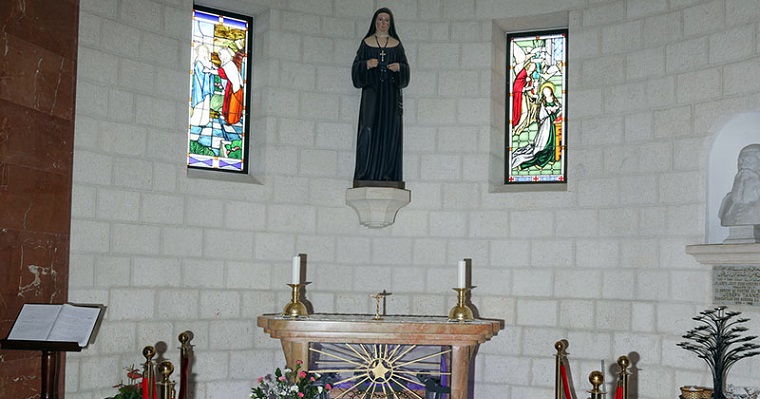
The Rosary Church on Agron Street
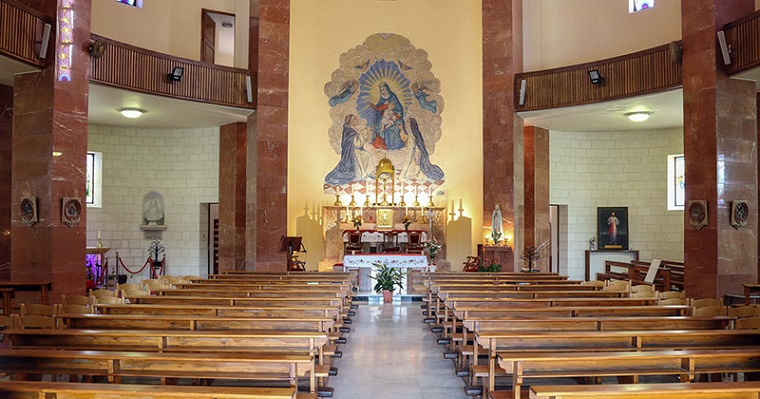
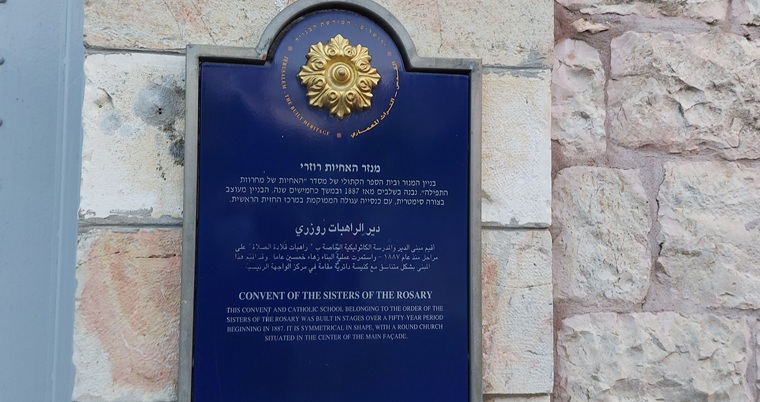
The Rosary Church is a unique church consecrated in 1937. Its form is that of the Rosary beads, and it features a representation of all 15 original Mysteries. The structure of the church is circular and composed of three circular stories (levels). The triple division of the structure vertically is seen both inside and outside the church and symbolizes the Holy Trinity. The second and third stories teach us that the many events and facets of Jesus’ and Mary’s appearance in the world are all, in fact, one.
The ceiling inside the dome of the church is painted like the heavens, and beneath them are three circular architraves, which also symbolize the Holy Trinity. The main apse, which extends up to the second story, features a large painting of Mary giving the Rosary to Saint Dominic and Saint Catherine. The fact that it is on both the first and second stories symbolizes Mary’s role as the connector between the worlds and her existence both in heaven and on earth. The windows on the ground floor (the Rosary) show Mary’s activity (mysteries), and the light entering through them symbolizes the light entering the world through these Mysteries, while the narrow, tall windows on the second floor show her activity in the higher worlds. In the small apse close to the main altar is a statue of Saint Marie Alphonsine, and beneath it is another altar with a large Rosary that she used in her life.
The entire church is one great Rosary, and its structure is reminiscent of the Rosary church in Lourdes, France—the most important site in the context of Mary’s apparitions, which was built in 1901. The Rosary Church on Agron Street was consecrated in 1936 and was likely influenced by the design in Lourdes.
Adjacent to the church is a convent for the Sisters and also a guesthouse. Marie Alphonsine saw the church and the future convent of the order in a vision, which included 15 rooms, and above each room was written the name of the Mystery related to that room and nun.
Teresa of Ávila, The Carmelite Order
The Discalced Carmelite Order numbers about 12,000 men and women in 800 monasteries worldwide. It continues the path of Teresa of Ávila and John of the Cross, important Christian mystics in 16th-century Spain.
Teresa of Ávila is the only woman recognized as a Doctor (Teacher) of the Church and the founder of the Discalced Carmelite Order. During her mystical experiences, Mary placed a gold necklace with a valuable cross pendant around her neck. She developed a series of meditations and techniques that help a person advance on the spiritual path—techniques that are still used today by modern psychologists not affiliated with the order [7]. In one of her meditations, Teresa compared the soul to a polished mirror—what is impure in us blackens the mirror.
In her book The Interior Castle [5], she compares man to a castle with many rooms, with a single illuminated room inside the castle, which one must reach in order to illuminate the whole castle. The entrance door to this castle is prayer and contemplation.
There are four convents of Discalced Carmelite Order nuns in Israel. The first one was founded in Bethlehem by Mariam Baouardy in 1875. The Carmelite nuns’ convents are contemplative monasteries; the nuns spend at least a third of the day (8 hours), and sometimes more, in prayer, meditation, and deep contemplation. They believe that by doing so, they are performing a great service to the world. By continuous prayer, love, and acceptance, they take upon themselves the pain of the world—somewhat like Jesus—cleansing the negative energies and allowing human beings to connect to holiness more easily.
The work of God is not limited only to helping others physically; there is a need for some people to take upon themselves the task of developing and maintaining a connection with the Divine. The world exists not just because of actions, but—similar to the Jewish concept of the 36 Righteous Ones (Lamed-Vav Tzaddikim)—because of the connection to the Divine maintained by those who have attained such a state. Mariam Baouardy, a Carmelite nun from the Galilee, was one of these people. She received the miracle of the stigmata, visions, and Marian apparitions throughout her life, and was recently recognized as a Catholic saint by the Pope. She was the person who brought about the return of the Discalced Carmelite Order nuns to the country at the end of the 19th century.
Saint Mariam Baouardy
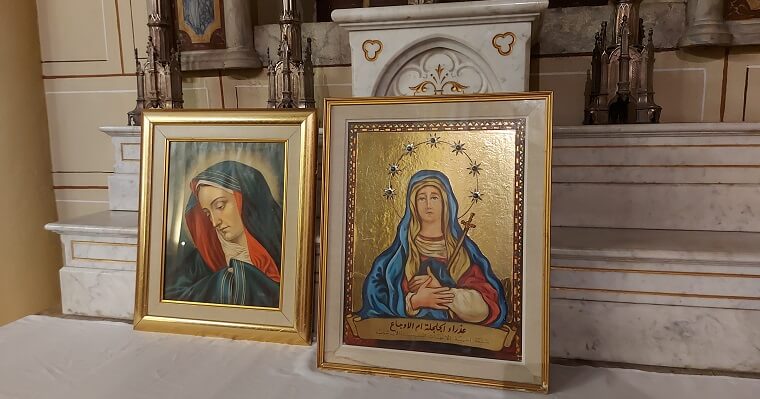
Mariam Baouardy’s life (1846–1878) was full of disasters. Her parents lived in Hurfeish. After 12 of their children died one after the other, they made a pilgrimage to Bethlehem and prayed at the Church of the Nativity for Mary to give them a daughter. She was born in 1846 and named after her. When she was three, both her parents died.
At age 13, her uncle arranged for her to marry a relative in Cairo, but due to a vision of Mary, she refused to marry. Her uncle beat her, and she sought help from a former family servant. He offered to marry her and convert to Islam. Her refusal led to a fit of rage during which he slit her throat, and thinking she was dead, threw her into one of the nearby alleyways.
Mariam was a 13-year-old girl who was rejected by the world, fatally wounded and forsaken, but then the miracle happened: the Virgin Mary came to her aid in the guise of a nun dressed in blue. She took her to a cave and nursed her wounds for four weeks, finally bringing her to a Franciscan convent.
After recovering, Mariam Baouardy had a true family and mother. She was not alone in the world, which gave her strength to cope with life. She worked as a servant in Alexandria and later traveled to the Holy Land. On the way, she reached the Church of the Holy Sepulchre in Jerusalem and took a vow of chastity.
At age 18, she joined the Sisters of St. Joseph of the Apparition order in Marseille, France. Concurrently, she received the miracle of the Stigmata and experienced ecstatic states. The wounds would appear on her body from Wednesday to Friday, leading up to the day of the Crucifixion [9].
In 1867, she was transferred to the Carmelite convent in Pau, and her visions intensified. She dedicated herself entirely to the Holy Spirit. Her states included levitation, prophecies, the intensification of the Stigmata; she received apparitions in several places and wrote beautiful poetry.
In 1870, Mariam Baouardy moved to Mangalore, South India, to participate in the founding of the female Carmelite convent, the first of its kind. After two years, she returned to France with a dream: to establish a Carmelite convent in Bethlehem. The service in India equipped her with the necessary experience needed to fulfill her life’s mission in her homeland, Israel.
In 1875, Mariam, together with a wealthy woman named Berthe Dartigaux (who contributed the money for the endeavor) and seven other nuns, set out for Israel to establish the first female Carmelite convent of its kind in Bethlehem. Being the only one who spoke Arabic, she chose the location of the convent (above the cave where David was anointed king by Samuel). Visions revealed to her the building design, which was modeled after King David’s Citadel, and she was responsible for the construction work as well.
In August 1878, she fell at the construction site and broke her left arm. The wound became infected, and she suffered a general deterioration that led to her death within three weeks. During this time, she accepted being a willing sacrifice for the good of humanity. She died at the age of 32 (the age at which Jesus died) and was buried in the convent in Bethlehem, which was nearing completion.
Already in her lifetime, Mariam Baouardy was known for experiencing mystical states that led to prophetic visions and bursts of ecstatic prayer and worship. Her thoughts and ideas during the visions were instructive and wise. She annihilated her ego and loved the whole world. Her love allowed her to bear the suffering of the world that appeared through the stigmata.
Her entry into ecstatic states was like falling into a trance. In the midst of daily tasks, she would feel as if her heart were open and wounded; she had thoughts of God that brought inspiration, felt as if someone were touching the wound in her heart, and she would fall into weakness, losing herself. According to the Carmelites, she taught the surrender of the self and connection to the spiritual light—the Holy Spirit.

Louis Massignon and the Badaliya
Louis Massignon (1883–1962) was one of the most important Orientalists in the first half of the 20th century and also a practicing Catholic who advocated for interfaith dialogue. He believed in a kind of spiritual geography of the world, which is sanctified by the act of pilgrimage to holy sites. Consequently, he made a pilgrimage to Jerusalem 27 times.
Massignon experienced an apparition of Jesus during a crisis whilst he was visiting the Middle East when he was 25; as a result, he became religious and at the same time delved into Oriental and Arabic studies. He wrote his doctoral thesis on the Sufi saint Al-Hallaj, whose figure is reminiscent of Jesus [11].
Massignon was greatly influenced by the figure of Francis of Assisi and was a friar of the Third Franciscan Order. In 1934, he prayed with Mary Kahil in Damietta at the mouth of the Nile, where Saint Francis met Sultan Al-Kamil. There, he was inspired to establish the Badaliya (Alternative) organization, a joint Muslim-Christian prayer group whose members vowed to give their lives for the sake of the other from the other religion—not to convert them, but so that the will of God would be fulfilled through them.
Massignon saw the figure of Mariam Baouardy as an example of a “Badaliya” [12], meaning a person who takes upon themselves the sorrow and suffering of the world on behalf of others (as Jesus did), a sacrificial soul called by God to take upon herself the wounds and pain of others so that they may be protected. Thus, her mysterious injury in Bethlehem during the building of the Carmelite convent was an occult event in which she took upon herself torment and death in order to allow for the establishment of a type of contemplative monasticism in the Holy Land. This act was important because the inner work of the Carmelite nuns in the convents she founded allows for the spiritual sustenance of the land.
Another source of inspiration for Massignon was Gandhi and his teaching on non-violence. Massignon was very concerned about what was happening in Israel and hoped that Jews, Christians, and Muslims could live together in peace. In the 1920s, he was an ardent Zionist and wrote in favor of Zionism to the Pope. But during the War of Independence, he became anti-Zionist and active in the struggle for Palestinian refugees. Nevertheless, he maintained contact with important figures in Jerusalem’s peace circles, such as Magnes and Buber.
In 1949, Massignon met with the Pope and updated him on the catastrophe of the Palestinians. In 1950, he converted to Greek Melkite Christianity so that he could pray in Arabic and be a married priest. He brought a positive perspective on Islam to the West and to Christianity, which was reflected in the decisions and declarations of the Second Vatican Council.
Patriarch Gori and 1954 Apparition
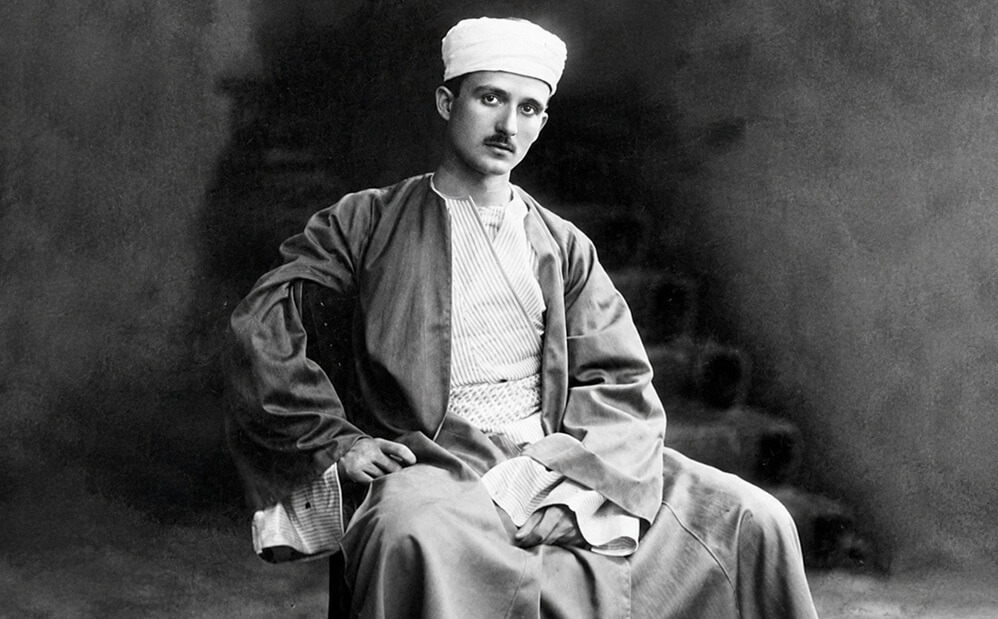
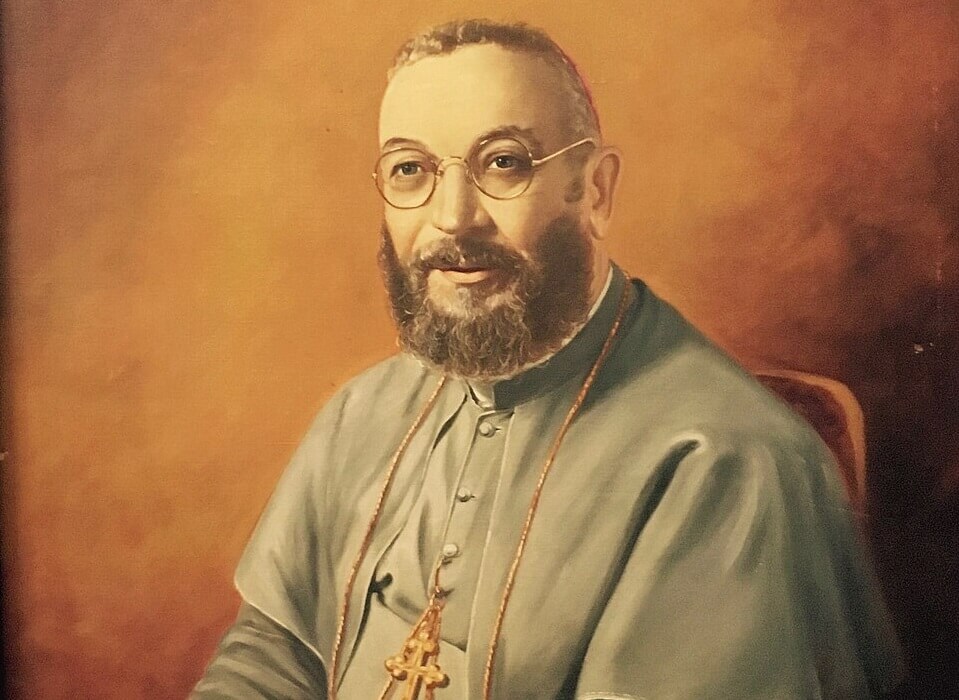
The first Latin Patriarch after the War of Independence was Patriarch Alberto Gori (1889–1970), who was previously the head of the Custodia Terrae Sanctae from 1937–1949. Gori was the Patriarch throughout the period of Jordanian rule and lived to see Jerusalem united in 1967. He died in 1970 and was buried in the chapel of the Patriarchate.
Gori arrived in Israel during World War I, became a Franciscan monk, and became head of the Custodia in 1937. He collaborated with Barlassina and Barluzzi and appears in Barluzzi’s painting of Our Lady of Palestine in the Church of the Visitation in Ein Karem. In 1954, he declared a Marian Year to commemorate the 100th anniversary of the promulgation of the dogma of the Immaculate Conception. In that year, a mass apparition of Mary occurred in the Coptic Church in Jerusalem. The story goes as follows:
In July 1954, tensions escalated between Israel and Egypt. In that month, there were two apparitions of Mary, two weeks apart, in the Coptic Compound of St. Anthony in Jerusalem, which was then under Jordanian rule. Some believe Mary appeared to try to bring peace to the land.
On the morning of Monday, July 18, 1954, 5th-grade children sitting in their classroom in the school in the Coptic Compound noticed a figure hovering in the air outside the classroom window. They immediately identified her as Mary, but the teachers, who could not see the sight, scolded the children. Then Mary appeared inside the classroom itself for a few minutes, her figure radiant and transparent in white and blue. She stood next to the wall, and the intensity of the light emanating from her increased until, eventually, some of the adults also managed to see her.
Word of the miracle spread throughout the city. In the days that followed, many people came to pray in the nearby Church of St. Anthony. A week later, during evening prayer on July 25, 1954, over 300 people were present in the church, including Muslims. Suddenly, there was great excitement—Mary was seen floating above the people or passing through them. The priest stopped the prayer in astonishment. Colored rays of light emanated from the Virgin and enveloped the people in colored sparks, reflected off the walls. The apparition lasted 15 minutes, until Mary’s figure finally faded, and only a blue-white outline of light remained.
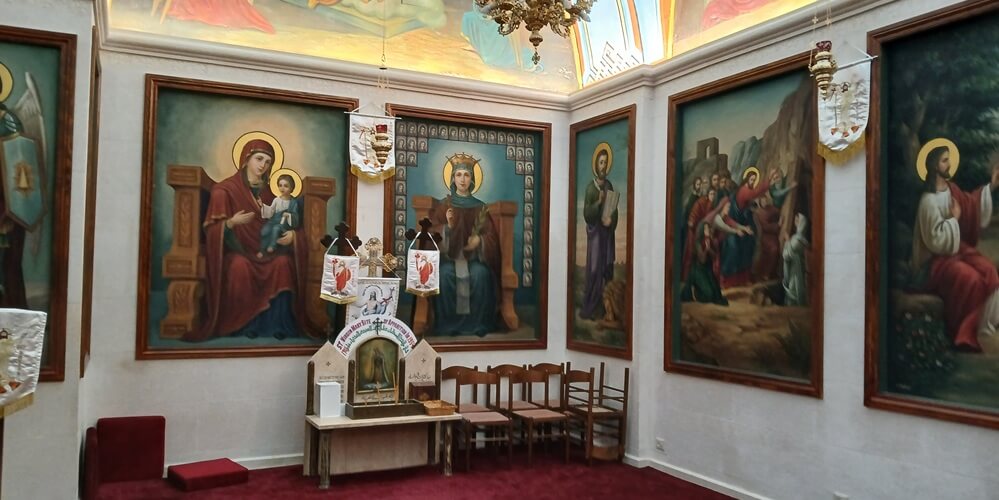
This apparition of Mary is of important significance because many people witnessed it for a relatively long time. Subsequently, the Coptic Archbishop of Jerusalem, Yacoub, converted the room where the children first noticed Mary into a church, featuring frescoes and icons of Mary. To this day, prayers are held there every Monday morning to commemorate the event.
Footnotes
[1] Duvignau, P. (1987). Mother Marie Alphonsine and the Congregation of the Rosary. Jerusalem: Economic Press.
[2] Ibid.
[3] Boss, S. J. (2000). Telling the Beads: The Practice and Symbolism of the Rosary. London: Darton, Longman & Todd.
[4] Saint Bernard of Clairvaux also suckles milk from Mary’s breast, as can be seen in art from this period. This was considered blasphemy in the preceding centuries.
[5] Teresa of Ávila. (2015). The Interior Castle (Trans. Dennis Haran Ben-Dor; Scientific Ed. Ruth Fein). Tel Aviv: Chad-Karn.
[6] Teresa of Ávila. (n.d.). The Way of Perfection (Trans. Yotam Reuveni). Tel Aviv: Nimrod Publishing.
[7] Myss, Caroline. (2001). Anatomy of the Spirit: The Seven Stages of Power and Healing (Trans. N. Shibak-Sheret). Tel Aviv: Or-Am.
[8] Maillard, S. E. (2011). Maryam of Bethlehem: The Little Arab. Children of Medjugorje Incorporated.
[9] Ibid.
[10] Ibid.
[11] Massignon, L. (2019). The Passion of Al-Hallaj, Mystic and Martyr of Islam. Princeton, NJ: Princeton University Press.
[12] Buck, Dorothy C. Louis Massignon and Mariam Baouardy (Blessed Mary of Jesus Crucified): A Palestinian Saint for Our Time.