Barluzzi and the Pilgrimage Churches
The Italian architect Antonio Barluzzi (1884–1960) is considered an architectural genius who designed many of the pilgrimage churches in Israel. He served as the architect for the Franciscan Custodia Terrae Sanctae from 1919–1958, meaning he was responsible on behalf of the Catholic Church for building Catholic churches in the Holy Land throughout most of the Christian (British) rule, as well as during the early years of the State of Israel. The central motif in his work is the expression of various New Testament Mysteries in the art and architecture of the churches that were built on the sites where the events occurred. In other words, many of the 24 churches he built were designed according to the divine manifestation associated with each place, drawing on divine inspiration and with the intention of transmitting a similar experience to the visitor through architecture and art. According to Barluzzi, the different events in Jesus’ life are Mysteries that hold lessons for our lives, and the churches were intended to reveal these Mysteries.
Much has been written about Barluzzi’s churches from artistic, architectural, political, and social perspectives, but what is more interesting, in my view, is to focus on the process Barluzzi underwent in designing them, their meaning for him, and the symbolism he employed to convey the experience he underwent while contemplating these Mysteries. In other words, the noetic, spiritual quality of the churches and how Barluzzi achieved it.
He was born in Rome in 1884, the 13th and last child of a devout Christian family, and lived with his parents near the Vatican. His father and grandfather worked as architects for the Vatican; his grandfather was responsible for preserving St. Peter’s Basilica in Rome, so it can be assumed that architecture was discussed at the dinner table. As early as age five, he was drawing remarkable sketches of churches and winning awards. In 1902, he finished school and told his mother that he wanted to become a monk, a priest. However, his confessor urged him to wait before making this decision.
In 1907, Barluzzi graduated with an engineering degree from the University of Rome. He joined engineering projects at the Verano Zoological Garden in Rome from 1909–1912, but did not find fulfillment in this field. When his brother Giulio received a commission to build the Italian Hospital in Jerusalem, Barluzzi was asked to join him, and thus he arrived in Jerusalem and stayed there from 1912–1913.
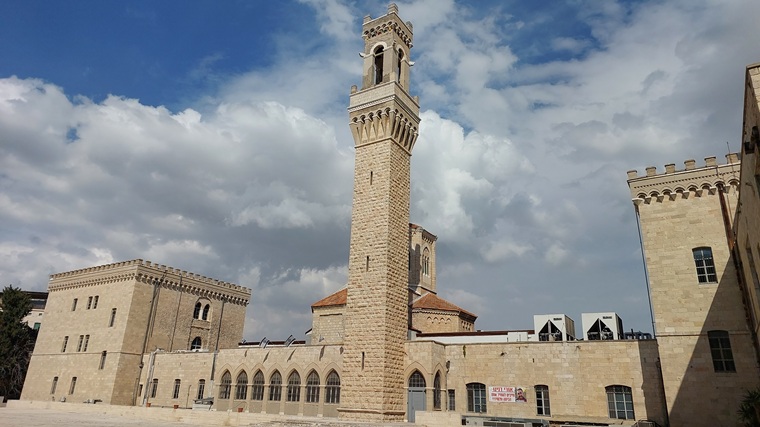
At that time, Italy was seeking its place among the European powers, and part of this effort involved demonstrating a presence overseas, especially in Jerusalem. The Italian Hospital was conceived as a significant institution that would proudly fly the Italian flag, containing a church intended to serve as a center for the Italian population in Jerusalem.
The large compound, now belonging to the Ministry of Education, is located at the lower end of Prophets Road. Its tower resembles the tower of Siena or the Palazzo Vecchio in Florence. The building features heraldic shields of Italian nobility, and the church has a hexagonal cross-section reminiscent of the Baptistery in Florence—in other words, this is Florence in the Land of Israel, with a style that is partly Gothic and partly Renaissance.
With the outbreak of World War I, Barluzzi, a citizen of an enemy country, was asked to leave Israel. He returned to Italy in 1915 and entered a seminary for priests, but was quickly drafted into the army as an officer responsible for fortifications. During his military service, he oversaw the excavations at Castel Sant’Angelo near the Vatican and also learned to maintain his religious practice under all conditions, including the Rosary prayer, which became a central part of his life. Above all, Barluzzi was a devout and humble man who followed the path of Jesus.
In 1917, he was sent to Palestine, then a battlefield between the Allied Powers and the Ottoman Empire. Barluzzi’s ship was torpedoed near Malta, but he was rescued and arrived on a British vessel in Rafah, where he joined the Italian Legion, which was part of Allenby’s army, and entered the city with the victory parade. In the first months after the conquest, he served as the representative of the Italian government in the parts of Israel captured by the British.
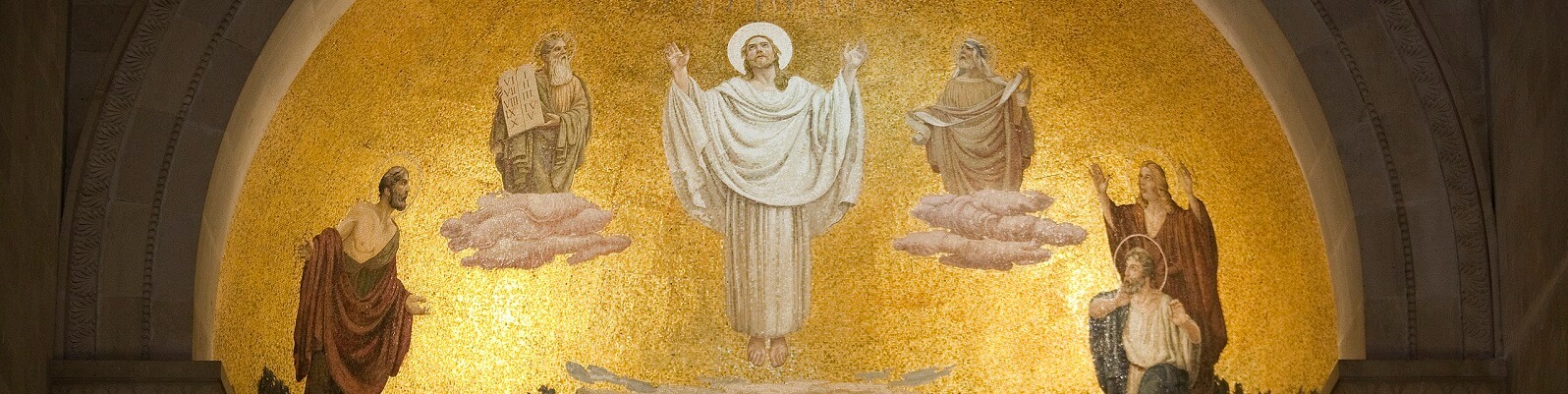
The Franciscans possess 75 holy sites in Israel. In 1919, Father Diotallevi, the head of the Custodia Terrae Sanctae, wished to rebuild the basilicas of Gethsemane and Tabor. He received plans that Barluzzi had sketched for the basilica on Mount Tabor while in Israel in 1914. He approached Barluzzi and asked him to take on the project. Barluzzi hesitated, returned to Italy to consult his confessor, and was directed by him to fulfill the mission. The moment he was told, “Go and build the Temple and then we shall speak,” his heart filled with happiness. His destiny was revealed: to become the greatest builder of pilgrimage churches in the Holy Land.
Over forty years of activity (1919–1958), Barluzzi designed many impressive structures. In Jerusalem, he designed the convent of the Saint Anthony Sisters, the Ethiopian Monks’ House, the Terra Sancta School, renovated the Greek Church of the Holy Face of Veronica on the Via Dolorosa, and more. Additionally, he designed five pilgrimage churches in Jerusalem itself: Bethphage, St. Lazarus in Bethany, the Church of All Nations in Gethsemane, the Church of Dominus Flevit on the Mount of Olives, and the Chapel of the Condemnation on the Via Dolorosa. Each of these represents one Mystery connected to events in Jesus’ life.
Barluzzi was a Knight of the Italian Crown, a Commander in the Order of the Holy Sepulchre, a Knight Commander in the Sovereign Military Order of Malta, a member of Jerusalem’s archaeological advisory body, a member of the Pontifical Academy of the Virtuosi at the Pantheon, a deputy counselor to the Consul in Jerusalem, and a high officer in the Order of Merit of the Italian Republic.
During World War II, Barluzzi, a citizen of an enemy country, remained in Italy, where he became more religious. He returned to Israel after the war, but soon the War of Independence broke out, and the country was divided between Jordanian and Israeli rule. He lived with the Christian Brothers in Bethlehem and planned the church in Bethphage. He then moved to the monastery in Bethphage and designed the altar in the Pater Noster Monastery on the Mount of Olives. During this period, he also built the Church of Dominus Flevit on the Mount of Olives, the Veronica Station on the Via Dolorosa, the Shepherds’ Field Church in Beit Sahour (the latter built like a tent), completed the Church of the Visitation in Ein Karem, and more.
In 1958, Barluzzi moved to Nazareth with the intention of beginning his swan song—the project that was meant to surpass everything he had done so far and serve as the culmination of his life’s work: the design of the Church of the Annunciation on a grand scale. However, his plans were rejected, and the plans of Giovanni Muzio were accepted instead. On the day he learned of the rejection, he suffered a heart attack, after which he left the country sick and heartbroken. It seems he underwent a personal Via Dolorosa during the last year and a half of his life, a period he spent in the Custodia Terrae Sanctae monastery in Rome, where the brothers cared for him. He died at the end of 1960.
Barluzzi intended for the architecture to arouse religious feelings and devotion in visitors. Indeed, pilgrims report that they pray with true devotion in the churches he built. He understood the need to revive the Christian drama in its original location and to draw inspiration for his artistic plans from Jesus’ voice echoing through the mountains and valleys of Israel.
Barluzzi consciously sought to create an experience of sanctity, and thus he said:
“In Palestine, every Holy Place has a direct reference to a definite mystery of the life of Jesus. It is natural, therefore, to avoid the general kind of architecture that continually repeats the same word, and instead to design the art to express the feeling called forth by that mystery. In this way, the faithful, upon entering the temple, can easily construct the Gospel story in their minds and concentrate their meditation on the thoughts appropriate to the mystery appearing there, instead of choosing the art first and forcing all other things to suit it. I think it is more fitting to first connect to the basic religious conceptions of the Holy Places in which the temple is built, and to adapt the architecture to them.”
Barluzzi sometimes used terms from the science of religion to describe his work:
“To achieve the most elegant, grand, and moving artistic effect, effort has been made to attain maximum simplicity of line. In the search for universal and profound qualities that will yield maximum results with minimum effort, it is almost an attempt to translate into architecture the majesty and simplicity of the Holy Scriptures. These works were done more with the heart than with science, seeking the soul of things.”
Barluzzi would meditate for hours before each creation—thinking, delving into the Gospel stories, discovering their divine secrets, and drawing inspiration for his architectural and artistic plans from them. He wanted the architecture to arouse religious feeling. In contrast to his ambitious designs, his life was marked by simplicity: he lived like a regular monk, attended Mass every morning, worked all day, and prayed for two hours each afternoon. Sometimes he would not sketch a single line for many hours but would sit at the table and contemplate. Everything he did was for God, with humility and gratitude for the opportunity he had been given.
And so he wrote: “I feel the unconquerable need to dedicate myself to the Holy Places, God willing, out of a conviction that I am destined for it, not to showcase my own abilities, but the wonders that God can achieve through humble means.” Barluzzi dedicated his life to the sanctuaries of the Holy Land, which occupied his thought, heart, and soul, and anyone who visits them can attest to the wonders that God achieved through him.
To demonstrate Barluzzi’s spirituality and his understanding of the Christian Mysteries, his use of sacred architecture and art to convey a message through the building, and to illuminate some of Jerusalem’s beautiful structures with a light of understanding, appreciation, and inspiration, I have chosen to discuss the first two churches he built: Gethsemane and the Chapel of the Flagellation on the Via Dolorosa—each possessing a different character. There are other structures and churches he built, but it is difficult to include them all in a general book on spiritual traditions. I refer those interested to two other books I wrote: The Mary Our Lady of Israel – Marian Apparitions in Israel and The Via Palma – The Pilgrimage Road from Acre to Jerusalem.
The Church of Gethsemane
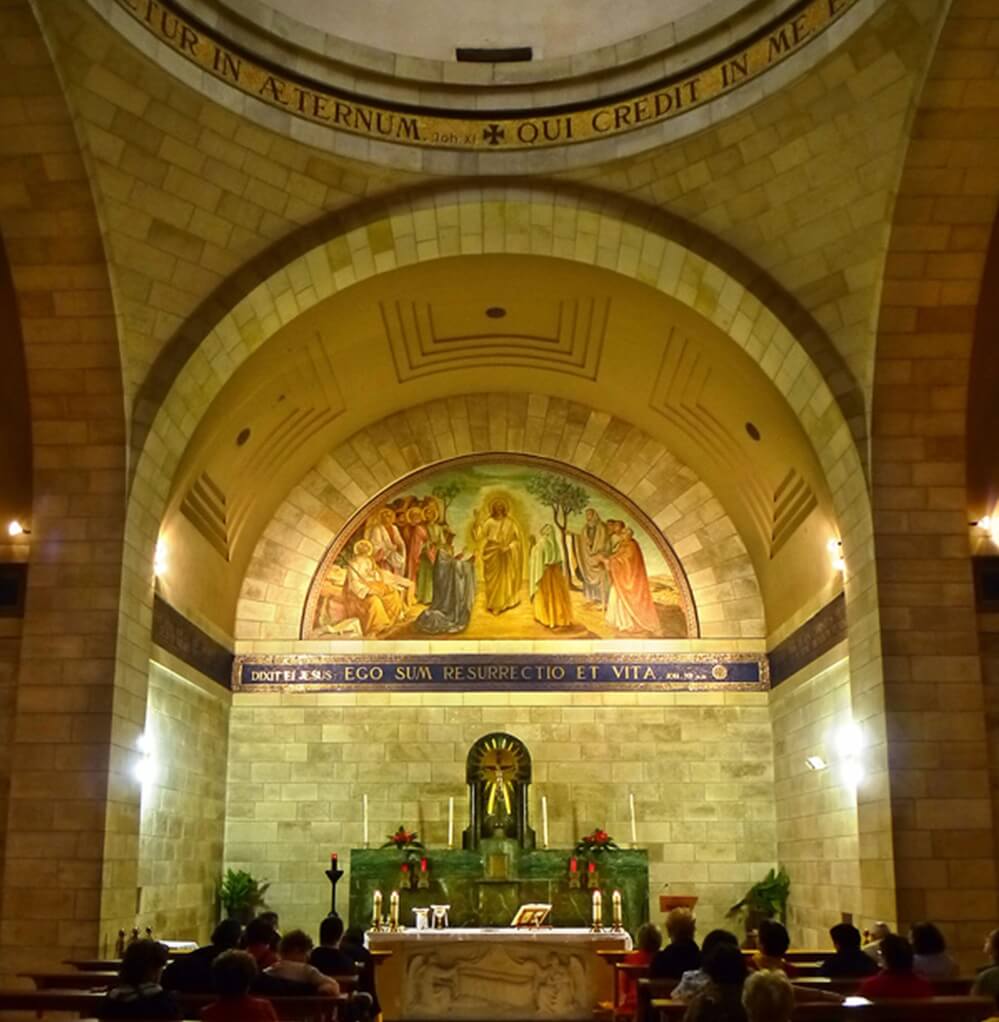
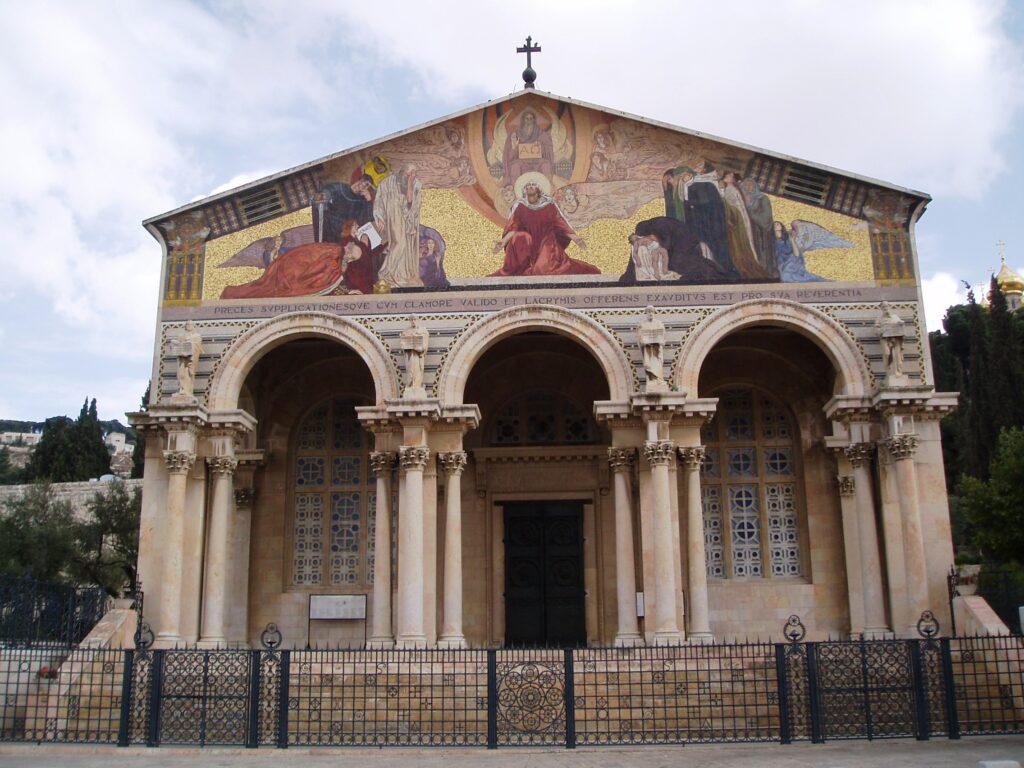
The wonderful Church of All Nations (or Church of Gethsemane) is poetry in stone and one of Barluzzi’s masterpieces. It is the first church he built, and it was consecrated, along with the Church on Mount Tabor, in 1924. The church on Mount Tabor emphasizes the motif of light, while the Church of Gethsemane emphasizes the motif of darkness. The Church of Gethsemane was built in a Neo-Classical style on Byzantine foundations and contains Byzantine-style mosaics, but the core of its art and architecture is entirely original and is linked to the understanding of the mystery of “the dark night of the soul”—the Agony in the Garden, which took place at this very site.
In the Church of Gethsemane, Barluzzi wonderfully succeeds, through architecture and art, in conveying this Mystery. It is not a private Dark Night, but a human Dark Night, which is expressed in the mosaic on the pediment above the entrance façade. On the right side of the mosaic, a woman dressed in black is seen holding a dead child in her arms (in the style of the Pietà), and behind her, people of various nationalities are lamenting. The woman is Europe, and the dead child represents the victims of World War I. The church was built after World War I, and the mosaic shows the victims of the war and its futility. This was the Dark Night of humanity. On the left side of the mosaic, opposite Europa and the dead child, the sages of antiquity appear—Socrates, Virgil, and others—holding their heads, and one of them holds a book inscribed “Ignorance.” In the center of the mosaic, a woman-angel opens her arms, half mourning, half inviting us to enter, and above her, God and angels hold a book containing the letters Alpha and Omega. Below the pediment is an architrave with the verse: “During the days of Jesus’ life on earth, he offered up prayers and petitions with fervent cries and tears to the one who could save him from death, and he was heard because of his reverent submission.” (Hebrews 5:7).
Most of the artists who participated in the church’s decoration were masters who came especially from Italy. The wonderful art is not limited to the mosaics; at the entrance to the church are bronze doors interspersed with dark glass, bearing a relief of a dense Tree of Life sending four branches toward the four symbols of the Evangelists. Above the door is an inscription with Jesus’ words to the disciples during His stay in Gethsemane: “Remain with me and spend the night here,” which invites the visitor to enter and participate in the Mystery of the Dark Night of the Soul—the Agony in the Garden.
Indeed, the entrance to the church is like entering a dark and savage world, a kind of jungle. The dense tree largely expresses the chaos that existed in the world before the coming of Jesus. The dark windows, made of alabaster stone, let in a heavy, thick purple light which, in Christian liturgy, symbolizes the motif of repentance and conversion.
The church hall is one large space, although it is divided by six thin columns. Above it are twelve small, flat domes dedicated to the twelve nations that participated in World War I on both sides of the divide, and which decided to build the church together after the war. For this reason, the church is also called “All Nations Church”; its construction was intended to show that things can be different—cooperation between nations instead of war and division.
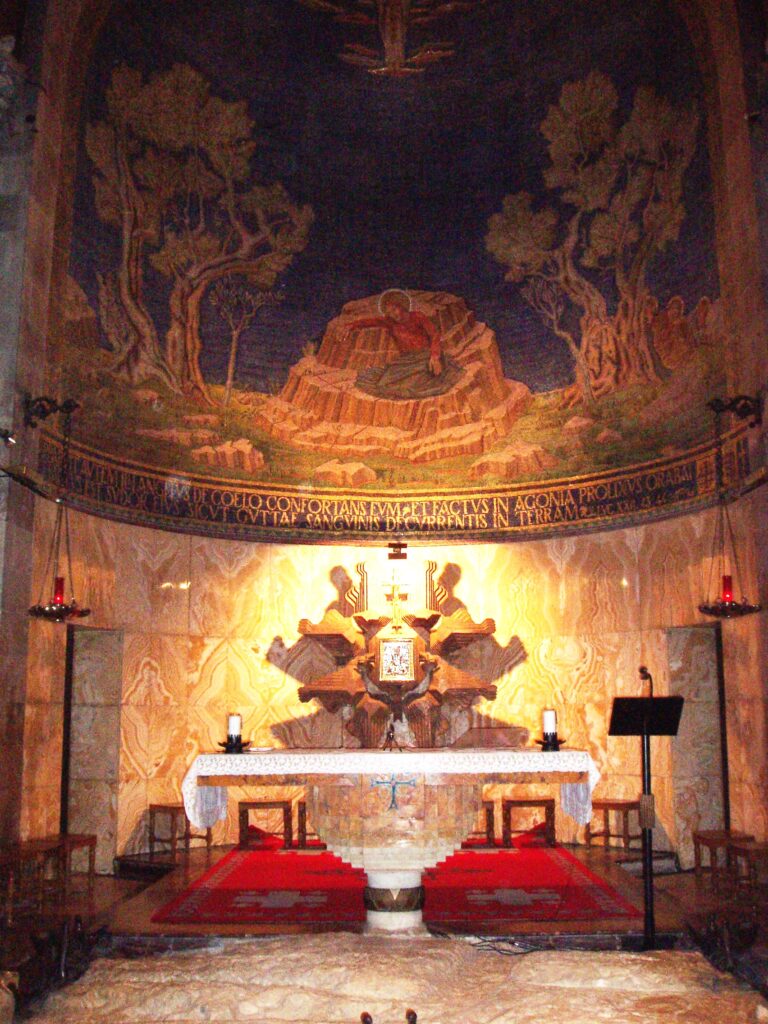
On the east side, oriented toward the Mount of Olives, there are three apses. Before the central apse is a natural rock connected to the bedrock, a kind of sacred rock on which Jesus rested while sweating blood and water during the difficult hour He endured. The rock is surrounded by a kind of grating that looks like a low barbed-wire fence, reminiscent of the terrible trench warfare of World War I. One can also imagine the barbed-wire fence as a crown of thorns. In the corners of the barbed-wire fence are two silver doves trapped, and between them are pairs of black doves drinking from the cup of poison.
The mosaic in the apse above the rock shows Jesus leaning on the rock, the disciples sleeping behind a nearby tree, and the entire landscape seeming to weep (in a Van Gogh style): the trees lean inward, the sky is dotted with clouds, and God looks down and holds His head. The rock and the surrealistic mosaic, the barbed wire and the trapped birds, the dim lighting—all reveal Jesus’ state during His darkest hour, the Agony in the Garden. The feeling is of a Dark Night descending upon those present with no possibility of escape.
There is only one place where hope and salvation are found: the dome above the rock, which is one of the twelve domes of the church but is different from the others. Above the rock is a golden dome with a blue circle in the center, supported by angels, containing openings that let in the light of the sun and stars. This is the motif of the “Spiritual Sun” that Barluzzi repeats on Mount Tabor and in other churches. This dome reveals to us that the solution to the soul’s Dark Night is spiritual light—focusing on the spiritual world, where alone meaning, justice, reward, and hope can be found. The truth is that we do not know why bad things happen in our lives, because the answer lies in another world, and therefore the way is to accept everything with love.
In In the left (northern) apse of the church, Judas Iscariot is seen betraying Jesus with a kiss. The soldiers come to arrest Jesus with torches whose light is ill-boding. This is the hardest moment of the hardest hour, and here too it seems that evil has won and there is no way out. But the right (southern) apse offers a solution: Jesus is seen filled with spiritual light and willingly surrendering to the soldiers. The heavens seem to open and clear, the trees turn outward instead of closing in, and the inscription beneath the mosaic says: “Jesus said to them, ‘I am he’” (John 18:5). This is the moment when Jesus comes to terms with His fate. And when the disciples finally wake up, after the whole drama is over and try to fight back, Jesus turns to Peter, who is drawing a sword, and commands him not to fight: “Jesus commanded Peter, ‘Put your sword away! Shall I not drink the cup the Father has given me?’” (John 18:11).
The Dark Night of the Soul
In Gethsemane, Jesus undergoes the “Agony in the Garden,” a process that later Christian mystics such as John of the Cross described as the “Dark Night of the Soul.” This is a difficult moment we all must go through in life, during which we are required to find our inner strength. After the Last Supper, Jesus descended from Mount Zion to Gethsemane in the Valley of Jehoshaphat, an olive grove outside the city, to be alone for a while. It was late evening. Jesus knew what was going to happen and asked God to spare Him from the cup of poison. He also asked the disciples who were with Him to stay by His side, but they fell asleep behind the trees, giving rise to the saying, “The spirit is willing, but the flesh is weak.” It is important to understand that this drama is not private, and certainly the disciples could have stayed awake, but they fell asleep because a spiritual struggle related to all of humanity—which is asleep—was taking place within them. Therefore, at this stage, Jesus takes upon Himself all human suffering, which is why He sweats blood and water.
The event of the Agony in the Garden reveals to us that we all must pass through the wilderness—a barren land, through difficulties—at one stage of our lives or another. The way to deal with this is to accept the will of God, as Jesus did when He said, “Thy will be done.” According to John Paul II, Jesus encountered all the sins and temptations of the world during His difficult hour in the garden, and His answer to God was: “Not my will, but thine, be done” (Luke 22:42)—an answer that stemmed not from His divine part but from His human part.
And thus the New Testament recounts:
“Jesus went out as usual to the Mount of Olives, and His disciples followed Him. On reaching the place, He said to them, ‘Pray that you will not fall into temptation.’ He withdrew about a stone’s throw beyond them, knelt down, and prayed, ‘Father, if You are willing, take this cup from Me; yet not My will, but Yours be done.’ An angel from heaven appeared to Him and strengthened Him. And being in anguish, He prayed more earnestly, and His sweat was like drops of blood falling to the ground. When He rose from prayer and went back to the disciples, He found them asleep, exhausted from sorrow. ‘Why are you sleeping?’ He asked them. ‘Get up and pray so that you will not fall into temptation.’” (Luke 22:39–46).
The disciples’ falling asleep are the three who were with Him on Mount Tabor; this symbolizes humanity’s denial of the Gospel. There is a kind of counter-force that appears when the Gospel is present, blinding people’s eyes, so they “have eyes, but see not,” and they also do not want to hear, so they “have ears, but hear not.” The greater the miracle, the stronger the denial—a kind of defense mechanism, a cognitive dissonance, an unwillingness to accept the fact that the Savior is already here. And in fact, everything we longed for is already here; the spirit is willing, but the flesh is weak. We have a mechanism of self-destruction, which is, in the deeper sense, the Christian concept of “sin.” It is possible that if the disciples had not fallen asleep, the world might have been saved even without Jesus’ sacrifice and suffering. Jesus turns to them three times before it is decreed that He will be delivered into the hands of sinners, just as Peter denies Him three times afterward.
During the Agony in the Garden, one can feel the loneliness of man facing his destiny. We came into the world alone and will leave it alone. Life is heading in one direction, and eventually we will have to account for what we did and what we did not do but should have done in this world (in the spirit of the Protestant Christian confession). The Agony in the Garden implores us to wake up from our slumber so that we do not miss the destiny and purpose for which we came into the world. As long as we are asleep, evil rules us and the world, and our soul experiences the torments of Hell instead of being in the Garden of Eden. Therefore, Christian monks stayed awake during vigils, but they knew that to succeed in the struggle they needed God’s help, and turned to Him in supplication and prayer.
The Agony in the Garden reveals to us the weakness of man when relying only on his own will and strength. The solution is to aim at being a tool in the hands of a greater will—the will of God. Jesus offers a solution to the human condition, which is “Thy will be done.” Another solution Jesus offers the disciples is constant prayer so that they “enter not into temptation.” The constant prayer of the heart entrusts the person into God’s hands.
Jesus has a dual nature, human and divine, and His human part does not want to suffer. Who is the sane man who would yearn for crucifixion? Jesus prays so intensely that His sweat drips like drops of blood; but when He understands that there is no alternative, He accepts the judgment with love. Jesus’ solution for walking through the Valley of the Shadow of Death is to accept everything that comes with love, including the moment of betrayal. Later in the story, it becomes clear that this unconditional acceptance enables salvation and resurrection, and this gives comfort and meaning to suffering that cannot be found elsewhere. The passage of the Divine through suffering strengthens the presence of light in the world and spreads it to dark places.
It must also be said here: the pain of the Agony in the Garden is mental, not physical. It stems primarily from the knowledge of something that has happened or is about to happen and is impossible to prevent, and we are all familiar with this feeling. The Agony in the Garden teaches us that mental pains are sometimes no less severe than physical ones because they create a private hell within us. At the same time, they reveal to us that sometimes there are reasons behind things that seem inexplicable, and that we cannot understand their meaning while they are happening. There is a divine plan leading somewhere, and what is important is not only what happens in this world but mainly how things are recorded and how they affect the world beyond—the world to come. Consequently, the pain becomes easier. Suffering existed in the world even before the appearance of Jesus and Christianity, and it is a significant part of human life. The importance of the Christian concept of suffering is that it acquires meaning, and this restores faith and hope for a better future to people, even in difficult situations.
The Chapel of the Flagellation
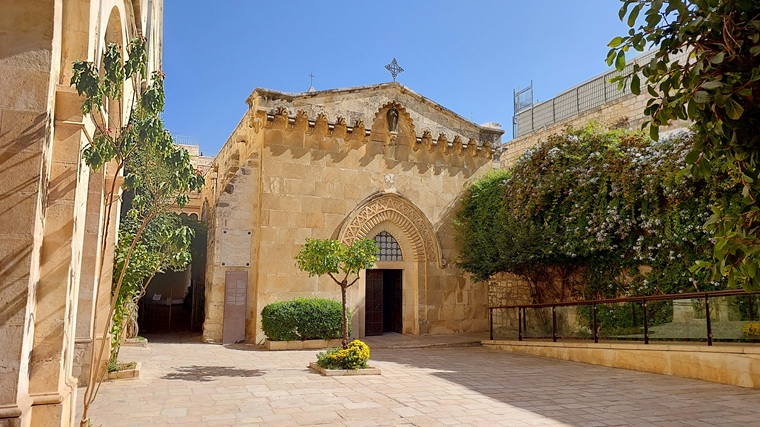
The Chapel of the Condemnation is located at the beginning of the Via Dolorosa, and it is one of the first churches Barluzzi built, consecrated in 1929, a year after the Church of All Nations. What is special about Barluzzi’s churches is that they narrate the story of the event that occurred in that place through the architecture, paintings, composition, materials, the general layout of the structure, and more. The story of the Church of the Condemnation is the story of the wickedness and ingratitude of the human race. Within it, there is a wonderful representation of the Crown of Thorns that allows us to understand this mystery.
The facade of the Chapel is a copy of the facade of Mary’s Tomb in the Valley of Jehoshaphat, a Crusader structure built by the Templars and Melisende as a place of Christian mysteries. The use of an architectural element from Mary’s Tomb suggests Barluzzi’s reference to the Rosary prayer practice, which leads to a deep and inner understanding of the events in Jesus’ life with Mary’s help and guidance. On the wall of the entrance facade are reliefs of the instruments of torture used during the Passion, and a verse from John: “Every one that is of the truth heareth my voice” (John 18:37). Above the entrance is a pointed arch, and above it another arch with a large and impressive carving of a Crown of Thorns.
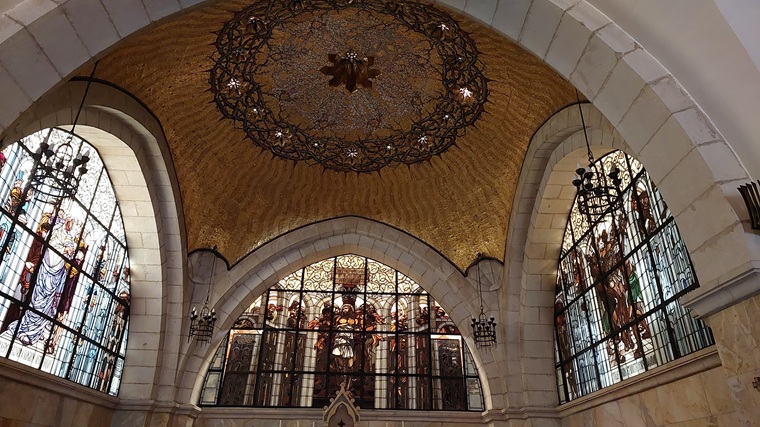
The inner space of the church consists of two small, equal, and complete parts—two symmetrical squares. The inner square is the area of the altar, the place where the drama unfolded, and the outer square is the place of the congregation. The inner part is surrounded by three walls with wonderful artistic stained-glass mosaics set in their upper sections. The eastern window shows the crowd pushing Jesus to His death, while the southern window shows the crowd lifting Barabbas the robber onto their shoulders. The images convey a sense of madness and distress, and communicate a message of an upside-down world where evil is carried aloft and good is persecuted.
The night before the trial, Pontius Pilate’s wife dreamed that Jesus was innocent and implored him to pardon Him. Consequently—and probably also following his conversation with Jesus—he turned to the crowd with an offer to pardon one man, according to the custom of the Passover holiday, thinking they would ask for Jesus’ pardon. However, in a world as mad as ours, the people asked for Barabbas the robber to be pardoned and desired Jesus’ death. Out of a place of self-destruction, they wanted to see innocent blood spilled in vain, worshipping the god of power and cruelty. In the northern window, Pontius Pilate is seen washing his hands, which was an act of declaring his innocence in Jesus’ crucifixion: “When Pilate saw that he was getting nowhere, but that instead an uproar was starting, he took water and washed his hands in front of the crowd. ‘I am innocent of this man’s blood,’ he said. ‘It is your responsibility!’” (Matthew 27:24).
What Barluzzi tells us in this window is that the blame for the madness that seized the world rests not only on those who perform the deeds, but also on those who say they did not know and are not responsible—and especially on those who are unwilling to take a stand and act—and that Pilate is guilty in all these respects. Furthermore, the act of washing his hands is an act of hypocrisy and self-righteousness that only amplifies evil in the world.
The colors in the inner part of the church are somber: brown, black, and gold, and they instill a sense of oppression that intensifies when contrasted with the scenes in the windows. The dark colors of the marble stones on the walls and floor direct the visitor to look up, where they discover a flat, golden dome featuring a gigantic Crown of Thorns, inside which are drops of blood and tears. Barluzzi’s genius leads the visitor to feel as if the gigantic Crown of Thorns in the dome is resting upon them and that there is no way out, somewhat like the feeling imposed on the visitor in the Church of All Nations in Gethsemane (Agony in the Garden).
In the Chapel of the Flagellation, as in the Church of All Nations in Gethsemane, the only way out of the impossible situation—expressed by the madness of the people in the windows, the dark and oppressive colors of the stones and the structure, and the Crown of Thorns above us—is found in the small, octagonal, star-shaped openings in the dome, hidden among the thorns of the Crown of Thorns. These openings let in blue heavenly light, teaching us that salvation and redemption can be found within suffering, in the connection to the heavenly and spiritual worlds, regardless of the events here on Earth. In addition to the octagonal openings, there are flowers symbolizing hope and faith sprouting out of the thorns; they symbolize the new life that will sprout after death. It seems as if the dry wood of the thorns comes to life.
It should be noted on this occasion that the wickedness of the crowd was blamed on the Jews in Christian history, but the Second Vatican Council ruled that the Jews are no longer guilty of Jesus’ death, and that the crowd who demanded Jesus’ crucifixion was made up of many people and nationalities, representing the entire human race.
The Meaning of the Crown of Thorns
The Mystery of the Crown of Thorns teaches us that we are all guilty and cannot wash our hands clean as long as we give place in our hearts to the world’s wickedness and deny the presence and kingship of Jesus—or, if you will, the possibility of sanctity. The crowns with which the external world crowns us are false crowns that will bring disappointment in the end. Even if we are crowned as kings and win all the happiness and power in the world, eventually we will discover that we have achieved nothing and that all our labor is in vain. Therefore, one should not strive for position and influence—for crowns of royalty—but rather put our reliance on the true reign and power of Jesus in our hearts, even if externally it seems that our only reward for our labor is a crown of thorns.
The scripture tells us that the crown of thorns was the soldiers’ way of mocking Jesus:
“Then Pilate took Jesus and had Him flogged. The soldiers twisted together a crown of thorns and put it on His head. They clothed Him in a purple robe and went up to Him again and again, saying, ‘Hail, king of the Jews!’ And they slapped Him in the face.” (John 19:1–3).
Jesus is the Son of God who came to earth to help us find the way to salvation. The expectation was that people would carry Him on their shoulders and crown Him with a crown of royalty, a crown of salvation, but instead they persecuted Him and forced a crown of thorns upon Him.
The deep meaning of the Crown of Thorns is connected to the punishment Adam received in the Garden of Eden:
“To Adam He said, ‘Because you listened to your wife and ate fruit from the tree about which I commanded you, “You must not eat from it,” cursed is the ground because of you; through painful toil you will eat food from it all the days of your life. It will produce thorns and thistles for you, and you will eat the plants of the field. By the sweat of your brow you will eat your food until you return to the ground, since from it you were taken; for dust you are and to dust you will return.’” (Genesis 3:17–19).
It is not enough that man has to work the ground by the sweat of his brow, investing all his strength and soul; eventually, the result of his work is thorns and thistles instead of figs and grapes. This is the world’s ingratitude, which rewards our work with thorns and bites the hand that feeds it. And thus the New Testament states: “and then twisted together a crown of thorns and set it on His head. They put a staff in His right hand. Then they knelt in front of Him and mocked Him. ‘Hail, king of the Jews!’ they said.” (Matthew 27:29).
The soldiers mock Jesus, and these are thorns piercing His flesh. Jesus takes upon Himself the world’s suffering; He is despised and rejected, a man of no account, as written in the prophecies of Isaiah. But this does not mean that He is not the King of the spiritual world, and as such, He has dominion over our hearts. And this is what the Mystery of the Crown of Thorns teaches. The world can control your body but not your soul, thoughts, or heart, and therefore you must give to Caesar what is Caesar’s, and to God what is God’s, even if it means torture and death.