The Rise of Germany
In the early 19th century, slightly more than 20 million people lived in Germany, most of them (90%) farmers, spread across several separate political entities, the largest of which was Prussia. By the end of the 19th century, nearly 60 million people lived in unified Germany, 75% of them in cities. Germany’s population tripled, becoming mostly urban and industrial. Germany effectively replaced France as the most populous country in Europe after Russia.
In 1871, after a series of successful military and diplomatic moves led by Prussia’s Iron Chancellor, Bismarck, Prussia united all German states except Austria under its rule, and the Prussian King Wilhelm I became the first German Emperor of what was called the Second Reich or the German Empire. Germany at that time was an important industrial power; German industry took over the textile and steel markets, exporting goods to Britain.
After German unification, Bismarck, who was the de facto ruler, pursued a cautious policy of alliances with Austria and Russia, conceded naval control to the British, and enacted extensive social and economic reforms. He instituted an advanced welfare state, worked on drafting a constitution, promoted industry, and encouraged the spirit of German unity and nationalism.
In 1869, the Prussian Crown Prince Frederick III (who briefly served as German Emperor for three months in 1888) visited the Holy Land and received a plot of land near the Church of the Holy Sepulchre, where the future Church of the Redeemer would be built. Concurrently, the Austro-Hungarian Emperor Franz Joseph arrived in Jerusalem for the opening of the Suez Canal and consecrated the Austrian Hospice (see chapter on Austria).
Germany became a leading world power. Technological development was accompanied by cultural and artistic flourishing in philosophy and science, as well as in music, literature, theatre, painting, and sculpture. All of this was connected to a spiritual revival encouraged by Kaiser Wilhelm II, who saw himself as a ruler by divine grace and was interested in spirituality—both Christian-German and universal. This new German spiritual revival led to a strengthening of the connection between Germany and the Holy Land, a relationship made possible by the fact that, from the end of the 19th century onward, Germany became a key ally of the Ottoman Empire.
Following the enthusiasm for German unification and the great victories over France and others, theories developed about the uniqueness of Germany and the German people, linking this to figures such as Charlemagne, Frederick Barbarossa, and Frederick II—all of whom had a connection to the Holy Land.
Germany was a land of both Catholics (in the south) and Protestants. The core of the new Germany was the Protestant state of Prussia, and generally, Germany was the place where a Lutheran Protestant spirituality developed, emphasizing faith and expressing a strong connection to the Old Testament. According to Lutheran belief, man is born in sin, and nothing—including reason or religious feeling—can save him except the grace of God. Humanity possesses an inherent flaw, an egoistic nature—this is the original sin that faith comes to redeem. Lutheran spirituality emphasizes hymns, and Luther himself wrote several of them, making it fitting that the Lutheran Church of the Redeemer in Jerusalem has remarkable acoustics.
An original Protestant thinker was Søren Kierkegaard from Denmark in the early 19th century. He wrote about the emotional experience of the Bible and the story of Jesus, arguing that a person must be shaken to the core by stories like that of Abraham (he wrote the book Fear and Trembling [1]). He maintained that there are three spheres of existence—aesthetic, ethical, and religious—and that a shock is required to move from one sphere to the next. He believed European society was becoming dull and apathetic, reading the story of Jesus as if it were a shopping list. Either you believe in the resurrection with all that it implies—or you don’t.

Two Types of Spirituality
Generally, one can say that there were two types of philosophical currents in Germany, and consequently two types of spirituality. The first is related to the Spirit of the Age, the historical process, and the development of reason and consciousness. This current is most completely represented by Hegel, but also appears in a different form in the Romantic movement. It is also a Western notion we are educated upon to this day—being part of a developing humanity, both personally and collectively. Goethe and Steiner lean toward this type of spirituality, though they both also address the state of the individual and the struggle within his soul.
Georg Wilhelm Friedrich Hegel (1770–1831) is one of the greatest philosophers who addressed world history, developing Idealism. According to him, history is the gradual manifestation of the Spirit and the increasing realization of human freedom. Thought is capable of understanding existence a priori. Consciousness perceives the world as something essentially distinct; a Phenomenology of Spirit is needed. The result of becoming through sensory awareness is self-consciousness, intellect, observing and practical reason, Spirit, religion, and absolute knowledge.
Through full experience, one comes to know the essence of the erring soul. The path is Thesis, Antithesis, and Synthesis. First, one grasps Being itself, then sees that it is Nothing, and then can proceed to the next stage. After Being, there is Existence; a dialectic takes place between them. Following that are the Finite and the Infinite—the culmination is Reason determining itself, observing itself, as the Absolute Idea.
The Idea manifests as Nature. The immediate and simple entity is Nature. Nature is simultaneously the Idea and its negation. Nature takes the form of externality, being outside of oneself. It is the embodiment of Reason in its otherness, determined by its externality and by chance.
The Spirit gradually achieves freedom from Nature and within Nature. The product of one consciousness becomes necessary by its predecessor, because it explicitly states what was implicit in the preceding one. Thus, the soul is determined by the body through sensation or through movements and gestures. Following that is self-consciousness—recognition through imagination, language, and thought—leading to free will.
Freedom is expressed in the ownership of property, in moral and ethical life in society and family, and in just law. World history testifies to the progress of the consciousness of freedom. The ruling principle in states changes from ancient times until today—when all human beings are free. There is a logical progression. History is only what promotes the development of freedom. Every new perception of freedom brings social and political changes. Freedom advances cunningly and with the wisdom of hindsight, not necessarily consciously. People are driven by dark passions and instincts but are actually promoting freedom. The World Spirit is not a transcendent power but humanity’s self-understanding. The Spirit is Being itself, the Idea that determines itself and becomes conscious of itself.
It is superfluous to state that in the 20th century, with the occurrence of the World Wars, the rise of totalitarian regimes worldwide, and the catastrophe of Nazism and the Holocaust, the concepts of human freedom and the journey of humanity toward Reason collapsed like a house of cards. Yet, perhaps human beings will ultimately reach freedom?
The second philosophical-spiritual stream that developed in Germany starting from the modern era has to do with the individual experience of the sacred. Friedrich Schleiermacher (1768–1834), one of the fathers of Protestant theology, advocated personal religion, distinguishing between the internal religious experience and external religion. This stream of thought reached its peak 100 years later with Rudolf Otto, who visited the Holy Land in 1912. Otto explained the experience of the sacred as a separate faculty in man, attempted to characterize it, and wrote an important book called The Idea of the Holy [2].
Rudolf Otto was influenced by Schleiermacher and the Moravian Brotherhood, which emphasized spiritual experiences and a response to the challenges of the modern era. According to their hermeneutic view, a higher interpretation (perception) of reality is needed, which aligns with Symbolism. He wrote about Martin Luther’s understanding of the Holy Spirit and, despite his emphasis on the sacred, was briefly involved in the politics of Prussia and the Weimar Republic.
Rudolf Otto traveled the world to understand the religious experience. The change in his life occurred when he visited a synagogue in Morocco, and during the Yom Kippur prayers, he felt something he later called the “Numinous”—a presence of a power greater than man, which is not physical but spiritual. He spent the rest of his life attempting to define the Numinous feeling, emphasizing that it is an independent capacity in man, a feeling different from every other feeling, that can only be related to within the context of the religious experience.
Real religious experience is an experience of the sacred, unity in all things, sensitivity, and a taste of the Infinite, and it brings about deep changes in life. There are two types of religion: for the spiritual elites and for the masses. Formal religion is morality and identification, a binding way of life suited for the masses, but for the few spiritually inclined people, what matters is the real religious experience that brings about the transformation of self-love into love of the Infinite (through the love of others), a union within oneself and outside, and intuition leading to devotion.
Within the Hegelian current, art is physical expression that has been idealized by freedom; the highest art is Romantic art, which begins with the advent of Christianity and expresses inner beauty. The artistic movement expressing the spirituality of Otto and Schleiermacher is the Symbolist movement. According to them, the Bible is a mirror surface; it must be read from a high vantage point in light of metaphysical experience and esoteric knowledge.
German culture of the late 19th century and early 20th century swung between these two currents of thought and spirituality. What ultimately took hold of the German people was the Spirit of History, the Spirit of the Nation.
German Occultism
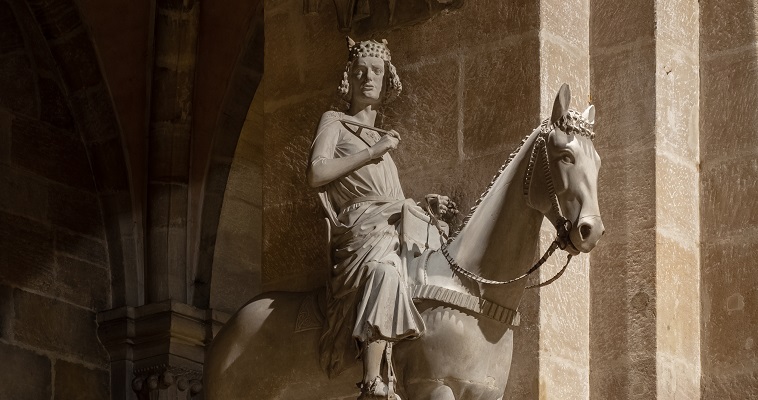
Parallel to these two spiritual-philosophical movements, there was a wave of interest in occultism and esotericism in 19th-century Germany, much of it with a nationalistic hue. The Germans were interested in ancient cultures, especially Egypt and the East, and found hidden connections to their new national identity. In a rootless society that underwent rapid urbanization, industrialization, and change, moving from 10% living in cities at the beginning of the 19th century to 75% living in cities at the end of that century, there arose a need for a new type of identity, and this was done by imagining a mythical past and purpose for the nation. A belief developed that the German (Aryan) people came from a mythical forgotten land called Thule, reminiscent of Atlantis, with an advanced culture and spirituality.
In a society with a Protestant background and a history of independent religious thought, there was a lot of place for astrology, alchemy, and occult sciences, partly encouraged by the rulers of Prussia. Yet, one must distinguish between occultism and spirituality, which means union with God, refinement, and love.
Towards the end of the 19th century and even more so at the beginning of the 20th century, a form of distorted esotericism developed with nationalistic hues. In the absence of God (Nietzsche “killed God”), and in the absence of Christian compassion, love, and universality (the word “catholic” means universal), a new type of religion relying on pseudo-science and a genuine feeling of a new era developed—a spiritual movement called Arianism, where everything was permitted, including the hate of others (something that has nothing to do with real spirituality by definition).
The Germans had Romanticism, but they lacked the development of it; in some ways the masses lacked the aesthetic refinement of the French, or the individuality and self-humour of the British. The individual was absorbed into the collective in a land that was supposedly meant to be a stronghold of privacy. Spirituality became secular and national; the German ethos grew at the expense of individual rights. Rudolf Steiner prophesied that the new Germany could be a source of spirituality and light for the world, or a dwelling place for the forces of darkness—sadly, the latter occurred with the rise of the Third Reich.
Wilhelm II
In 1888, a young man named Wilhelm II (1859–1941) suddenly found himself the ruler of a great nation that had not existed a few years earlier, a state that was the rising power in the world. A country whose birth story was a miracle, a country with a great future ahead of it, that rose as if from the dust, from nowhere, and still did not know where it was going. This was Germany, which did not even exist in 1870. Yet, by 1888, it was already the strongest country in Europe, with 50 million people, that had humiliated the French and Austro-Hungarian Empires in a series of successful wars.
After his accession to the throne in 1888, Wilhelm II clashed with the cautious and sober Bismarck. Wilhelm II was an incorrigible romantic with a tendency toward mysticism, captive to the dream of the German Empire, always dressed in military uniform and leaning toward the values of the Austrian military aristocracy. The result was that Bismarck was forced to resign in 1891. Wilhelm II led Germany toward expansion and growth that ultimately led to World War I.
Wilhelm II ruled until the end of World War I in 1918. At the beginning of his reign, Germany was a rising power in all respects: economic, industrial, cultural, educational, scientific, and also demographic. The population grew by 50%. Industrial plants were established everywhere; Germany led the world in science, culture, and art. People like Einstein, Nietzsche, and others operated in Germany. Reform Judaism developed in Germany, and Zionism found support there. But Wilhelm II dreamed of Germany leading the world both militarily and politically, and for that to happen, he had to create a German colonial empire like those of England and France, and also build a navy that could compete with England’s. His desire was supported by German industrialists, capital magnates, and the German romantic-national dream that served as a unifying bond for all the different groups in Germany.
However, Germany was at a disadvantage compared to Britain and France in terms of global expansion. Most of the good places were already taken, and what naturally remained were the Balkan countries (recently liberated from the Ottoman Empire) and the Ottoman Empire itself, which was the “Sick Man of the Bosphorus.” The German expansion dream looked eastward, toward the territories under Polish and Russian rule. In other words, the awakening power called Germany was constrained on one side by France, on the other by Russia, and globally by the British, and felt it had nowhere to expand. The burgeoning state established in Central Europe was on the verge of an explosion stemming from its subjective feeling of having no recourse and of being entrapped by the global balance of power.
Wilhelm II supported German construction projects in Jerusalem, including the Church of the Redeemer in the Christian Quarter, Augusta Victoria on the Mount of Olives, and the Dormition Church on Mount Zion. The three enormous churches and adjoining complexes were built over time, while referencing each other and German history, as we will see later.
Germany rehabilitated the Ottoman army after the Balkan War and helped build railways across the Empire, including the Hejaz Railway and the Valley Railway in the Jezreel Valley. For this reason, the Germans could do as they pleased in Jerusalem, and thus they installed bells in the church towers, which rang out Christian chimes across the city for the first time in 800 years. The bells of the three massive buildings were synchronized with each other.
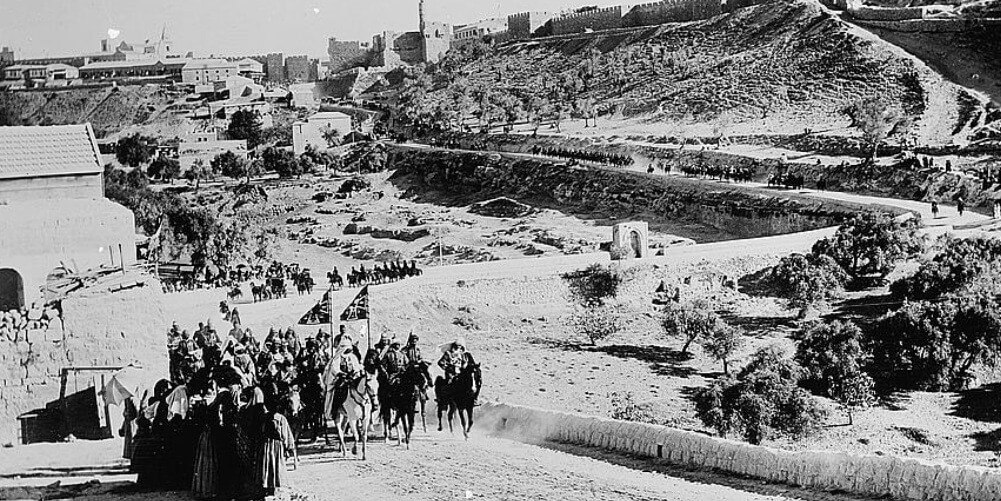
In 1898, Wilhelm II visited Jerusalem to inaugurate the Church of the Redeemer and toured the Middle East. He visited the tomb of Saladin in Damascus and delivered a speech in his praise, noting him as an ideal knightly figure. This was one year after the First Zionist Congress in Basel in 1897. Wilhelm II supported Zionism and met with Herzl during this visit. As part of the visit, Wilhelm II received a plot of land on Mount Zion from the Ottomans, where the German Catholics would later build the Dormition Church.
Wilhelm II saw himself as a kind of crusader pilgrim fulfilling the aspirations of his father and grandfather. It is worth noting that the English King Edward VII, Wilhelm II’s relative and a source of inspiration, visited Israel in 1862 as a prince. It should be noted that the two central figures of the Axis powers in World War I—Wilhelm II and Franz Joseph—both made significant visits to the Holy Land, which helped shape their worldview and were a facet of their connection to the Ottoman Empire (synchronicity).
During the first 20 years of his reign, Wilhelm II was associated with a circle of people who met at Liebenberg Castle, belonging to Prince Philipp zu Eulenburg, and were called the Liebenberg Circle [3]. Philipp was perhaps the person closest to the Kaiser, and the circle of friends was like his family. He was a mystic and a romantic who wrote books, poems, and plays—some fictional—about the ancient origins of the German people, including a mystical ballad called “Atlantis” and other romances about ancient Nordic origins, which were performed in the castle accompanied by music. Philipp believed in spirits, mediums, and Spiritualism, and claimed that the Kaiser also had a tendency toward this. His spirituality is reminiscent of the Rosicrucians and somewhat of the German chivalric ideal. He was called “The Troubadour” by his friends and was a central figure in organizing Herzl’s meeting with Wilhelm II in 1896.
Eulenburg apparently visited Jerusalem during his tour of the Middle East between 1872–1875, and it is possible that he told Wilhelm II about the wonders of the Holy Land and its connection to the German tradition. He accompanied Wilhelm II on his journey to the Holy Land in 1898, and it was probably not just a diplomatic mission, but a spiritual journey for both of them.
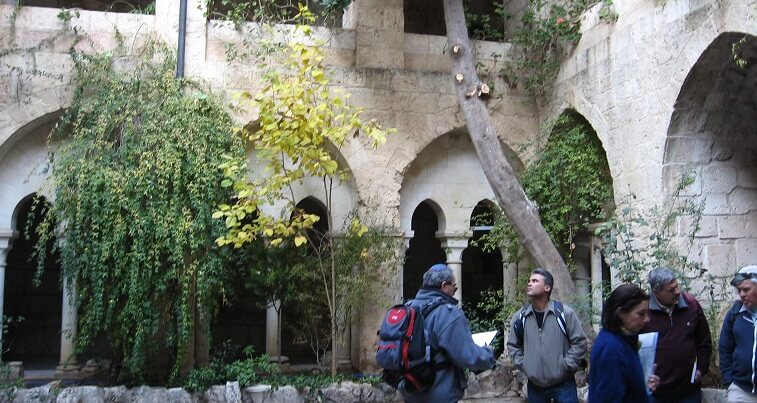
The Church of the Redeemer
There were several important Protestant figures and missionaries who were active in Jerusalem in the late 19th century. One of the most important was Conrad Schick, who arrived as a Protestant missionary, worked in the workshop of the Anglican Christ Church, became a kind of city architect, and, among other things, designed his house on Prophets Street—Tabor House—and also engaged in archaeological excavations.
Others were Samuel Gobat, the first German Protestant bishop, who built an impressive education system, and Johann Ludwig Schneller, who founded the Schneller Orphanage. They were in contact with Consul Finn and his wife. Later, the Templers also arrived and established a colony in Jerusalem. At the end of the 19th century, there were 1,500 Germans in the city, but their importance in its development was far beyond the relative size of the community.
The German influence in the city culminated with the visit of Kaiser Wilhelm II to the Holy Land and Jerusalem in 1898 to inaugurate the Church of the Redeemer (Erlöserkirche), one of the most impressive buildings in the Jerusalem landscape to this day.
The Church of the Redeemer is built on the site of the Crusader Church of Santa Maria Latina (see chapter on the Hospitallers) and in the style of a cathedral in Piacenza, Italy, the place where the First Crusade was declared in 1095. It symbolizes the silent crusade of Wilhelm II and his father Frederick III to achieve a Christian presence in Jerusalem. The land was gifted to the Germans by the Ottoman Sultan Abdulaziz in 1869, and the cornerstone was laid by Prince Frederick III, who visited Jerusalem for the opening of the Suez Canal. At the same time, the Austrian Emperor Franz Joseph also visited Jerusalem and inaugurated the Austrian Hospice. There was competition for influence between the two German-speaking empires. This was three years after the Austro-Prussian War and two years before the unification of Germany. The synchronistic network was at work this time too.
Initially, the first floor of the adjacent Crusader cloister was renovated, and the “Crusader Chapel” was inaugurated there as the first center for German Protestants in Jerusalem as early as 1871. Today it is part of the museum on the site. The project was halted for several years and resumed only with the accession to power of Wilhelm II in 1888.
The plan was based on earlier designs by Friedrich Adler, who designed 300 churches, including St. Thomas Church in Berlin. He was an expert on ancient architecture and an archaeologist, a professor of architectural history in Berlin, who participated in expeditions to Olympia and Asia Minor and visited Jerusalem, examining the ruins of the Santa Maria Latina Church as early as 1871. Based on his survey and proposals, his student Paul Ferdinand Groth designed the Church of the Redeemer in Romanesque Revival style. He was also responsible for the construction and completed the cloister and adjacent buildings. Paul Ferdinand Groth was in contact with Conrad Schick, conducting archaeological excavations with him at the construction site, which have recently been opened to the public as an underground archaeological park, accessed from the church level.
The plan for the bell tower was sketched by Wilhelm II himself, and it resembles a similar tower in Tivoli, Rome. The northern entrance features an arch with representations of agricultural work throughout the seasons. The carvings somewhat resemble astrological signs—evidence of the importance of astrology in the Middle Ages.
The church itself was inaugurated on 31.10.1898, during the royal visit of Wilhelm II. 31.10 is the day Martin Luther declared the Reformation. It is also All Saints’ Day (Halloween). At the ceremony, Wilhelm II spoke the following words:
“From Jerusalem, the light came forth in its glory, from which the German nation became great and sublime; and what the German people became, they became under the flag of the cross, the symbol of self-sacrificing love.” [4]
These words attest to the connection between the renewed spiritual German nationalism and Jerusalem.

Dormition – Mother of God
During Wilhelm II’s visit to Jerusalem in 1898, he received land on Mount Zion from Sultan Abdul Hamid and permission to establish a religious complex there. The Kaiser approached the Pope and offered to transfer the plot to German Catholic institutions, and so it happened. In 1895, the German Association of the Holy Land was founded, with the goal of strengthening the connection between German Christians and Israel, and it took responsibility for the construction.
At the end of the 19th century, there was a revival of Benedictine monasticism in Southern Germany. The Benedictine revival movement renewed the tradition of Gregorian Chant and developed religious art that was a synthesis of East and West. One of their centers was the Beuron Archabbey, which headed a network of monasteries. This monastery undertook to establish a daughter monastery at the place of the Dormition (Himmelfahrt / Assumptio Mariae) in Jerusalem. The Benedictines had a presence and monasteries in Jerusalem during the Crusades, and the Dormition was their return.
The monks of Beuron were influenced by the revival movement of Prosper Guéranger in France, who revitalized Catholic liturgy and rediscovered the Gregorian chants. He was one of the prominent Catholic thinkers and leaders of the 19th century, who brought a new spirit and renewal to the monasteries of France, especially the Benedictines. Prosper founded monasteries and also influenced a pair of his students, the brothers Maurus and Placidus Wolter, to establish the monastery in Beuron. Prosper also influenced the liturgy and renewal of the French Olivetan Benedictine Order. In the same years that the German Benedictines established themselves in the Holy Land, the French Benedictines also returned to Jerusalem and established their monastery in the Crusader Church of Abu Ghosh (synchronicity).
In 1900, the cornerstone for the Dormition was laid. The German architect Heinrich Renard designed the church. Construction lasted 10 years, ending in 1910. In 1926, the monastery was granted the status of an Abbey, with an authoritative Abbot as head of the monastery; in 1951 it became independent. Today it has several dozen monks and a branch of a Catholic academic institution, and it is also responsible for the Benedictine guesthouse and church in Tabgha near the Sea of Galilee.
The secret of the church is that its structure is reminiscent of the Palatine Chapel in Charlemagne’s palace in Aachen. All the kings of the Holy Roman Empire were crowned in this structure, which still exists today, until the 16th century.
Charlemagne is the ideal king figure in the German tradition, who brought about a cultural and religious Renaissance at the end of the 8th century. He was the first to attempt to establish a Christian and just kingdom in Europe and was responsible for the transfer of the title of the Holy Roman Empire from Byzantium to Germany. He ruled over parts of Germany, France, and Europe. His era saw a flourishing of scholarship and law, and the beginning of the development of feudal society and the ideal of chivalry.
Charlemagne and his knights played a crucial role in stopping the Muslim expansion into Europe, strengthening Christianity and the Papacy, and Christianizing Northern Europe. According to legend, Charlemagne did not die because of his righteousness but fell asleep and is still sleeping today in the crypt of his Royal Chapel in Aachen, waiting for the moment Germany needs him, when he will return and establish a just kingdom on earth for the final time, ushering in the Kingdom of Heaven. This tradition parallels the Jewish tradition of King David, who did not die but is alive and exists in the caves beneath Mount Zion. However, in the crypt of the Dormition Church, one will not find Charlemagne sleeping, nor King David—instead, one finds a statue of a sleeping beautiful woman representing Mary, who fell asleep at this location.
According to Mariological belief, Mary’s body was sanctified even before the Annunciation and certainly with the pregnancy and birth, and therefore, when her time came to die, an angel appeared to her and announced that she would not die. When her day came, she would fall asleep for three days, and then Jesus would come and take her body and soul to heaven, and so it was. Mary fell asleep at the site of the ancient Christian community house on Mount Zion, and thus the church erected at the place is called “Dormition” (falling asleep).
The statue of the Sleeping Mary has a face and hands made of ivory and is located beneath a small stone canopy supported by six columns symbolizing six holy biblical women depicted on the canopy: Jael, Eve, Esther, Deborah, Ruth, and Judith. Between them, and directly above the statue of the Sleeping Mary, is the figure of Jesus. All figures are painted inside circles. Around the figure of Jesus on the ceiling, there is an inscription from the Song of Songs (2:13): “Arise, my darling, my beautiful one, and come away,” expressing the Marian concept, widespread in the Late Middle Ages, of the mystical marriage between Jesus and Mary.
The mystical marriage between Jesus and Mary is another expression of the attraction between the masculine and the feminine, between opposites—the relationship between the Godhead in heaven and human beings on earth.
This union is aimed at awakening humanity from its slumber and bringing about a new consciousness that will hasten the Kingdom of Heaven. Not only Mary is sleeping beneath the canopy, but Charlemagne, King David, and, in fact, all of humanity as well, and they all need to awaken, and will awaken on Judgment Day. Meanwhile, we must awaken to our lives, to the high spiritual possibility inherent in them.
The canopy resting on a circle of six columns is surrounded by an ambulatory supported by 12 additional columns representing the 12 Apostles, and on its wall are six small apses containing six altars dedicated to Mary, which are (clockwise): Mary as Daughter of her People, Mary Queen of Pilgrims, Mary Queen of Monks, Mary Queen of the West, Mary Queen of Prophets, and Mary Queen of the Patriarchs. The six altars were donated by six nations that venerate Mary: Austria, Hungary, Venezuela, Brazil, the United States, and Côte d’Ivoire. The Austrian altar (the first) was built in honor of Engelbert Dollfuss, the Chancellor of Austria assassinated by the Nazis.
The Crypt is built like a rotunda, so one can circle the symbolic “tomb” in two circular spaces, one inside the other. The church structure above the crypt is also circular, and one can see concentric circles on the floor—an inner circle that opens into larger circles. The circle is a symbol of perfection, as it has neither beginning nor end. It symbolizes the cycles of life, birth and death, and is linked to the feminine principle. Furthermore, something different can occur inside the circle than what occurs outside, and therefore it also symbolizes consciousness. Circular churches are related to resurrection according to the model of the Rotunda of the Church of the Holy Sepulchre.
On the southern side of the Crypt is an opening into a space with columns and a chapel dedicated to the descent of the Holy Spirit that happened nearby, featuring a painting of Mary seated at the head of a table with the Twelve Apostles on either side, with the Holy Spirit descending on them in the form of a dove and flames of fire. To the left stands another altar dedicated to John the Baptist, with a copper relief on either side depicting female figures who, according to the New Testament, witnessed the crucifixion of Jesus. All the women have identical facial features, but if one taps the different figures, each emits a different sound.
The main hall of the church has a large apse with a mosaic image of Mary holding the Child Jesus in her arms, who holds a book open to the sentence: “I am the light of the world.” On the floor of the main hall are concentric circles expressing Christian religious cosmology: in the center, three intertwined circles with the words “Holy, Holy, Holy.” Surrounding them are figures of the Four Living Creatures of Ezekiel’s vision and the names of the four major prophets in the Old Testament who heralded the coming of Jesus. Following them is a wheel with the 12 signs of the Zodiac, linked to a wheel with the names of the 12 minor prophets in the Old Testament and the 12 Apostles in the New Testament, and finally, a circle with 26 saints. In the outermost circle are verses from Proverbs 8:23–24: “I was formed long ages ago, at the very beginning, when the world came to be. When there were no watery depths, I was given birth, when there were no springs overflowing with water.”
The church floor is an expression of Christian cosmological views. Its meaning is that the Divine Light, which is Jesus, flows into the world through the Four Evangelists, reaches all corners of the earth through the 12 Apostles, and is revealed through the 26 Saints who gave their lives for the new faith. Furthermore, the floor reveals that the first revelation is Spiritual Light, which is the Holy Trinity. The second revelation is Prophetic Light, which appears in the form of the four major prophets and the Four Living Creatures of Ezekiel’s vision. The third revelation is the work of the 12 minor prophets, the 12 Apostles, and the Saints—in other words, the Community (Israel of the Spirit), or the Church.
The walls of the main hall have six chapels. The first chapel on the left is dedicated to Saint Boniface, an English Benedictine saint and the Apostle and patron saint of Germany. The second chapel on the left is dedicated to John the Baptist. The third chapel on the left is dedicated to Jesus’ father, Saint Joseph, with medallions in the background showing the ancestors of Jesus and emblems of the knightly orders that donated money for the altar’s construction.
The first chapel on the right is dedicated to Saint Benedict, the founder of the Benedictine Order that maintains the place. He resembles Moses and holds the book of monastic rule in his hands. Above Benedict’s statue are 14 ivory carvings and reliefs depicting the miracles that occurred to him, and on the periphery of the chapel are medallions of all the saints of the Benedictine Order.
The second chapel on the right is dedicated to Saint Willibald [5], who was born in England in 700 and had the distinction of being the first English pilgrim to the Holy Land. He later became a bishop of one of the German cities. The mosaic shows St. Willibald and the patrons of Bavaria venerating Mary, and on the sides appear the emblems of the Bavarian knightly orders. The altar contains a Latin inscription that says: “All patrons of Bavaria, pray for us.”
The third chapel on the right is dedicated to the Three Magi. The mosaic shows patrons, bishops, and founders of churches in the German city of Cologne—where the relics of the Three Magi are located. Above the altar is a bronze relief depicting the birth of Jesus and the adoration of the Three Magi, with a shining star above the relief symbolizing the star that illuminated their path. The relief is a copy of a relief in a church in Cologne.
The church interior has an extraordinary echo, which is related both to the importance of Gregorian Chant in the renewed Benedictine Order and may also hint that the church was built according to the principles of sacred architecture, suggesting that there is more to it than meets the eye. In this context, it is interesting to note that, according to John Michell [6], the Palatine Chapel in Cologne is built according to the celestial diagram model that also appears at Stonehenge and in other structures around the world (see chapter in the first book). The diameter of the central space in the Dormition is almost identical to that in Aachen.
Recently, the dome was painted scarlet red on the inside, the color of the descent of the Holy Spirit at Pentecost, and one can sometimes feel this.
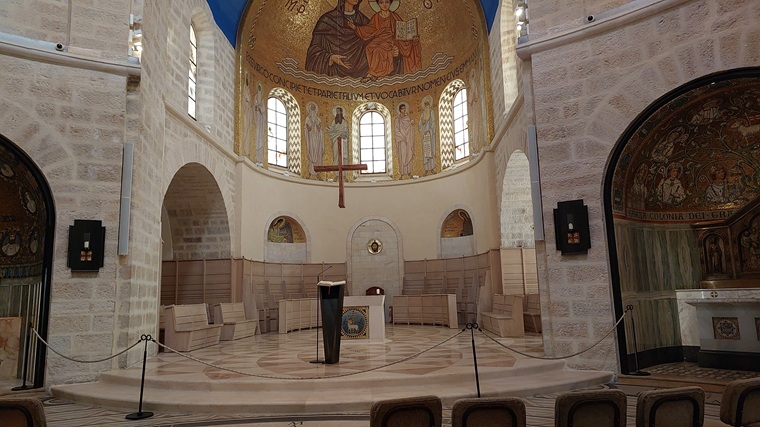
Augusta Victoria Church of Ascension
The third marvelous structure the Germans built in Jerusalem is the Church of the Ascension in the Augusta Victoria complex atop the Mount of Olives. When Kaiser Wilhelm II visited the Holy Land, his wife accompanied him, and together they ascended the Mount of Olives and dreamed of establishing a church there. A few years after they returned to Germany, a suitable plot of land was purchased at the summit of the mountain.
Like other churches in Jerusalem, this church also mimics, in some of its architectural elements, ancient churches in Germany—in this case, the Church of St. Michael in Hildesheim from the 11th century, which is a World Heritage Site. Hildesheim was the center of the Holy Roman Empire at that time. Saint Bernward of Hildesheim wanted to demonstrate its importance and built the church as a model of the Heavenly Jerusalem and of a city meant to rival Rome and Jerusalem, as well as to give divine legitimacy to the German Ottonian dynasty. He was an educator, a relative of the king, and a friend of Pope Sylvester II.
The Holy Roman Empire essentially began with Otto the Great (912–973) of the Ottonian dynasty, who replaced the Carolingian dynasty. The last ruler of the dynasty was Henry II the Saint, who ruled from 1014–1024 from his center in Hildesheim. If the structure of the Dormition Church is linked to Aachen and the Carolingian dynasty, the structure of the Augusta Victoria Church is linked to the Holy Roman Empire and the Ottonian dynasty.
Wilhelm II saw himself as the successor to the legendary Hohenstaufen dynasty of the Middle Ages, which ruled the Holy Roman Empire and whose importance lay partly in the fact that its last kings were also Kings of Jerusalem. Among the famous kings were Frederick Barbarossa and Frederick II (see chapter in the second book). This is reflected in the ceiling paintings, which also show Wilhelm II and his wife holding the church structure, exactly as in Byzantine churches.
The ceiling paintings of the Augusta Victoria Church follow the model of St. Michael’s Church in Hildesheim, where one sees the genealogy of Jesus from Adam to Joseph, as well as events, prophets, kings, and angels from the Old Testament, figures and events from the New Testament, and the Seven Virtues, all in medallions. On the ceiling at Augusta Victoria, one sees angels and apostles, and on the walls a representation of the prophets, scenes from the New Testament, and more. But its unique feature is the representation of the Heavenly Jerusalem with the four important Crusader kings on the ceiling: Godfrey of Bouillon, Baldwin I, Baldwin II, and Fulk of Anjou, as well as a representation of the German kings—Frederick Barbarossa, Frederick II, and Conrad III—and the kings Richard the Lionheart of England, Louis VII, and Philip II of France, all of whom participated in the Crusades. The context is clear: the church is a validation of the Kaiser’s rule by Divine Grace, his role as the renewer of German Christian culture, and the leader of the Quiet Crusade.
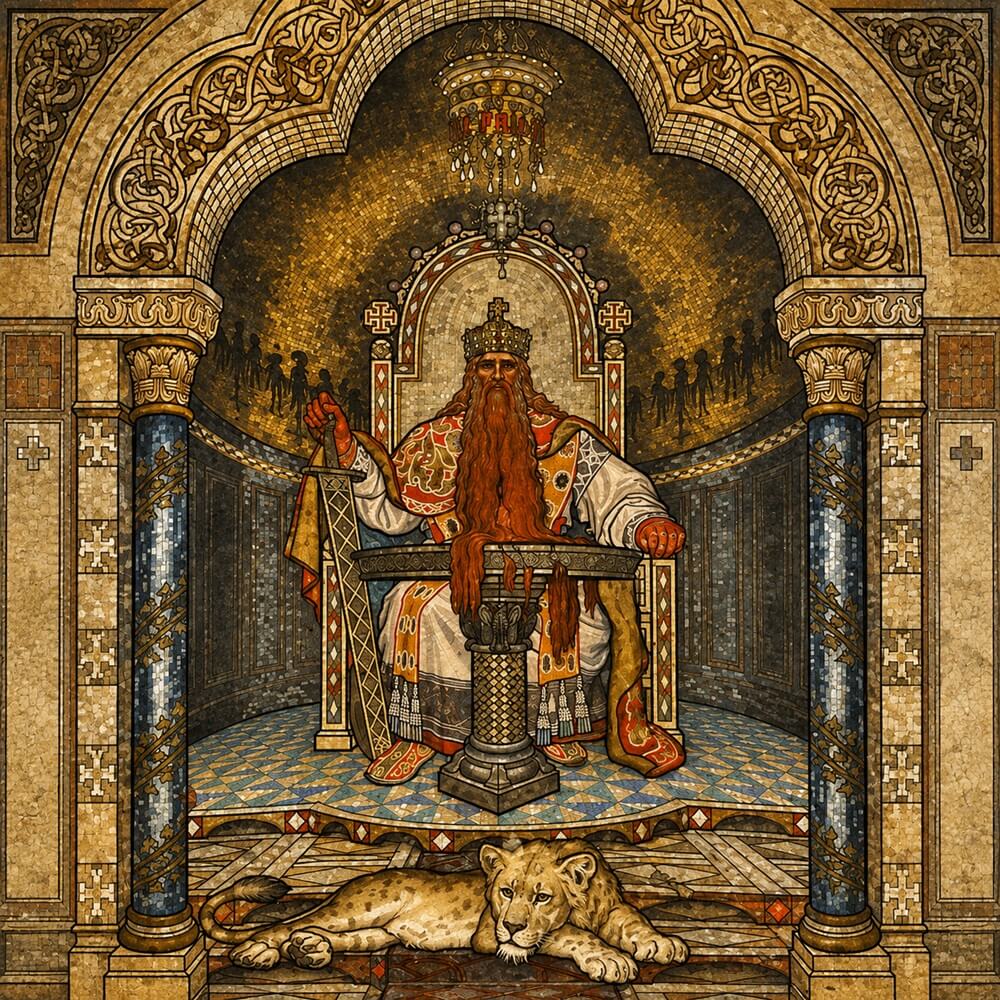
The church has a balcony leading to a large reception hall, with a mosaic on one wall showing Frederick Barbarossa sitting half-asleep next to a stone table, his wild red beard growing long like tree roots and penetrating through the cracks in the stone. According to legend, he did not die but is sleeping in the crypt of his castle beneath a mountain in Germany, waiting for the time when Germany will need him. Wilhelm II represented him in this way in the monument he erected in his honor at Kyffhäuser, Germany (see chapter on Barbarossa, second book). The meaning of the name Barbarossa is “Red Beard,” and if so, then Wilhelm II is “White Beard.”
Wilhelm II’s adoption of Barbarossa as a model indicates his interest in alchemy and his connection to German esoteric Rosicrucian societies. In the alchemical process, the basic substance—which is black—is transformed through the spiritual fire (which is red) back into white. This is also reflected in the red and black bricks of the fireplace in the room and in the red and white ablaq style of masonry in the arches of the church hall.
In any case, Wilhelm II’s romantic spiritual ideal ultimately led him astray into the catastrophe of World War I. Towards the end of his life, he spoke out against Nazism, arguing that one should not confuse true German spiritual nationalism with dark fanaticism. As he said: “From our Germany, which was a nation of poets and musicians and artists and soldiers, it became a nation of hysterics and recluses, swallowed up by a mob led by a thousand liars or fanatics…” [7]
Another thing worth mentioning in the Augusta Victoria Church of the Ascension is the large apse where Jesus is seen ascending to heaven, flanked by people dressed in white. Unlike in other churches, the apse faces south toward the summit of the Mount of Olives—the place from which he ascended—and not east. The walls and windows of the church feature many heraldic shields of German noble families, offering another glimpse into the tradition we wrote about elsewhere. On the ground floor near the entrance is a showcase with a prayer book in Hebrew containing a prayer for the welfare of the Kaiser, a plastering trowel, and a key to the place, which perhaps indicates a connection to the Freemasons, for whom the plastering trowel is a symbol.

Romanesque Architecture
The Dormition, Augusta Victoria, and Redeemer Churches are some of the most beautiful examples of Romanesque architecture in Jerusalem. The style called “Romanesque” takes its name from the root word Rome. To some extent, it represents a return to the Roman building style in its use of round arches, brick construction, thick walls, and symmetry, but it is not identical to the classical Roman style. The Romanesque style suited the spirit of the time by creating massive structures that resembled fortresses. Furthermore, later sources gave the Romanesque style a spiritual and religious interpretation, viewing it as a style that directs a person inward, toward contemplation and the inner world. The round arches, small windows, and thick walls create a sense of gloom and mystery, while the symmetry adds tranquility and order. The Romanesque style was well suited to the contemplative spirit of the monasteries.
Romanesque cathedrals and churches were, in many cases, built as part of the pilgrimage routes that began to develop in Europe starting in the 10th century. The architecture reflects this in the relationship between the main building, its surroundings, and other related structures. In the Field of Miracles in Pisa, which is considered the peak of the Romanesque style, the cathedral is one part of a system of adjacent buildings symbolizing different stations on the pilgrimage route. In front of it stands the Baptistery, next to it the famous Leaning Tower, and alongside it the Monastery.
However, pilgrimage is not only an external journey but also an internal journey of contemplation and approach to the sacred. The spiritual journey is supported by solitude and detachment from the material world, which is reflected in the gloom and enclosure of the spaces within the buildings themselves.
One of the features of the Romanesque style is a corridor surrounding the apse from the exterior, called the ambulatory, where a variety of secondary altars and chapels related to holiness are located. It seems as if the eastern area of the church, where the altar is located, takes on a life of its own; an entire order of saints is expressed within it. The chapels and secondary altars allow for the housing of sacred relics—a central concern in the Middle Ages.
Another characteristic of Romanesque architecture is a monumental façade featuring towers and sculptures. The façade symbolizes the grandeur and splendor of the Church toward the external world, but it also leads inward to mystery and contemplation. Entering the church is like entering another world. Therefore, a large part of the church liturgy involves processions leading from the outside to the inside. The purpose of the façade is to guide one inward, but over time, it acquires a life of its own.
The Romanesque style first appeared in the Church of San Vitale in Ravenna and in the Palatine Chapel of Charlemagne in Aachen, which are unique and exceptional achievements. The structure in Aachen is a large multi-story octagonal building connected to the royal palace. Charlemagne used Roman arches and building techniques, but in a distinctive and innovative manner. The cathedral in Aachen and the Church of San Vitale served as the models and prototypes for the emergence of a new architectural style called “Romanesque” in the 11th century.
The churches of San Vitale in Ravenna and the Palatine Chapel of Charlemagne in Aachen have three floors expressing the hierarchy of spirit, the world of ideas, and matter. The theme of the graded Trinity is at the foundation of Christian mystical thought (in contrast to the co-equal Trinity), and also appears in the Byzantine art of the period, especially in the form of three-tiered fountains. The world is perceived as containing three realities simultaneously: an earthly reality as the lower floor, a divine reality as the upper floor, and an intermediate reality of angels, powers, and energies as the middle floor. In Romanesque architecture, there seems to be no connection between the upper floor, which is seemingly unattainable, and the lower floor. This changes with the transition to the Gothic style, where the upper floor seems to connect with those beneath it, and the light entering from above through the stained-glass windows becomes part of the building, flooding everything.
Pope Gregory VII (the Great) (1073–1085) led the Gregorian Reform in the Church, bringing about the primacy of the Papacy over the Empire (the Walk to Canossa) and strengthening the moral conduct of the Church. Gregory VII attacked simony (the buying of offices with money) and encouraged celibacy for priests. Part of the reform was the emergence of a new architectural and artistic style: the Romanesque style. In this context, several prominent churches were built. An important and central Romanesque church was established in Cluny. Other famous Romanesque buildings include the church in Lucca and the Cathedral of San Martino.
The Gregorian Reform was promoted by Pope Alexander II and the popes who followed. In addition to architecture, a new form of church art appeared, primarily sculpture and carving, along with an intensification of prayer and pilgrimage. The developing religious perception was that behind the visible world other worlds exist, that the Scriptures have a hidden meaning, and therefore the new sculptures and art contain several levels of understanding. This developing perception was based on the writings of Origen, Jerome, Augustine, and especially Hugh of Saint Victor [8].
Hugh came from Germany to the Abbey of St. Victor in Paris in 1120, which was an important center of learning (founded in 1108). He became head of the Abbey and died there in 1141. He was influenced by Pseudo-Dionysius the Areopagite and Augustine, and wrote the book On the Sacraments of the Christian Faith [8], which contains an allegorical understanding of the Christian mystery. He reintroduced the celestial hierarchy of Pseudo-Dionysius [9] in his Commentary on the Celestial Hierarchy, and this appears in Romanesque sculpture and decoration.
The Romanesque style developed simultaneously with the Gothic architectural style, perhaps slightly preceding it. Both styles were influenced by thinkers active in Paris—the Gothic in particular by Abbot Suger of Saint-Denis—and both relied on the thought of Pseudo-Dionysius. According to Hugh of Saint Victor, Divine Wisdom is the archetypal form of creation, a kind of secondary divinity. Science and philosophy help in understanding and containing the mystery of Jesus; they are effective tools in religious life and therefore should be encouraged.
Romanesque art revealed four levels of interpretation in the text of the Holy Books: literal, typological (allegorical), moral, and mystical. The renewed Romanesque sculpture adopted this approach. It drew its inspiration from classical, Byzantine, Celtic, and even Mesopotamian and Nordic sculpture, but its meaning arose from the allegorical interpretation of the sculpted events. There was a transition from the aesthetic to the spiritual. This is reflected in the fact that some of the sculptures cannot be seen, and their placement was intended to exorcise evil spirits and invoke higher energies. For example, the statue of Archangel Michael is usually found on the western side, because the angel’s energy helps prevent evil spirits from entering the building and repels them.
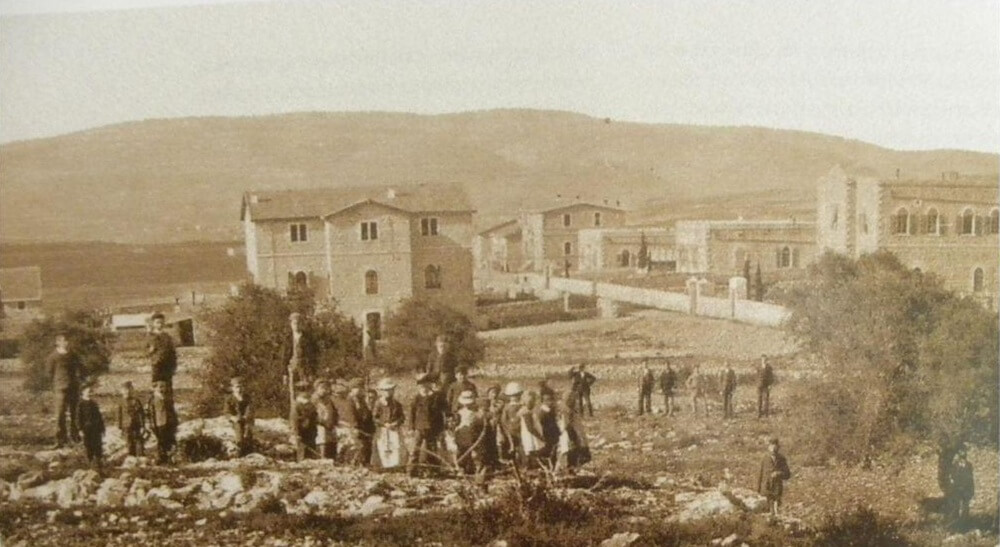
The German Templers
One of the most beautiful neighborhoods in Jerusalem is the German Colony. The story behind it concerns a Protestant spiritual community that viewed settlement in the Holy Land in general, and Jerusalem in particular, as an act that would hasten the Redemption. The story goes as follows:
Christoph Hoffmann (1815–1885) decided to dedicate his life to establishing the Kingdom of God in the Land of Israel, gathering the people of God in Jerusalem so as to hasten the Second Coming of Jesus and the Redemption. For this purpose, he founded the Templer Society in Germany together with Georg David Hardegg—a movement of Christian renewal in the spirit of 18th-century Pietism. The word Temple refers to the Christian community enjoying the gifts of the Spirit—the People of God. The name is based on a verse in the First Letter to the Corinthians (3:16–17): “Don’t you know that you yourselves are God’s temple and that God’s Spirit dwells in your midst? If anyone destroys God’s temple, God will destroy that person; for God’s temple is sacred, and you together are that temple.”
Hoffmann preached for a change in human attitude and behavior that would be expressed in a pure and productive community life, as a necessary stage on the way to the Second Coming of Jesus. The emphasis of religion, he argued, should be morality, contemplation, and devotion, through which a person would receive the gifts of the Spirit: intuition, inspiration, and prophecy. The goal of Christian life is a mystical rebirth in God and, in the spirit of God’s love, to spread the light among other human beings.
The practical innovation of Hoffmann and Hardegg was the establishment of a model society in the Land of Israel, in the hope that this would lead to the spread of the ideas of spiritual Christianity throughout the world and eventually to global social change. The community in the Holy Land was intended to serve as a model for other communities worldwide [10].
The Templers came to the Holy Land in 1868 and established a colony in Haifa. This was the same year that Bahá’u’lláh also arrived in the Holy Land, writing a letter to the head of the community, Hardegg, who wished to meet him [11]. Bahá’u’lláh saw the Templers’ arrival in the Holy Land as an intuitive response to his own coming. He affirmed their belief in the awaited Second Coming of Jesus and called on them to recognize him as the embodiment of the Light of God. This did not happen. Instead, the Templers established additional colonies, and in 1873 the German Colony in Jerusalem, where they moved their center. Thus Hoffmann moved to Jerusalem in 1878, where he died and was buried.
It is interesting to note that the Germans already had a Protestant community in Jerusalem in 1852, and between 1866–1869 it was led by Carl Hoffmann, Christoph Hoffmann’s nephew. It can be assumed that there was communication between the two, and that Carl Hoffmann informed Christoph Hoffmann that the times were favorable for new settlement in the Land of Israel. The society Christoph Hoffmann founded was initially called “Friends of Jerusalem,” and the book he wrote toward the end of his life was titled My Way to Jerusalem [12]. Jerusalem was an ideal concept for him, not merely a physical place.
The Templers established the German Colony, whose houses still exist today, as does its interesting cemetery. In 1882, their community house was built—the Templer Church on Bethlehem Road in Jerusalem. In 1898, Kaiser Wilhelm II and his wife, Augusta Victoria, visited Jerusalem and were welcomed by the Templers, who maintained their German citizenship. Over the years, the Templers lost some of their spiritual charisma, but in the meantime they became an important economic and social factor in the life of the city. During World War II, they were expelled from their colonies in the Land of Israel by the British, but a community of them still exists in Australia.
German Idealism
On Prophets Street, there are two German charitable institutions. The first is a children’s hospital—the first of its kind in the world—founded by an idealist named Max Sandretzky, who dedicated his life and his family’s lives to treating sick children without profit or missionary influence. He was a friend of none other than Bismarck and was supported by one of the German dukes, a general in the Prussian army. The second institution is the German Hospital belonging to the Deaconess Sisters, a Protestant charitable institution founded by Theodor Fliedner in Germany in the mid-19th century. Theodor himself came to the Holy Land to promote this institution and inaugurated the Talitha Kumi Orphanage for girls. He is known for having influenced Florence Nightingale in the development of modern nursing.
Deaconesses comes from the word diakonos (deacon). This is a movement that developed with the help of several people at the end of the 19th century, and today close to a million people are active within it. The idea of deacons in Christianity is that they serve society; there are seven deacons who are responsible for both the welfare of the community and religious worship. In addition to these two German institutions, there were other hospitals on Prophets Street: the English Hospital (now an educational institution), the Italian Hospital, the Rothschild Hospital, the Bikur Cholim Hospital, and more.
Footnotes:
[1] Kierkegaard, S. (1985). Fear and trembling (A. Hannay, Trans.). London: Penguin Books. (Original work published 1843)
[2] Otto, R. (1999). The Idea of the Holy: An Inquiry Into the Non-Rational Factor in the Idea of the Divine and Its Relation to the Rational. Translated by M. Ron. Tel Aviv: Carmel. (Hebrew translation)
[3] Domeier, N. (2015). The Eulenburg affair: A cultural history of politics in the German Empire (Vol. 1). Boydell & Brewer.
[4] Ben-Arieh, Y. (1977). A City Reflected in its Periods: Jerusalem in the Nineteenth Century. Jerusalem: Yad Izhak Ben-Zvi.
[5] Hugeburc. (1968). Vita Willibaldi: The Hodoeporicon of Saint Willibald (C. H. Talbot, Ed. & Trans.). In Soldiers of Christ: The Lives of Saints and Martyrs (pp. 141–163). London: Sheed and Ward.
[6] Michell, J. (1979). The Heavenly City: The Heavenly Diagram of Sacred Architecture and Geometry. London: Thames & Hudson.
[7] Wikipedia on Wilhelm II (translated quote).
[8] Hugh of Saint Victor. (2007). On the Sacraments of the Christian Faith (De sacramentis Christianae fidei) (R. Baron, Trans.). Cambridge, MA: Harvard University Press.
[9] Pseudo-Dionysius the Areopagite. (1987). The Celestial Hierarchy. In The Complete Works (C. Luibheid & P. Rorem, Trans.). New York: Paulist Press. (Classics of Western Spirituality)
[10] Ben-Artzi, Y. (1996). From Germany to the Holy Land: The Templer Settlement in Palestine, 1869–1948. Jerusalem: Yad Izhak Ben-Zvi.
[11] Ekbal, K., & Lambden, S. (2003). Tablet to Hardegg (Lawh-i-Hirtík): A Tablet of Bahá’u’lláh to the Templer Leader Georg David Hardegg. Lights of ‘Irfán, 4, 97–110.
[12] Hoffmann, C. (1884). Mein Weg nach Jerusalem: Erinnerungen aus meinem Leben [My Way to Jerusalem: Memoirs from My Life]. Stuttgart: Verlag von Christoph Hoffmann.