The Second Crusader Kingdom Period
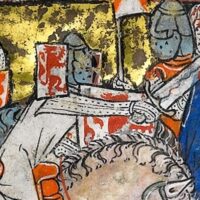
In 1187, the Crusader Kingdom of Jerusalem fell to Ṣalāḥ ad-Dīn (Saladin). Later in the book, we will see how this looked from the Muslim perspective, how it related to Muhammad’s Night Journey, and how it led to the rise of the Sufi orders. However, for Christians, it was a disaster and a sign that God was displeased with them. Just as He brought about the exile of the Children of Israel because of their sins, so too did He bring about the defeat of the Christians for the same reason. Therefore, they needed to repent and adopt a new, purer spirituality to replace the one that had failed.
It is said that Pope Urban III died of a broken heart after news arrived of the loss of the Holy Land, and his successor, Gregory VIII, also died of illness two months later. The consensus was that God was turning His back on the Christians, and the reason, as preached by Henry of Albano, was the collective sins of the Christian world and the proliferation of internal wars within it. The remedy was to establish peace among the kings of Europe—especially those of France, Philip II, and England, Henry II—and enlist them in the common effort to re-liberate the Holy Land.
This matter was critical because of the connection between the earthly Jerusalem and the heavenly Jerusalem. Thus, within five years, some of the most important kings of Europe made a sacred peace agreement among themselves and committed to the sacred mission, launching the Kings’ Crusade to re-liberate the Holy Land, led by the English Richard the Lionheart, the French Philip II, and the German Frederick Barbarossa.
The 12th century was a romantic period of improbable historical events, the development of spiritual doctrines, and the return of mysticism and philosophy to Christianity through the encounter with the Muslim world. The 13th century was the peak of the Middle Ages, a time of enlightenment and holiness. Politically, the divine peace did not last long among the great kingdoms and kings, or even among the different forces within the Crusader Kingdom itself. It was a period of wars between Christians and power struggles, but culturally, artistically, and spiritually, there was immense development in the form of new orders, universities, and more—development that would lead to the Renaissance after the crisis of the 14th century. This development of Europe is intrinsically linked to the history of the Second Crusader Kingdom.
In 1191, the Crusaders re-conquered Acre and the entire coastal plain up to Jaffa and established the Second Kingdom of Jerusalem, which existed for about a hundred years until the fall of Acre to the Mamluks in 1291. Already at its founding, the Crusaders secured rights for pilgrims to Jerusalem, and from 1229 until 1241, they managed to regain control of Jerusalem itself. The spiritual traditions that emerged during this period are discussed in the following chapters.

Frederick Barbarossa
There are a few important legendary rulers in Germany: the first is Charlemagne, the second is Frederick Barbarossa, and to them one can add, to some extent, Frederick II. However, Frederick II’s main focus, affiliation, and attention were related to Southern Italy and not Germany. Thus, Frederick Barbarossa is portrayed as the just German king who did not die but fell asleep and will return to establish a kingdom of justice on earth at the end of days.
Even before becoming king, the young Frederick Barbarossa came to Jerusalem during the Second Crusade along with his uncle, Emperor Conrad, who later appointed him as his heir. According to legends, during the Crusade, Frederick discovered—through a vision—a legendary sword inscribed with holy words that gave him supernatural powers. During his coronation in Rome, the church was filled with spiritual light. The coronation ceremony was infused with esoteric spiritual symbolism. The sword disappeared and reappeared during one of the battles, and eventually its whereabouts were lost.
Frederick Barbarossa was a redhead, hence his name—Red Beard (Barbarossa). He ascended to power in 1155 and ruled until 1190. During his tenure, he was influenced by the visions of the “Prophetess on the Rhine,” Hildegard of Bingen (1098–1179), who served as a kind of admonishing advisor to him at the beginning of his reign. She was a nun with heavenly visions who developed a theory of the structure of the spiritual worlds—worlds of emanations, cosmic order, and man as a microcosm of that order—assigning humanity a role as the completer and rectifier of creation, a doctrine somewhat reminiscent of Kabbalistic teachings.
Hildegard wrote ecclesiastical poetry and plays, and from a young age could perceive reflections of the divine light, leave her body, and go on astral journeys in which she visited places and spiritually encountered different people and periods. Thus, she could visit, describe, and remain in contact with the spiritual Jerusalem (sometimes linked to the Church) instead of the physical Jerusalem. According to Hildegard, the soul’s journey back to God is likened to the pilgrim’s journey to Jerusalem.
In 1151, she published her first book of visions, which received papal approval, called Scivias (“Know the Ways”). Her third book, published in 1169, is called Liber divinorum operum (“Book of Divine Works”), containing cosmological descriptions of creation and of man as a microcosm. Paintings from this book decorate the walls of the Knights’ Halls in Acre, including a human figure that looks like Leonardo da Vinci’s Vitruvian Man and a portrayal of a round world with the forces ruling over it in six spheres above.
Hildegard was active in the Rhine Valley during a cultural and religious renaissance supported by Frederick Barbarossa. In this context, the Archbishop of Cologne, Rainald von Dassel, brought the relics of the Three Magi to Cologne from Milan, turning the city into a new Jerusalem in Germany. A tradition of courtly love developed in Germany, along with Holy Grail legends, Christian mysticism, and doctrines of alchemy that later appeared in the writings of Albertus Magnus. The meanings of the gifts of the Three Magi are the esoteric studies of Alchemy—gold, Magic—myrrh, and Astrology—frankincense.

The red color alluded to in Barbarossa’s name symbolizes change and renewal according to alchemists, revealing Frederick’s preoccupation with the occult. The red color is the purifying and refining fire that transforms base materials into gold. Hence, Barbarossa attained the Philosopher’s Stone and therefore achieved eternal life. According to the Rosicrucians, he was a Philosopher King, a figure who promoted spiritual chivalry—an enlightened man. According to Goethe, he is connected to the spiritual destiny and esoteric tradition of the German people.
In any case, in 1190, Frederick Barbarossa set out at the head of a large army for the Land of Israel as part of the Third Crusade. However, like Alexander the Great before him, part of the purpose of the journey was a search for knowledge, not merely military conquest. The army marched through the Balkans and had to fight hostile forces along the way. In addition, the Byzantines tried to obstruct him, but Frederick overcame all difficulties, reached Turkey, conquered Konya—the capital of the Seljuks—and continued to Armenian Cilicia, where, unexpectedly, he drowned in a river. As a result, his large army dissolved, and only a few thousand reached the Land of Israel.
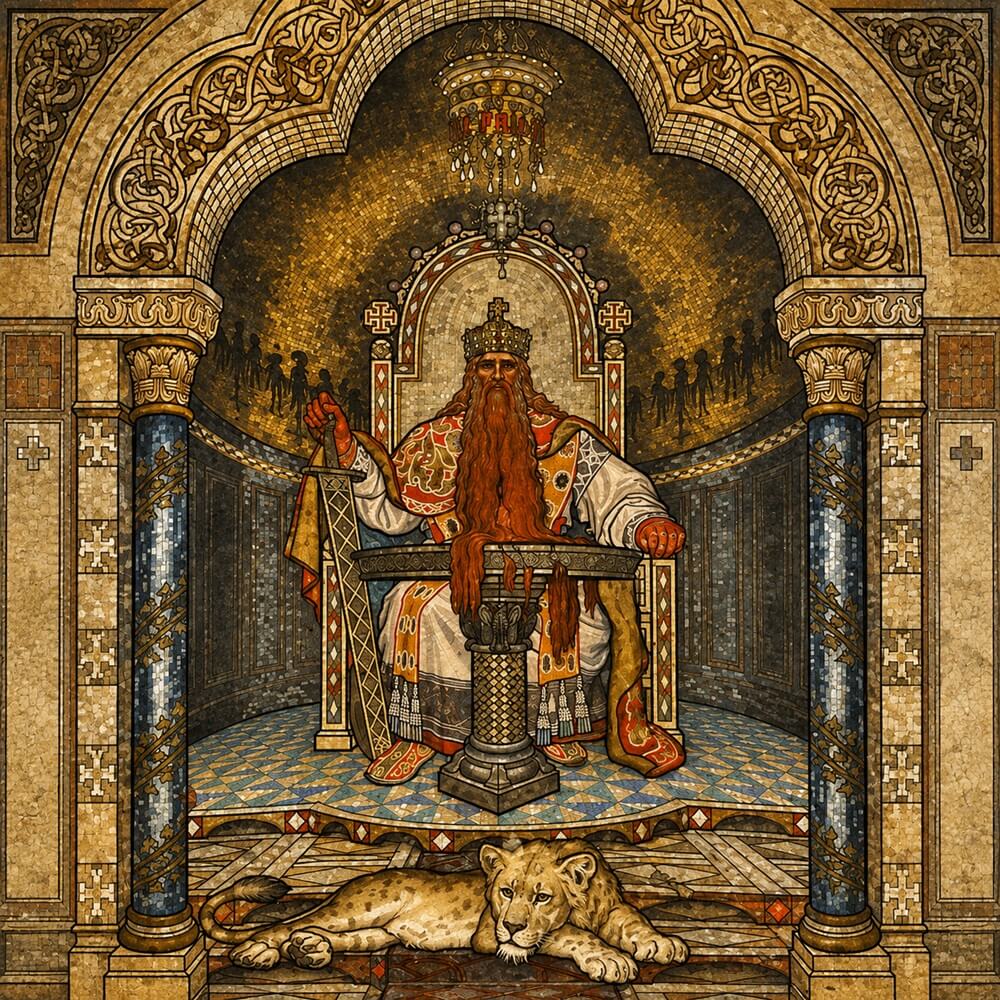
However, according to legends, Frederick did not drown but disappeared for unknown reasons and returned to Germany, where he is sleeping to this day in the basement of one of the castles he built, and some say in a cave on Mount Kyffhäuser beneath one of these castles. In the 19th century, Wilhelm II erected a huge monument there with a statue of Frederick Barbarossa—seventy years old—sitting drowsily on a throne near a table, with his red beard, which has grown wild, enveloping the table and penetrating through it like the roots of an oak tree. According to other legends, he is in a cave on Mount Untersberg in Bavaria, on the border with Austria, an impressive and sacred offshoot of the Northern Alps.
In any case, Barbarossa wakes from his sleep every hundred years to see whether the ravens are still flying around the mountain where the cave or basement is located. If the time comes when there are no more ravens, he will rise from his sleep and lead Germany anew in a decisive battle that will establish its greatness, re-establish a kingdom of justice on earth, and hasten the second coming of Jesus.
In the Augusta Victoria Church in Jerusalem, the figure of Frederick Barbarossa sitting in the cave is depicted in the magnificent reception hall. Although he did not manage to reach Jerusalem, Kaiser Wilhelm II saw himself as his successor (see chapter on Augusta Victoria, Book 3). The German emperor who eventually arrived in Jerusalem, along with the German knights of the Teutonic Order, was his grandson—Frederick II in 1229.

Frederick II
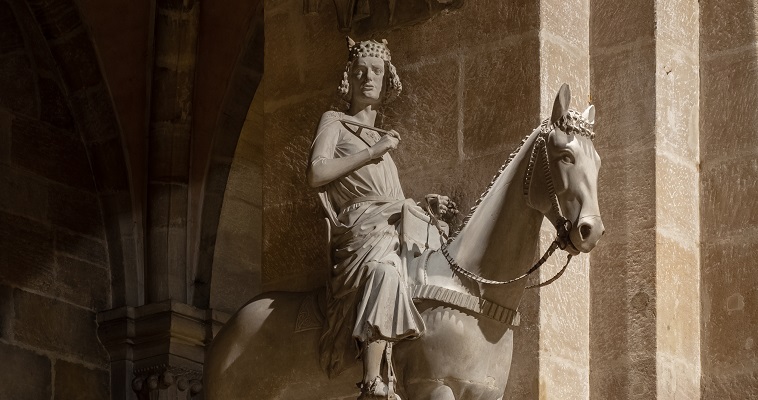
One of the most important people in the history of Jerusalem is Frederick II, known as the First Renaissance Man, a person of outstanding qualities. He was famous as a patron of the sciences and arts, King of the Holy Roman Empire, and also king of Jerusalem, Southern Italy, Burgundy, and Sicily—an enlightened ruler who combined the East and the West in his persona.
Fredrick II was the grandson of the legendary German king Frederick Barbarossa, the son of Henry IV, Emperor of the Holy Roman Empire, and Constance, Queen of Sicily. He was a unique man who knew seven languages, engaged in poetry and philosophy, had a free mind, and strong political ambition. Frederick II built the first modern state in Europe in Southern Italy, where he was a kind of enlightened absolute ruler, a philosopher who promoted art and science. He was unconventional in his views and actions, scorning “ordinary” established religions, including Catholic Christianity and the Pope, as well as orthodox Islam. Frederick II loved freedom and successfully fought for his worldview. At the same time, he valued dialogue and cooperation, respected the Muslim world, and knew its language and customs. He was called the “Wonder of the World” and is largely considered the first Renaissance man, a figure larger than life.
Frederick II was educated at the Papal Court in Rome by Pope Innocent III, and later was personally educated by a clergyman who would later become Pope Honorius III. Honorius III initiated the Fifth Crusade to Egypt, and when it became complicated, he pleaded with Frederick II for help. When Frederick II avoided it, a bitter conflict arose between the two men.
For years, Honorius tried to get Frederick II to launch a Crusade to liberate Jerusalem from Muslim rule, and he postponed it to the point of being excommunicated. However, when he finally set out on the Sixth Crusade in 1228, he succeeded—without shedding a drop of blood but only through negotiation—in bringing Jerusalem back into Christian hands, including the Church of the Holy Sepulchre (the compromise was that the Muslims would continue to control the Temple Mount complex). When he arrived in Jerusalem, he married Isabella II, the heiress of the Kingdom of Jerusalem, and officially became King of Jerusalem in a solemn ceremony in the Church of the Holy Sepulchre [1].
At that time, Holy Grail stories were widespread in Germany, and the most complex and mystical version of these stories was called Parzival, probably written between 1210 and 1220 by a German knight, poet, and possibly monk named Wolfram von Eschenbach, who likely lived in Bavaria and perhaps Austria (the first version of the Holy Grail stories was written by Chrétien de Troyes in France in 1180). In this story, the hero Percival reaches the mysterious Grail Castle, where wondrous things are revealed to him, but he does not respond appropriately and is forced to embark on a long and solitary journey that lasts five years until he manages to find the Grail Castle again and become the Guardian of the Grail. This is a journey during which Percival undergoes a process of development and self-discovery and discovers (among other things) that he has a Muslim twin brother who is his equal in strength and morality.
The figure of Percival in the stories is fascinating. He is raised by his mother, and only a chance encounter with the Knights of the Round Table, dressed in Templar attire, causes him to leave the forest where he grew up and his mother, and ask to become a knight at Arthur’s court. The figure of Percival is a kind of reappearance of Jesus in Europe—an innocent figure not of this world—who grew up to be the ideal Philosopher King. It also resembles the figure of Frederick II, who grew up without a father and set out to find himself in his travels around the world and in his journey to the East to regain Jerusalem [2].
Henry IV (Frederick II’s father) changed the tradition of the transfer of the throne of the Holy Roman Empire, making it hereditary, out of a desire to create a new, global Christian Norman-German state based on the figure of a Divine King. He was supported by the Counts of Andechs, foremost among them Berthold IV, who supported the young Frederick II against the many rivals he had and helped him take his place at the helm of government. The story of Percival alludes to these events.
Frederick II saw himself as an emperor chosen by God and destined to serve God with his heart, mind, and power—but apparently only in the way he saw fit, and he was not willing to accept the dictates of others. Despite the liberation of Jerusalem, he did not receive recognition from the knightly orders of the Templars and the Hospitallers, and the Pope continued to excommunicate him and did not recognize his achievements. However, the new German order of the Teutonic Knights supported him.
Frederick II’s arrival in Jerusalem and his coronation as King of Jerusalem, in addition to being Emperor of the Holy Roman Empire, were perceived by the adherents of the German House of Hohenstaufen as a divine intervention—the beginning of redemption, a messianic appearance. He was perceived by his followers as the Fisher King, the Guardian of the Grail, the replacement for King Arthur, and the founder of the Holy Brotherhood. At that time, the status of the Templar Order declined after it lost the Battle of Hattin and lost its spiritual center in the Dome of the Rock in Jerusalem. The void left by the Templars was filled to some extent by the German Teutonic Knights, an order established only after the renewal of the Crusades and the reconquest of Acre in 1191.
The Teutonic Knights excelled militarily in the Fifth Crusade in Egypt, were known for their iron discipline, and were the main force upon which Frederick II relied in his maneuvers within internal Crusader and Christian Catholic politics. The Grand Master of the Order, Hermann von Salza, supported him and mediated in the struggles he had with the Pope and with the other nobles and military orders in the land.
After his return to his kingdom in Southern Italy, Frederick II built a special castle in Apulia called Castello del Monte, whose design is based on the sacred architecture of the Dome of the Rock. He went to war against Pope Gregory IX, who replaced Honorius III in 1227. At one point, Frederick II forced the Pope to flee to Lyon, France. As a consequence, he was declared a heretic, an Antichrist, and excommunicated. For the next twenty years, he continued to fight Pope Gregory IX and later Innocent IV. All of Europe witnessed the struggle between the Pope and the Emperor, who proved to be a strategic genius and represented the forces of progress. Italy was torn between two factions: one supporting the Pope, led by the cities of Pisa and Siena, and the other supporting the Emperor, led by the cities of Bologna and Genoa.
In 1244, the Christians lost Jerusalem, and in 1250, precisely when his supporters achieved success on the battlefield, the Emperor died of dysentery and was buried in Palermo. The Jewish historian Ernst Kantorowicz wrote of him: “Dante felt a deep sense of respect for the Hohenstaufen. During his lifetime, Frederick II was a model for a ruler, a judge, a scholar, and a poet—the perfect prince, the glorified hero. A man who, as long as his fortune prevailed, sought after the human spirit; a ruler who gathered around him the most noble and brilliant souls in the world.”
 The Teutonic Knight
Richard of Cornwall
Not only the Germans became an influential factor during the Second Kingdom of Jerusalem, but also the English. This was expressed in the central role of Richard the Lionheart in the reconquest of the Land of Israel. However, immediately afterward, England fell into civil war, and precisely then, one of the most fascinating people in 13th-century Europe, Richard III of Cornwall, appeared on the stage of the history of the Land of Israel. He led a successful and little-known Crusade called the “Barons’ Crusade,” which brought the rule of the Crusaders in the land, and the movement of pilgrims to Jerusalem, to their peak.
Richard of Cornwall was the grandson of Eleanor of Aquitaine, the son of King John, the nephew of Richard the Lionheart, and the main supporter of the weak King Henry III, his brother. In addition to being the Earl of Cornwall in southwestern England, he was also the Count of Poitou in France, and later was crowned King of Germany. But above all, Richard was one of the wealthiest people in Europe. He was the one who built Tintagel Castle in England as a model of the Arthurian legends.
The Barons’ Crusade lasted from 1239 to 1241 in two stages. The first stage was led by Theobald I of Navarre, also called “the Troubadour,” and the second stage was led by Richard of Cornwall. During the Crusade, he achieved control over many fortresses in the north, such as Mount Tabor and Beaufort, through diplomatic means and without the need to use force, and he rebuilt the walls of Crusader Ascalon. Some say that after this Crusade, the Christians controlled the entire area from the sea to the Jordan River. According to sources from the period, he made a pilgrimage to Jerusalem, but it is unknown what he did there.
Richard was an ardent follower of the legends of King Arthur and the Holy Grail, similar to his uncle, Richard the Lionheart, who reigned before him. When he returned to England, he built a fortress in Tintagel on the coast of Cornwall that simulated King Arthur’s fortress. Tintagel was considered the place where King Arthur was conceived with the help of the wizard Merlin. Despite having no strategic importance, Richard built a massive fortress on the cliffs above the coast.
From that period, the mystical connection between England and Jerusalem strengthened, expressed in the participation of the future King Edward I in the Ninth Crusade to the Land of Israel and in the English perception of themselves as descendants of the true Israel and of England as the Heavenly Jerusalem. Edward spent much of his childhood in the home of his uncle—Richard of Cornwall.
The English claim that Joseph of Arimathea arrived in England with the Holy Grail, and there are also claims that they are descendants of the Lost Tribes and are obligated to build a New Jerusalem in England. Thus, the most popular song in England at the beginning of the 20th century is “Jerusalem” (The Heavenly Jerusalem), written at the beginning of the 19th century by the painter and mystic William Blake, which became England’s unofficial anthem.
The English presence in Jerusalem can be noticed in the Church of the Holy Sepulchre. At the entrance to the Church of the Holy Sepulchre in Jerusalem, the nobleman Philip d’Aubigny is buried, who made a pilgrimage to Jerusalem and died there in 1136, a signer of the Magna Carta and the educator of Henry III.

Footnotes:
[1] From that time, the King of Jerusalem, which was the official title of the ruler of the Crusader Kingdom, resided outside of Israel and was not practically involved in the kingdom’s affairs.
[2] Kawanishi, T. (2013). Study of the legend of Holy Grail’s Knight and Emperor Friedrich II by the European House of Andechs Meranien: From the viewpoint of their aim for ending of international religious war “the Crusades” in 12–13th century. Mediterranean Journal of Social Sciences, 4(10), 160–170.